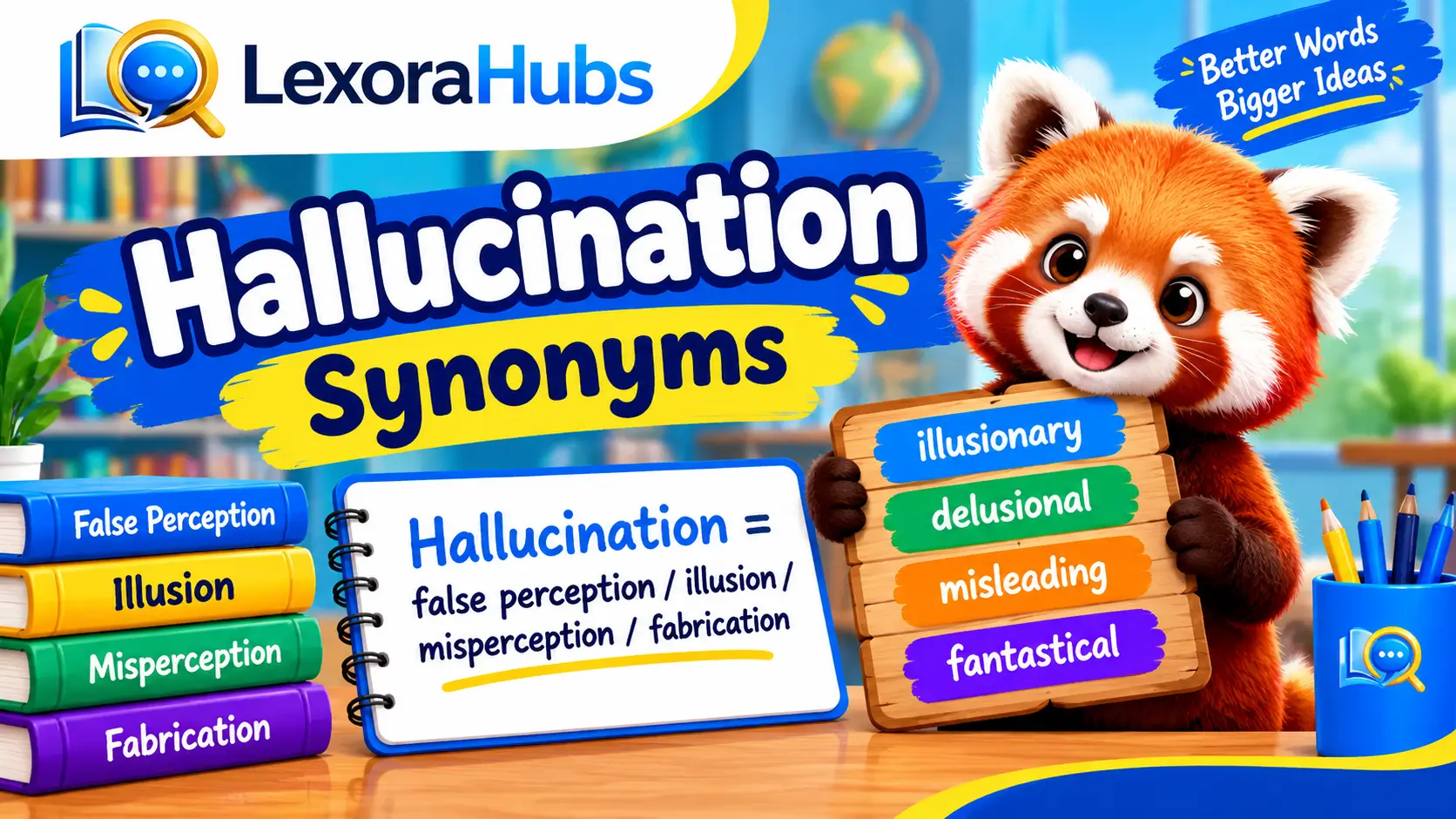
A hallucination synonym is a word or phrase that describes seeing, hearing, or sensing something that is not really there. Words like illusion, false perception, vision, and delusion may fit, depending on the context. The best choice depends on whether you mean a mental experience, a mistaken belief, or an AI error.
Introduction
Imagine a person sitting alone in a quiet room. Suddenly, they hear someone calling their name, but nobody is there. They may feel confused and wonder what just happened. The right words can help them explain this experience clearly.
For example, a writer might use illusion when describing something that looks real but is not. However, a medical text may need a more exact term. Choosing the right word helps readers understand the message without confusion.
- Students can use synonyms to improve vocabulary and write better essays.
- Bloggers can choose clear words that match what readers search for.
- Content writers can avoid repetition and explain complex ideas simply.
- Daily English users can express thoughts and experiences more clearly.
Learning related words also helps you understand how meaning changes with context. Some words describe a false sight or sound, while others refer to mistaken beliefs or imagined events. Therefore, it is important to choose carefully, especially when discussing health or technology.
“The right word can make a difficult idea easier to understand.”
Good vocabulary does more than make writing sound interesting. It helps you share the exact meaning you want others to understand.
“Clear words help people share their thoughts with confidence.”
50 Synonyms for Hallucination
The following words are related to hallucination, but they are not all exact replacements. Some describe false sights or sounds, while others describe dreams, mistaken beliefs, or errors in artificial intelligence.
1. Illusion
Meaning: An illusion makes something seem real when it is not.
Examples: The mirror created an illusion of space. The road shimmered like water in sunlight.
2. Delusion
Meaning: A delusion is a strong belief that does not match reality.
Examples: He held a delusion about his powers. The doctor listened carefully to his concerns.
3. Vision
Meaning: A vision is an image seen in the mind or imagination.
Examples: She described a strange vision last night. His vision seemed vivid and bright.
4. Mirage
Meaning: A mirage is an image that appears real but is not.
Examples: The traveler saw a mirage in the desert. The distant water vanished before sunset.
5. Apparition
Meaning: An apparition is a strange figure that seems to appear suddenly.
Examples: They reported an apparition near the old house. The shadow looked like a person.
6. Phantom
Meaning: A phantom is something imagined or seen without a real source.
Examples: He thought a phantom crossed the hallway. The phantom disappeared into the darkness.
7. Specter
Meaning: A specter is a frightening figure that seems unreal or ghostlike.
Examples: A specter appeared in the scary story. She thought she saw one outside.
8. False perception
Meaning: False perception means sensing something that does not match reality.
Examples: The report described a false perception of sound. He questioned what he had heard.
9. Misperception
Meaning: Misperception happens when someone understands a sight or sound incorrectly.
Examples: The noise caused a misperception in the dark. She mistook a coat for a person.
10. Misinterpretation
Meaning: Misinterpretation means giving something a meaning that is not correct.
Examples: His comment led to a misinterpretation. She explained what the message really meant.
11. False belief
Meaning: A false belief is an idea that does not match the facts.
Examples: He held a false belief about the event. New evidence changed her view.
12. Fantasy
Meaning: A fantasy is an imagined event that may not be real.
Examples: The child enjoyed a fantasy about dragons. His fantasy became a short story.
13. Imagination
Meaning: Imagination helps people form ideas or pictures inside their minds.
Examples: Her imagination filled the room with dragons. He imagined a castle in the clouds.
14. Dream
Meaning: A dream is an experience or story that happens during sleep.
Examples: I had a strange dream last night. The dream felt real until morning.
15. Daydream
Meaning: A daydream is a series of thoughts that distract someone while awake.
Examples: His daydream took him far away. She imagined winning a grand prize.
16. Reverie
Meaning: A reverie is a pleasant state of deep thought or imagination.
Examples: She sat in a quiet reverie. His reverie ended when the phone rang.
17. Hallucinatory experience
Meaning: A hallucinatory experience involves sensing something without a matching outside source.
Examples: He described a hallucinatory experience to his doctor. She wrote down what she sensed.
18. False sensation
Meaning: A false sensation is a feeling that does not match an outside cause.
Examples: He reported a false sensation on his arm. The feeling surprised him during the night.
19. Phantom sensation
Meaning: A phantom sensation is a feeling without the expected physical source.
Examples: She described a phantom sensation after surgery. The doctor asked when it began.
20. Auditory hallucination
Meaning: An auditory hallucination means hearing sounds or voices without an outside sound source.
Examples: He reported hearing a voice in silence. His doctor asked about the experience.
21. Visual hallucination
Meaning: A visual hallucination means seeing something that is not actually present.
Examples: She saw shapes that others could not see. The nurse recorded her visual experience.
22. Imagined voice
Meaning: An imagined voice is a voice experienced in the mind rather than heard externally.
Examples: He remembered an imagined voice from sleep. She described the sound in her journal.
23. Imagined image
Meaning: An imagined image is a picture formed by the mind rather than seen outside.
Examples: He pictured an imagined image of a bird. Her mind created a colorful scene.
24. False image
Meaning: A false image is a picture that does not reflect what is real.
Examples: The camera produced a false image. The strange shape fooled the viewer.
25. False vision
Meaning: A false vision is something seen that does not match the outside world.
Examples: He described a false vision after waking. The experience confused him for a while.
26. Unreal perception
Meaning: Unreal perception describes sensing something that does not exist outside the mind.
Examples: She discussed an unreal perception with her doctor. He wanted to understand what happened.
27. Distorted perception
Meaning: Distorted perception happens when something seems different from how it really is.
Examples: The curved glass caused distorted perception. The straight line looked strangely bent.
28. Sensory distortion
Meaning: Sensory distortion changes how a person experiences sights, sounds, or feelings.
Examples: The flashing lights caused sensory distortion. He found the sounds unusually loud.
29. False appearance
Meaning: A false appearance makes something seem different from its real form.
Examples: Fog gave the trees a false appearance. The hill looked like a giant animal.
30. Ghostly image
Meaning: A ghostly image is a pale or unclear figure that seems unreal.
Examples: A ghostly image appeared in the mist. The figure vanished behind the trees.
31. Phantom image
Meaning: A phantom image is an image that seems present but has no clear physical source.
Examples: He noticed a phantom image in the display. The faint shape disappeared quickly.
32. Apparent vision
Meaning: An apparent vision is something that seems visible but may not be real.
Examples: She reported an apparent vision at night. The unusual shape soon faded away.
33. Mental image
Meaning: A mental image is a picture created and held inside the mind.
Examples: He formed a mental image of home. She pictured the beach while studying.
34. Mental picture
Meaning: A mental picture is an image someone imagines without seeing it directly.
Examples: The story gave me a mental picture. He imagined the house beside the lake.
35. Imaginary sight
Meaning: An imaginary sight is something pictured in the mind rather than seen in reality.
Examples: He described an imaginary sight from sleep. The scene belonged to his dream.
36. False sensory experience
Meaning: A false sensory experience feels real despite lacking a matching outside cause.
Examples: She reported a false sensory experience. Her doctor asked about its timing.
37. Perceptual error
Meaning: A perceptual error occurs when the brain misreads information from the senses.
Examples: The shadow caused a perceptual error. He mistook a rope for a snake.
38. Cognitive distortion
Meaning: Cognitive distortion is a thinking pattern that changes how someone views reality.
Examples: Fear can lead to cognitive distortion. She checked the facts before reacting.
39. Misjudgment
Meaning: Misjudgment happens when someone makes an incorrect decision about a situation.
Examples: His misjudgment caused a small problem. She corrected her view after learning more.
40. Mistaken impression
Meaning: A mistaken impression is an incorrect idea about someone or something.
Examples: The first meeting gave a mistaken impression. He learned the truth later.
41. False memory
Meaning: A false memory is a recollection of something that did not happen as remembered.
Examples: She had a false memory of the visit. The family checked the old photographs.
42. Fabrication
Meaning: A fabrication is a made-up story or claim presented as true.
Examples: The report exposed a fabrication in his story. She asked him to share proof.
43. Invention
Meaning: An invention can be a made-up idea, story, or explanation.
Examples: The tale was an invention for children. He admitted that he made it up.
44. Falsehood
Meaning: A falsehood is a statement that is not true.
Examples: The article contained a clear falsehood. The editor corrected it the next day.
45. False claim
Meaning: A false claim is a statement that facts do not support.
Examples: The website shared a false claim. Readers checked the facts before sharing.
46. AI error
Meaning: An AI error occurs when a computer system gives an incorrect result.
Examples: The chatbot made an AI error. We checked its answer against trusted sources.
47. AI-generated falsehood
Meaning: An AI-generated falsehood is incorrect information produced by an artificial intelligence system.
Examples: The tool produced an AI-generated falsehood. The writer verified every fact before publishing.
48. Fabricated answer
Meaning: A fabricated answer gives made-up information instead of a correct response.
Examples: The chatbot returned a fabricated answer. The researcher checked the source carefully.
49. False output
Meaning: False output is information from a system that does not match the facts.
Examples: The program returned false output. The team tested the results again.
50. Inaccurate response
Meaning: An inaccurate response contains information that is not fully correct.
Examples: The assistant gave an inaccurate response. A reliable source helped correct the mistake.
“A word is most useful when it matches the meaning you want to share.”
Hallucination Antonyms
Common antonyms for hallucination include reality, fact, truth, accuracy, and genuine perception. These words point toward what is real or supported by evidence. For example, a hallucination may involve seeing a figure that is not present, while accurate perception matches the surroundings. Remember that an antonym depends on context: the opposite of an AI hallucination is a factually correct answer, not simply a different kind of imagined experience.
Hallucination Synonym and Antonym
An appropriate synonym for hallucination may be false perception, while an antonym may be accurate perception. The best pair depends on the intended meaning. In a story, illusion may work well; in a discussion about AI, fabricated information may be clearer. In medical writing, use precise terms rather than treating every related word as interchangeable. This helps readers understand the difference between an unusual experience, a mistaken belief, and an incorrect computer-generated answer.
Hallucination Symptoms
Hallucinations may involve hearing voices, seeing people or objects, smelling odors, tasting something, or feeling sensations without a matching outside source. These experiences can have different causes, including illness, medicines, sleep problems, or substance use. They are not the same as ordinary imagination or dreams. A person experiencing new or troubling symptoms should seek medical advice. Sudden confusion or symptoms with serious illness need urgent medical attention. Avoid using a synonym as a diagnosis.
Hallucination Synonym Slang
There is no single slang word that always means hallucination. In casual speech, people may say seeing things, hearing things, or imagining things. These phrases are easy to understand, but they can sound dismissive when someone is describing a real and upsetting experience. For AI errors, people may casually say a chatbot is making things up. Choose informal wording for friendly conversation, but use more precise language in health, research, and professional writing.
Mental Hallucination Synonym
The phrase mental hallucination is often used to refer to a hallucination experienced by the mind, but hallucination or false sensory experience may be clearer. The exact term depends on whether the experience involves sight, sound, touch, smell, or taste. A delusion is different because it refers to a belief, rather than a sensory experience. When writing about mental health, avoid diagnosing someone based on a brief description and use respectful, accurate language.
Hallucination Sentence
A sentence using hallucination should make its meaning clear from the context. For example, “The patient told the doctor about a hallucination.” In a technology article, you might write, “The chatbot produced a hallucination by inventing a source.” These examples show why context matters. A good sentence explains whether the word refers to a sensory experience or false information created by an AI system.
Hallucination Definition
A hallucination is a sensory experience that seems real even though there is no matching outside source. Someone may hear a voice, see a figure, or feel something that is not physically present. In artificial intelligence, the word has a different use: it describes information generated by a system that is false or unsupported. Understanding these meanings helps you choose a suitable synonym for schoolwork, health writing, or technology content.
Hallucination Syndrome
Hallucination syndrome is a phrase that may appear in medical discussions, but hallucinations alone do not identify one specific syndrome. They can occur for many reasons, including medical conditions, medication effects, sleep loss, or substance use. Writers should avoid using this phrase as a diagnosis without reliable clinical support. When describing a person’s experience, use specific language and recommend professional assessment when appropriate. Clear wording reduces confusion and avoids unfair labels.
Frequently Asked Questions About Hallucination Synonyms
1. What is hallucination in simple words?
A hallucination happens when someone sees, hears, feels, smells, or tastes something that seems real but has no matching source around them. For example, a person may hear a voice when nobody is speaking. Hallucinations can happen for different reasons, so one experience does not explain the cause. In everyday writing, false perception may describe the idea, but medical discussions should use precise terms and avoid guessing at a diagnosis.
2. What is another word for hallucinating?
Words and phrases related to hallucinating include experiencing a false perception, seeing things, and hearing things. The best expression depends on what is happening. For example, “He reported seeing things that others could not see” describes a visual experience. In casual speech, people sometimes say someone is imagining things, but this can minimize a real experience. For formal writing, describe the specific experience rather than assuming what caused it.
3. What is another word for AI hallucination?
Useful alternatives for an AI hallucination include fabricated information, false output, made-up answer, and unsupported claim. These phrases describe cases where an AI system produces information that is incorrect or lacks reliable support. For example, a chatbot might invent a book citation or give a false fact with confidence. However, not every AI mistake is a hallucination. Writers should check claims against dependable sources before sharing or publishing them.
4. What are 5 good synonyms?
Five useful words related to hallucination are illusion, false perception, vision, apparition, and phantom. An illusion makes something seem real when it is not. False perception describes sensing something inaccurately. Vision may refer to an image in the mind, while apparition and phantom often suggest a ghostlike figure. These words have different meanings, so they cannot always replace one another. Choose the word that best matches the situation you are describing.
5. What is another word for hallucination?
Illusion is a common alternative when something seems real but is not. Other possibilities include false perception, apparition, phantom, and vision. For an AI-related article, fabricated information may be more accurate than illusion. For medical writing, the exact term should reflect the experience being described. Before replacing a word, consider the audience, subject, and intended meaning. This simple check makes your writing clearer and helps prevent misleading statements.
6. What is a hallucination called?
A hallucination may be described as a false sensory experience. Its more specific name depends on the sense involved. An auditory hallucination involves hearing something without a matching outside sound, while a visual hallucination involves seeing something that is not present. These terms describe experiences rather than explain their causes. In AI, the same word refers to generated information that is false or unsupported. Context determines which description is most appropriate.
Conclusion
Learning synonyms for hallucination can make your English stronger and your writing more precise. Instead of repeating one word, you can choose alternatives such as illusion, false perception, phantom, or fabricated information. Each word has its own meaning, so understanding the difference is just as important as learning the word itself.
For students, these words can improve essays, reading skills, and vocabulary tests. Bloggers can use them to write clear, helpful articles that match their readers’ needs. Content writers can avoid repetition and explain technical topics in simple English. In daily conversations, the right word helps you explain an idea without confusing the listener.
Start by learning five words from this list. Write a short sentence for each one, then try using them in emails, essays, or everyday conversations. You can also read your sentences aloud to see whether each word fits naturally.
Remember that related words are not always exact synonyms. An illusion, a delusion, and an AI-generated falsehood describe different things. Choosing carefully will help you communicate accurately and confidently.
“Good writing begins with clear thinking and the right words.”
Keep practicing a little each day. Over time, your vocabulary will grow, your sentences will become more varied, and your ideas will be easier to share.
“Every new word gives you another way to express an idea.”
Files, images, and data analysis are unavailable until usage resets at 2:49 AM. Continue chatting with text only, or upgrade for more access.

Ryan is a content writer focused on creating informative and well-structured articles for LexoraHubs readers.