“Insecurities” is one of those words we reach for often — in conversation, in writing, in therapy sessions — but repeating it again and again can make your writing feel flat. Below is a complete, organized list of synonyms for insecurities, grouped by the type of insecurity they best describe, along with real example sentences, nuance differences, idioms, and antonyms.
Quick Answer: The most common everyday synonym for insecurities is self-doubt. For formal writing, use diffidence or apprehension.
What Does “Insecurities” Mean?
Insecurities (noun, plural of insecurity) refers to feelings of uncertainty, self-doubt, or a lack of confidence about oneself, one’s relationships, or one’s situation. The word comes from the Latin securus (“free from care”), with the prefix in- meaning “not” — literally, “not secure.”
The concept gained psychological weight in the early 20th century through Alfred Adler’s theory of the inferiority complex, which proposed that feelings of inadequacy formed in childhood often drive adult behavior and compensation strategies. This is part of why “insecurity” today straddles both everyday language and clinical psychology.
There are two broad ways the word is used:
- Emotional/psychological insecurities — self-doubt, low self-esteem, lack of confidence
- Situational insecurities — uncertainty about a job, relationship, or circumstance
Singular vs. Plural: “Insecurity” or “Insecurities”?
The two forms aren’t quite interchangeable:
- Insecurity (singular) usually describes a general trait or overall feeling: “His insecurity was obvious in every meeting.”
- Insecurities (plural) usually refers to specific, individual self-doubts: “He has insecurities about his height and his accent.”
As a rule of thumb: use the singular for a broad emotional state, and the plural when listing or pointing to distinct triggers.
Synonyms for Emotional & Psychological Insecurities
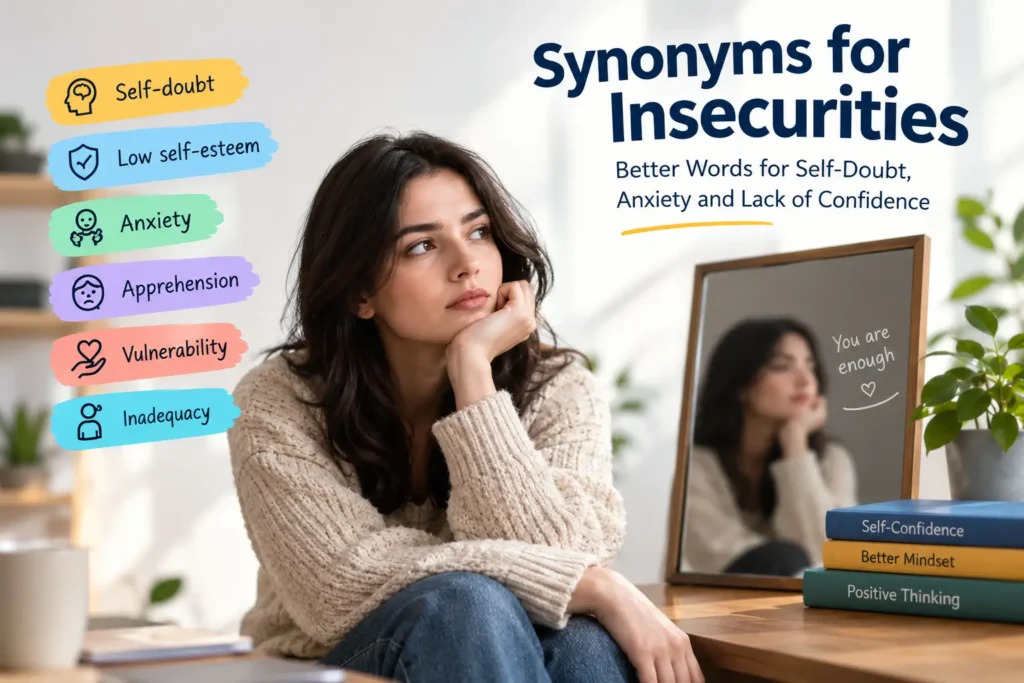
These words describe self-doubt or a lack of confidence in oneself.
| Synonym | Example Sentence |
| Self-doubt | Her self-doubt kept her from applying for the promotion. |
| Low self-esteem | Years of criticism left him with low self-esteem. |
| Diffidence | He spoke with a diffidence that surprised his colleagues. |
| Self-consciousness | Her self-consciousness about her accent faded over time. |
| Apprehension | A quiet apprehension crept in before the interview. |
| Misgivings | She had misgivings about her own abilities. |
| Unease | An unease about being judged followed him everywhere. |
| Vulnerability | Talking about his fears meant showing real vulnerability. |
| Uncertainty | His uncertainty about himself was obvious to everyone. |
| Inferiority complex | A childhood inferiority complex shaped how she saw herself. |
| Timidity | Her timidity made public speaking feel impossible. |
| Anxiety | Social anxiety made new situations exhausting. |
| Inadequacy | A nagging sense of inadequacy followed her into every new role. |
| Self-deprecation | His constant self-deprecation masked how anxious he really felt. |
Nuance Guide: How These Words Differ
Many of these synonyms overlap but aren’t identical — here’s the subtle distinction between the most commonly confused ones:
- Self-doubt is episodic — it flares up in specific moments (e.g., before a decision).
- Low self-esteem is a trait — a more stable, long-term self-view.
- Diffidence describes behavior — hesitancy or shyness in how someone acts, not just how they feel internally.
- Inferiority complex implies a deeper, often subconscious pattern, usually rooted in early experiences, that shapes ongoing behavior (e.g., overcompensating).
- Apprehension and unease are more situational and short-term than the others — closer to nervousness than identity.
Adjective & Verb Forms: “Feeling Insecure”
Not every writer needs the noun. If you’re describing a person or an action rather than the abstract feeling, these work better:
| Context | Synonym Phrase | Example |
| Adjective | Insecure → unsure of oneself | He came across as unsure of himself during the pitch. |
| Adjective | Insecure → self-doubting | She’s a self-doubting perfectionist. |
| Adjective | Insecure → inadequate (feeling) | He felt inadequate next to his more experienced coworkers. |
| Verb phrase | Feel insecure → second-guess oneself | She second-guesses herself before every presentation. |
| Verb phrase | Feel insecure → doubt oneself | He doubts himself even when the evidence says he’s right. |
| Verb phrase | Act insecure → seek reassurance | He constantly seeks reassurance from his partner. |
Synonyms for Relationship & Situational Insecurities
These fit better when describing doubt about a relationship, job, or circumstance rather than the self.
| Synonym | Example Sentence |
| Doubts | He voiced his doubts about where the relationship was headed. |
| Fears | Old fears of abandonment resurfaced during the argument. |
| Worries | Her worries about being replaced never really went away. |
| Uncertainties | The uncertainties of a long-distance relationship wore them down. |
| Jealousy | Unchecked jealousy started to damage their trust. |
| Instability | The instability of the job made it hard to plan ahead. |
| Precariousness | The precariousness of his position kept him on edge. |
| Anxieties | Money anxieties dominated most of their conversations. |
Synonyms for Physical & Body Insecurities
When the insecurity is about appearance rather than personality or circumstance, these fit more naturally:
| Synonym | Example Sentence |
| Body image issues | Years of comparison online fed her body image issues. |
| Self-scrutiny | His self-scrutiny in front of mirrors bordered on obsessive. |
| Body dissatisfaction | Body dissatisfaction is common among teenagers today. |
| Appearance anxiety | Appearance anxiety spiked for her before every photo. |
| Physical self-consciousness | His physical self-consciousness kept him out of the pool all summer. |
| Complex (about) | She’s always had a complex about her height. |
Context-Specific Insecurities
Different settings call for different vocabulary:
- Workplace: job insecurity, impostor syndrome, professional self-doubt — “Impostor syndrome had him convinced the promotion was a mistake.”
- Parenting: parenting anxiety, self-doubt as a parent — “New parents often battle quiet self-doubt about every decision.”
- Social media–driven: comparison anxiety, validation-seeking — “Comparison anxiety from scrolling Instagram left her feeling worse, not better.”
- Attachment/relationships (psychology term): anxious attachment, attachment insecurity — “His attachment insecurity showed up as constant need for reassurance from his partner.”
Insecure, Insecurity, and Food Insecurity: Which Synonym Fits?
When choosing an insecure synonym, it helps to identify exactly what kind of uncertainty or lack of confidence you mean. The adjective insecure usually describes a person, feeling, or situation, while insecurity is the noun used for the underlying feeling or condition. For example, someone may feel insecure about their appearance, while their insecurity may affect how they respond to criticism or social situations.
Synonyms for “Insecure”
If you are searching for a synonym for insecure, the best alternative depends on the sentence. Common insecure synonyms include uncertain, self-doubting, unsure, apprehensive, uneasy, vulnerable, hesitant, and unconfident.
For personal confidence, self-doubting or unsure of oneself may be more precise. For a temporary emotional reaction, uneasy or apprehensive can work better. When describing a person who lacks confidence in a social situation, self-conscious or hesitant may sound more natural.
Here are a few examples:
- Insecure: She felt insecure about speaking in front of the class.
- Self-doubting: She became self-doubting after receiving negative feedback.
- Apprehensive: He was apprehensive about starting a new job.
- Self-conscious: She felt self-conscious about her appearance.
- Uncertain: He was uncertain about whether his decision was correct.
These synonyms for insecure are related, but they are not always interchangeable. Choosing the word that matches the exact situation makes your writing more natural and precise.
Insecurity Synonyms in Different Contexts
The phrase insecurity synonym can refer to several different types of uncertainty. For emotional or personal situations, useful alternatives include self-doubt, lack of confidence, low self-esteem, unease, vulnerability, and inadequacy.
If you are looking for insecurity synonyms for a relationship, words such as doubt, worry, jealousy, uncertainty, and fear may be more appropriate. In a workplace context, job insecurity, professional self-doubt, or uncertainty may better communicate the intended meaning.
This is why synonyms of insecure and synonyms of insecurity should be selected according to context rather than treated as a single interchangeable list. The adjective describes something as lacking confidence or certainty, while the noun refers to the feeling, concern, or condition itself.
What About “Food Insecurity”?
The phrase food insecurity synonym has a different meaning from emotional insecurity. Food insecurity refers to limited or uncertain access to enough affordable, nutritious food. Because it describes a social and economic condition, emotional words such as self-doubt or low self-esteem are not appropriate substitutes.
Depending on the context, related expressions for food insecure synonyms may include limited access to food, inadequate access to nutritious food, food hardship, or lack of reliable food access. These phrases should be used carefully because they do not always have exactly the same technical meaning as food insecurity.
For example:
- Emotional insecurity: Her self-doubt made her hesitant to speak.
- Relationship insecurity: His uncertainty about the relationship caused worry.
- Food insecurity: The family experienced difficulty maintaining reliable access to nutritious food.
Understanding this distinction helps prevent an important semantic mistake: insecurity can describe a personal or emotional state, while food insecurity refers to access to adequate food. The correct synonym therefore depends on the subject, audience, and intended meaning.
Idioms & Expressions for Insecurity
Natural, conversational alternatives that work well in dialogue or informal writing:
- Feeling small — “That comment made her feel small in front of everyone.”
- Not good enough — “He always worried he wasn’t good enough for the team.”
- In over one’s head — “She felt in over her head on her first day.”
- Walking on eggshells (about oneself) — used for chronic self-monitoring behavior.
- Losing one’s nerve — “He lost his nerve right before walking on stage.”
Related Psychological Terms
If you’re writing in a more clinical or therapy-adjacent context, these terms are closely related but distinct from general “insecurity”:
- Impostor syndrome — persistent belief that one’s success is undeserved or about to be “found out.”
- Anxious/insecure attachment style — a relationship pattern rooted in early attachment experiences, marked by fear of abandonment and need for reassurance.
- Inferiority complex — a deep-seated, often unconscious feeling of inadequacy (Adlerian psychology).
Note: these are recognized psychological concepts, not just stylistic synonyms — use them only when that specific meaning applies.
Formal / Written English Synonyms
Better suited for essays, reports, or academic writing.
- Diffidence
- Trepidation
- Apprehension
- Disquietude
- Irresolution
- Hesitancy
Antonyms of Insecurities
For contrast or when you need the opposite meaning:
Confidence, self-assurance, security, stability, certainty, self-esteem, poise, composure
Quick FAQ
What is a simple word for insecurities? “Self-doubt” or “worries” are the simplest, most common everyday alternatives.
What is a formal word for insecurities? “Diffidence” or “apprehension” work well in formal or academic writing.
Is “insecurity” the same as “anxiety”? Not exactly — anxiety is a broader emotional/physiological response, while insecurity specifically refers to a lack of confidence or certainty about oneself or a situation. They often overlap but aren’t identical.
What’s the difference between “insecurity” and “insecurities”? “Insecurity” (singular) usually describes a general trait or feeling; “insecurities” (plural) usually refers to specific self-doubts, like insecurities about appearance or intelligence.
Is “impostor syndrome” a synonym for insecurity? Not exactly — it’s a related but more specific psychological pattern involving self-doubt about one’s own competence or achievements, usually in professional or academic settings.
Final Thoughts
The right synonym depends on context: use self-doubt, low self-esteem, or diffidence for personal/emotional insecurities, doubts, uncertainty, or instability for relationship or situational ones, and body image issues or appearance anxiety for physical ones. Choosing the precise word — rather than defaulting to “insecurities” every time — makes your writing sharper, more specific, and more human.

Ryan is a content writer focused on creating informative and well-structured articles for LexoraHubs readers.