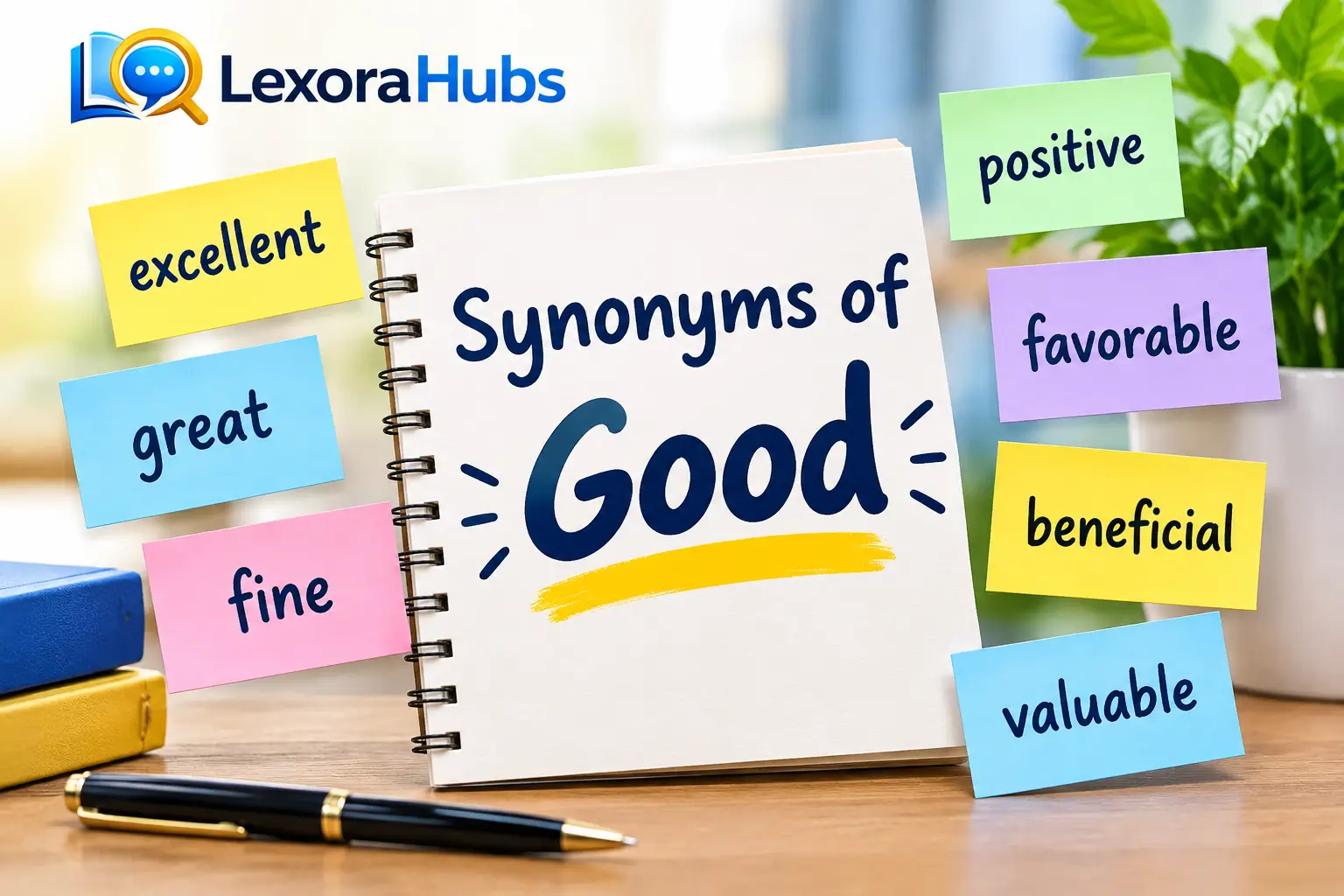
The most common synonyms of good include excellent, great, fine, positive, wonderful, pleasant, useful, valuable, kind, admirable, suitable, effective, decent, satisfactory, and outstanding. The best choice depends on what you mean by “good” and the situation in which you use it.
The word good is a common English adjective used to describe something positive, useful, enjoyable, suitable, or of high quality. For example, “She did a good job” means that she performed the task well.
However, “good” can sometimes feel too general. Choosing a more specific synonym can make your English clearer and more expressive. This guide explains the meaning of good, useful alternatives, differences between similar words, examples, and how to choose the right synonym for different situations.
What Does Synonyms of Good Mean?
The phrase synonyms of good refers to words that have a similar meaning to the adjective good. These alternatives can describe quality, behavior, results, feelings, usefulness, or positive qualities.
The word good has a very broad meaning. It can describe something that works well, produces a positive result, has high quality, or creates a pleasant experience. For example, “This is a good book” may mean the book is enjoyable, well-written, or useful.
Good can also describe a person’s character. In “He is a good person,” the word suggests that he is kind, honest, caring, or morally positive. In another sentence, “She is a good student,” it may mean that she performs well academically.
Because good has many meanings, there is no single synonym that works in every sentence. Excellent may be better when describing very high quality, while kind is more appropriate for someone’s behavior. Effective works better when discussing results or methods.
Understanding these differences helps you select a word that communicates your exact meaning instead of simply replacing good with another general adjective.
Quick List of Synonyms of Good
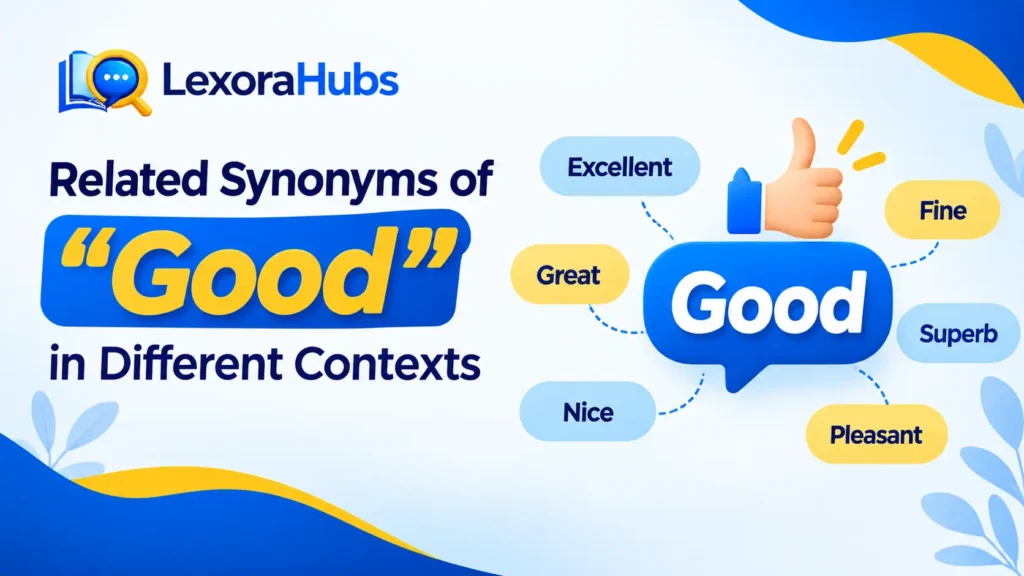
Here are some useful alternatives to good:
| Word | Simple Meaning |
|---|---|
| Excellent | Extremely good or high quality |
| Great | Very good or impressive |
| Fine | Good or satisfactory |
| Positive | Favorable or beneficial |
| Wonderful | Very pleasing or enjoyable |
| Pleasant | Enjoyable or comfortable |
| Useful | Helpful or practical |
| Valuable | Worthwhile or important |
| Kind | Caring and considerate |
| Admirable | Worthy of respect |
| Effective | Producing the desired result |
| Suitable | Right for a particular purpose |
| Decent | Acceptable or reasonably good |
| Satisfactory | Good enough to meet expectations |
| Outstanding | Exceptionally good |
| Superb | Extremely impressive or excellent |
| Positive | Showing a favorable quality or result |
| Beneficial | Producing a helpful result |
| Remarkable | Unusually good or impressive |
| Impressive | Causing admiration because of quality or ability |
These words are related to good, but they are not always exact replacements. Some describe quality, some describe personality, some describe results, and others describe how something feels. The context should always guide your choice.
1. Excellent
Excellent means extremely good or of very high quality.
The restaurant offers excellent food and service.
Excellent is a stronger word than good. When someone says something is excellent, they usually mean that it is noticeably better than average.
It is commonly used for work, performance, products, services, academic results, and experiences. For example, an excellent student performs at a very high level, while an excellent product has outstanding quality.
Use excellent when you want to express a high level of quality rather than simply saying something is good.
Example
She received excellent results in her final exam.
Use excellent when something is considerably better than average.
2. Great
Great means very good, impressive, enjoyable, or important depending on the context.
We had a great time at the concert.
Great is one of the most common informal alternatives to good. It can describe experiences, people, ideas, results, and situations.
Unlike excellent, great often sounds more natural in everyday conversation. Someone may say “That was a great movie” or “Great job!” without sounding overly formal.
It can also have meanings unrelated to quality, such as describing size or importance, so context matters.
Example
You did a great job on the presentation.
Use great for a natural and enthusiastic way to describe something positively.
3. Fine
Fine can mean good, satisfactory, acceptable, or healthy depending on the sentence.
The weather is fine today.
Fine is usually weaker than excellent or great. It often means that something is acceptable or satisfactory rather than outstanding.
For example, if someone says, “The meal was fine,” they may mean that the meal was acceptable but not especially impressive. In conversation, “I’m fine” usually means that the person is okay.
Fine can therefore be useful when you want a neutral or moderate positive meaning.
Example
The plan is fine with me.
Use fine when something is acceptable, satisfactory, or reasonably good.
4. Positive
Positive means favorable, beneficial, encouraging, or showing approval.
The meeting had a positive outcome.
Positive is different from good because it often describes an effect, attitude, result, or situation rather than general quality.
For example, “good feedback” and “positive feedback” are similar, but positive specifically emphasizes favorable reactions.
The word is common in business, education, communication, psychology, and everyday English.
Example
The new policy has had a positive effect on employees.
Use positive when you want to emphasize a favorable result, attitude, or effect.
5. Wonderful
Wonderful means extremely pleasing, enjoyable, or impressive.
We had a wonderful evening together.
Wonderful is stronger and more expressive than good. It often communicates happiness, excitement, or appreciation.
It can describe experiences, people, places, events, ideas, and moments. “A wonderful vacation” suggests that the experience was highly enjoyable.
The word usually has a warm and enthusiastic tone.
Example
She gave us a wonderful opportunity to learn.
Use wonderful when you want to express strong appreciation or enjoyment.
6. Pleasant
Pleasant means enjoyable, comfortable, friendly, or agreeable.
We had a pleasant conversation after lunch.
Pleasant is more specific than good when describing an experience that feels comfortable or enjoyable without necessarily being exciting.
It is commonly used with words such as conversation, weather, experience, environment, smell, voice, and personality.
For example, a pleasant conversation is comfortable and enjoyable, while an excellent conversation may suggest a higher level of quality.
Example
The hotel provided a pleasant environment for guests.
Use pleasant when you want to emphasize comfort, enjoyment, or agreeableness.
7. Useful
Useful means helpful or practical for a particular purpose.
This guide contains useful information.
Useful is not an exact synonym for good because it focuses on practical value. Something can be useful even if it is not enjoyable or impressive.
For example, a simple tool may not be beautiful, but it can still be very useful.
This word is especially appropriate when discussing information, tools, advice, skills, resources, or technology.
Example
Her advice was very useful during the project.
Use useful when the main idea is that something helps you accomplish a purpose.
8. Valuable
Valuable means useful, important, worthwhile, or worth a lot.
His experience was valuable to the team.
Valuable can describe something with practical, emotional, educational, professional, or financial worth.
Unlike good, it emphasizes importance or worth. For example, “valuable advice” means advice that is especially helpful or important.
It is common in professional and academic writing.
Example
The training provided valuable knowledge for new employees.
Use valuable when you want to emphasize worth, importance, or usefulness.
9. Kind
Kind means caring, helpful, gentle, or considerate toward others.
She was kind to the new student.
Kind is a useful synonym for good when describing a person’s character or behavior. However, it does not replace good in every situation.
For example, “He is a good person” may mean he has strong moral qualities, while “He is a kind person” specifically emphasizes his caring treatment of others.
Kind is especially useful when discussing relationships and personal behavior.
Example
It was kind of him to help his neighbor.
Use kind when good refers specifically to caring or considerate behavior.
10. Admirable
Admirable means deserving respect, approval, or praise.
Her dedication to helping others is admirable.
Admirable is stronger and more specific than good when you want to express respect for someone’s actions or qualities.
It is often used for courage, honesty, dedication, patience, discipline, effort, or achievements.
The word has a somewhat more formal tone than great or nice.
Example
His commitment to the project was admirable.
Use admirable when something deserves respect or praise.
11. Effective
Effective means successful in producing the desired result.
This method is effective for improving productivity.
Effective is especially useful when good refers to whether something works. It focuses on results rather than general quality.
For example, a good strategy may be effective, but “effective” tells the reader specifically that the strategy achieves its intended purpose.
It is common in business, education, medicine, technology, and formal writing.
Example
Regular practice is an effective way to improve your writing.
Use effective when you want to emphasize successful results.
12. Suitable
Suitable means appropriate or right for a particular person, purpose, or situation.
This room is suitable for small meetings.
Suitable differs from good because it focuses on whether something fits a particular need.
For example, a large room may be good in general but not suitable for a small private meeting.
This word is useful in professional and formal contexts.
Example
This course is suitable for beginners.
Use suitable when you mean that something is appropriate for a specific situation.
13. Decent
Decent means reasonably good, acceptable, or satisfactory.
He found a decent apartment near his workplace.
Decent is often used when something is better than merely acceptable but not necessarily excellent.
It is common in informal and everyday English. “A decent meal” usually means a reasonably good meal, not an outstanding one.
The word can also describe acceptable behavior or living conditions.
Example
The restaurant serves decent food at a reasonable price.
Use decent when something is reasonably good without suggesting exceptional quality.
14. Satisfactory
Satisfactory means good enough to meet a requirement, standard, or expectation.
Her performance was satisfactory.
Satisfactory is more formal than fine or decent. It often appears in academic, workplace, technical, and official contexts.
It does not usually mean excellent. Instead, it indicates that something has reached the expected level.
For example, a satisfactory result meets the requirements, while an excellent result goes beyond them.
Example
The final report was satisfactory and met all the required standards.
Use satisfactory when something meets an expected standard.
15. Outstanding
Outstanding means exceptionally good, impressive, or noticeable.
She delivered an outstanding performance.
Outstanding is considerably stronger than good. It is often used to praise achievements, work, performance, quality, or ability.
It is common in professional, academic, and formal contexts. For example, an outstanding employee performs at a level that clearly stands out from others.
Example
The team achieved outstanding results this year.
Use outstanding when something is exceptionally good and stands above the rest.
16. Superb
Superb means extremely good or excellent.
The hotel provided superb service.
Superb is a strong positive adjective. It is often used to express admiration for quality, performance, food, service, or experiences.
It has a slightly more polished tone than great and can work well in both everyday and formal contexts.
Example
The chef prepared a superb meal.
Use superb when you want a strong alternative to good or excellent.
17. Beneficial
Beneficial means producing a helpful or positive result.
Exercise can be beneficial for overall well-being.
Beneficial is more specific than good because it focuses on positive effects or advantages.
It is especially useful in formal, academic, health, business, and educational writing.
Example
The training program was beneficial for new employees.
Use beneficial when good means helpful or advantageous.
18. Remarkable
Remarkable means unusual, impressive, or worthy of attention.
She made remarkable progress in a short time.
Remarkable is useful when something is noticeably impressive or unusual. It is stronger than simply good because it suggests that the quality or result deserves special attention.
It can describe achievements, changes, abilities, progress, or events.
Example
The student showed remarkable improvement during the semester.
Use remarkable when something stands out as especially impressive or unusual.
19. Impressive
Impressive means causing admiration because of quality, skill, size, achievement, or ability.
His presentation was very impressive.
Impressive is often used for things that make people notice or admire them. It can describe a performance, achievement, building, skill, result, or appearance.
It is not always interchangeable with good because its main focus is the reaction of admiration.
Example
She gave an impressive performance at the competition.
Use impressive when you want to emphasize that something creates admiration.
Synonyms of Good vs. Excellent
Good and excellent both describe positive quality, but excellent is much stronger.
The hotel is good.
This sentence gives a general positive opinion.
The hotel is excellent.
This sentence communicates a much higher level of quality.
Good is broad and neutral, while excellent suggests that something is far above average.
Use good for general approval and excellent when you want to express very high quality.
Synonyms of Good vs. Great
Good and great are both common everyday words, but great usually expresses stronger enthusiasm.
That was a good movie.
That was a great movie.
The second sentence sounds more enthusiastic. Great is especially common in spoken English and informal communication.
Use great when you want your positive opinion to sound stronger or more enthusiastic.
Synonyms of Good vs. Fine
Good and fine can both describe acceptable quality, but fine is often weaker or more neutral.
The food was good.
This normally communicates a positive opinion.
The food was fine.
This may simply mean that the food was acceptable.
Fine is useful when you do not want to express strong enthusiasm.
Synonyms of Good vs. Kind
Good can describe a person’s overall character, while kind specifically describes caring and considerate behavior.
He is a good person.
He is a kind person.
The first sentence is broader. The second focuses on how he treats others.
Use kind when the specific quality you want to describe is caring behavior.
Synonyms of Good vs. Effective
Good is a broad positive word, while effective focuses on results.
This is a good method.
This is an effective method.
The second sentence specifically says that the method works and produces the desired result.
Use effective when success or performance is the main point.
Positive Synonyms of Good
Many alternatives to good have a positive tone, but the exact feeling changes from word to word.
- Excellent — very high quality
- Great — very good or impressive
- Wonderful — highly enjoyable or pleasing
- Superb — exceptionally good
- Outstanding — exceptionally successful or impressive
- Remarkable — unusually impressive
- Admirable — worthy of respect
- Pleasant — enjoyable or comfortable
- Beneficial — helpful or advantageous
- Valuable — worthwhile or important
- Effective — successful in producing a result
- Kind — caring and considerate
For example, excellent is appropriate for quality, kind for personality, effective for methods, and beneficial for positive effects. Choosing the specific word makes your writing more precise.
Synonyms of Good for Different Situations
The best synonym depends on what you are trying to describe. A word that works for a student may not be the best choice for a business strategy or personal behavior.
For Students
When describing a student’s work or performance, words such as excellent, effective, satisfactory, outstanding, and remarkable can be useful.
Maria gave an excellent answer during the class discussion.
For a student who performs exceptionally well, outstanding or excellent may be stronger than good. Satisfactory works when the performance meets the expected standard.
For Athletes
For sports and physical performance, excellent, impressive, outstanding, remarkable, and great are natural choices.
The athlete gave an impressive performance in the final match.
Use impressive when you want to emphasize the effect of the performance, and outstanding when the performance is exceptionally strong.
For Business
In business and professional situations, effective, valuable, suitable, positive, excellent, and successful can be more precise than good.
The company developed an effective strategy for reaching new customers.
Here, effective is better than good because it tells the reader that the strategy produces the desired result.
For Personal Challenges
When discussing someone’s response to difficulty, words such as admirable, strong, remarkable, positive, and excellent may fit depending on the meaning.
Her positive attitude helped her continue during a difficult period.
Admirable is especially useful when you want to show respect for someone’s courage, effort, or determination.
For Formal Writing
Formal writing often benefits from specific words instead of the general adjective good.
Useful alternatives include:
- Effective
- Beneficial
- Valuable
- Suitable
- Satisfactory
- Excellent
- Admirable
- Remarkable
The proposed method is effective for improving communication between departments.
These words make formal writing more precise because they explain why something is considered good.
Synonyms of Good for Feelings, Appearance, and Personality
The best synonym of good depends on the meaning and context. For synonyms of really good, words such as excellent, superb, and outstanding express a high level of quality. For synonyms of good feeling or a synonym of feeling good, words such as happy, cheerful, content, and pleasant may fit, depending on the situation.
For synonyms of looking good, use attractive, appealing, stylish, or handsome. When describing a good person, words such as kind, honest, caring, and admirable are more precise. Similarly, kind, friendly, and pleasant can describe someone who is good-natured.
In contrast, synonyms of not good include poor, unsatisfactory, unpleasant, and inadequate. When choosing a synonym, consider whether you mean quality, appearance, feelings, or personality. This makes your writing clearer and more natural.
Synonyms of Good in Example Sentences
Good:
She did a good job on the project.
Excellent:
She did an excellent job on the project.
Great:
We had a great experience at the museum.
Fine:
The final arrangement is fine for everyone.
Positive:
The project produced a positive result.
Wonderful:
They had a wonderful vacation.
Pleasant:
We enjoyed a pleasant conversation.
Useful:
The guide contains useful information.
Valuable:
His experience was valuable to the company.
Kind:
It was kind of her to help me.
Admirable:
His dedication to the community is admirable.
Effective:
This is an effective way to learn new vocabulary.
Suitable:
The program is suitable for beginners.
Decent:
We found a decent hotel near the airport.
Satisfactory:
The student’s performance was satisfactory.
Outstanding:
She received an award for her outstanding performance.
Superb:
The restaurant offered superb service.
Beneficial:
Regular reading is beneficial for language development.
Remarkable:
He made remarkable progress in English.
Impressive:
The team’s final performance was impressive.
Synonyms of Good Afternoon
The phrase good afternoon is a greeting rather than a simple description of quality, so its alternatives work differently from ordinary synonyms of good.
Depending on the situation, you can use greetings such as:
- Hello
- Hi
- Greetings
- Good day
For example:
Good afternoon, everyone.
can become:
Hello, everyone.
Hello is the most natural general alternative. Greetings is more formal, while good day can sound more formal or traditional.
Because good afternoon functions as a greeting, words such as excellent or wonderful do not normally replace good directly.
Synonyms of Good Morning
Like good afternoon, good morning is a greeting.
Common alternatives include:
- Hello
- Hi
- Greetings
- Good day
For example:
Good morning, everyone.
can naturally become:
Hello, everyone.
The best choice depends on the relationship and level of formality. Hi is casual, hello is neutral, and greetings is more formal.
Synonyms of Good Luck
Good luck is a phrase used to wish someone success or a favorable result.
Possible alternatives include:
- Best of luck
- Best wishes
- All the best
- I wish you success
- Wishing you the best
For example:
Good luck with your exam!
can become:
Best of luck with your exam!
Best of luck is a very close alternative, while best wishes can be broader and more suitable for messages or formal situations.
Synonyms of Good Riddance
Good riddance is an expression used when someone is pleased that an unwanted person or thing has left or gone away.
Possible related expressions include:
- Glad to see it go
- Finally gone
- I’m glad that’s over
- Goodbye and good riddance
However, these expressions are not always interchangeable. Good riddance usually carries a negative or dismissive tone.
For example:
The old problem is finally gone. Good riddance!
This expression should be used carefully because it can sound rude or unfriendly when directed toward a person.
How to Choose the Right Synonym
Choosing a synonym is not simply about finding another word with a similar dictionary definition. You should consider the exact meaning, context, tone, and level of formality.
First, use excellent when something has very high quality.
Next, choose great when you want an enthusiastic and natural everyday expression.
For strong positive quality, outstanding, superb, or remarkable may be better.
If you want to show that something works successfully, use effective.
If something helps or creates a positive result, beneficial is more precise.
For a person’s caring behavior, choose kind.
For something appropriate for a particular purpose, suitable works well.
For professional or academic writing, words such as effective, valuable, beneficial, satisfactory, and admirable can make the meaning more precise.
Always ask yourself what you actually mean by “good.” Are you talking about quality, usefulness, success, personality, enjoyment, or suitability? The answer will usually tell you which synonym to choose.
Common Mistakes With Synonyms of Good
One common mistake is treating every synonym as an exact replacement for good. Many related words have more specific meanings.
For example:
This tool is kind.
This does not make sense if you mean the tool is useful. Useful would be the correct choice.
Another mistake is using excellent when you only mean acceptable.
The result was satisfactory.
means that the result met the required standard.
The result was excellent.
means that the result was much better than the expected standard.
Words can also differ in tone. Good riddance, for example, has a negative or dismissive tone, while wonderful is strongly positive.
Another common mistake is using informal words in formal writing without considering the context. “Great” is perfectly natural in everyday conversation, but effective, valuable, or beneficial may communicate a more precise meaning in a report.
The safest approach is to read the complete sentence and decide what quality you actually want to express.
Is Synonyms of Good Always a Positive Word?
The phrase synonyms of good refers to alternatives to the word good, so the phrase itself is neutral. Most synonyms of good have a positive meaning, but not every expression containing the word “good” is positive.
For example, good is normally positive:
She is a good teacher.
However, good riddance expresses relief that something unwanted has gone away and can sound negative or dismissive.
The meaning also depends on context. Fine can be positive, neutral, or only mildly approving.
Therefore, do not judge an expression only by the presence of the word good. Consider the complete phrase and the speaker’s intended meaning.
Why Are Synonyms of Good Important?
Learning alternatives to good can improve vocabulary because good is one of the most common and general adjectives in English.
In learning, students can use words such as excellent, effective, satisfactory, and remarkable to describe performance more precisely.
At work, words such as valuable, effective, suitable, and beneficial can make professional communication clearer.
In personal communication, kind, admirable, wonderful, and pleasant can describe people and experiences more accurately.
Using specific vocabulary also helps avoid repetition. Instead of writing “good” several times in a paragraph, you can choose a more precise word based on what you actually mean.
For example:
The course was good. The teacher was good. The results were good.
could become:
The course was valuable. The teacher was admirable. The results were excellent.
The second version communicates more information without adding unnecessary length.
Frequently Asked Questions
What are 10 synonyms for good?
Ten common synonyms for good are excellent, great, fine, positive, wonderful, pleasant, useful, valuable, effective, and outstanding. Each word has a slightly different meaning, so the best choice depends on the sentence.
For example, use effective for something that works well, valuable for something worthwhile, and kind when describing caring behavior.
What’s a better word for “very good”?
Depending on the context, stronger alternatives to “very good” include excellent, outstanding, superb, remarkable, exceptional, and impressive.
For everyday English, great is also a natural choice. For formal writing, excellent, outstanding, or remarkable may be more appropriate.
What is a better word than good?
There is no single word that is always better than good. The best alternative depends on what you want to communicate.
Use excellent for high quality, effective for successful results, valuable for importance or worth, pleasant for enjoyable experiences, and kind for caring behavior.
What is a better word than perfect?
Words such as excellent, outstanding, exceptional, superb, flawless, and ideal can sometimes be used when you want a strong positive description.
However, these words are not exact replacements in every sentence. Perfect usually means that something has no faults or fully meets an ideal standard, while excellent means very high quality without necessarily being flawless.
Conclusion
The best synonyms of good include excellent, great, fine, positive, wonderful, pleasant, useful, valuable, kind, admirable, effective, suitable, satisfactory, outstanding, superb, beneficial, remarkable, and impressive.
These words share a positive connection with good, but they are not exact matches. Excellent and outstanding describe very high quality, effective focuses on results, useful focuses on practical help, kind describes caring behavior, and pleasant describes an enjoyable experience.
The right word depends on the sentence, context, tone, and exact meaning you want to express. Instead of automatically replacing good with another general adjective, think about the specific quality you are describing.
Understanding these differences can make your English vocabulary more precise and natural. It can also improve your writing, communication, and ability to express positive ideas clearly in everyday, academic, and professional situations.

Ryan is a content writer focused on creating informative and well-structured articles for LexoraHubs readers.