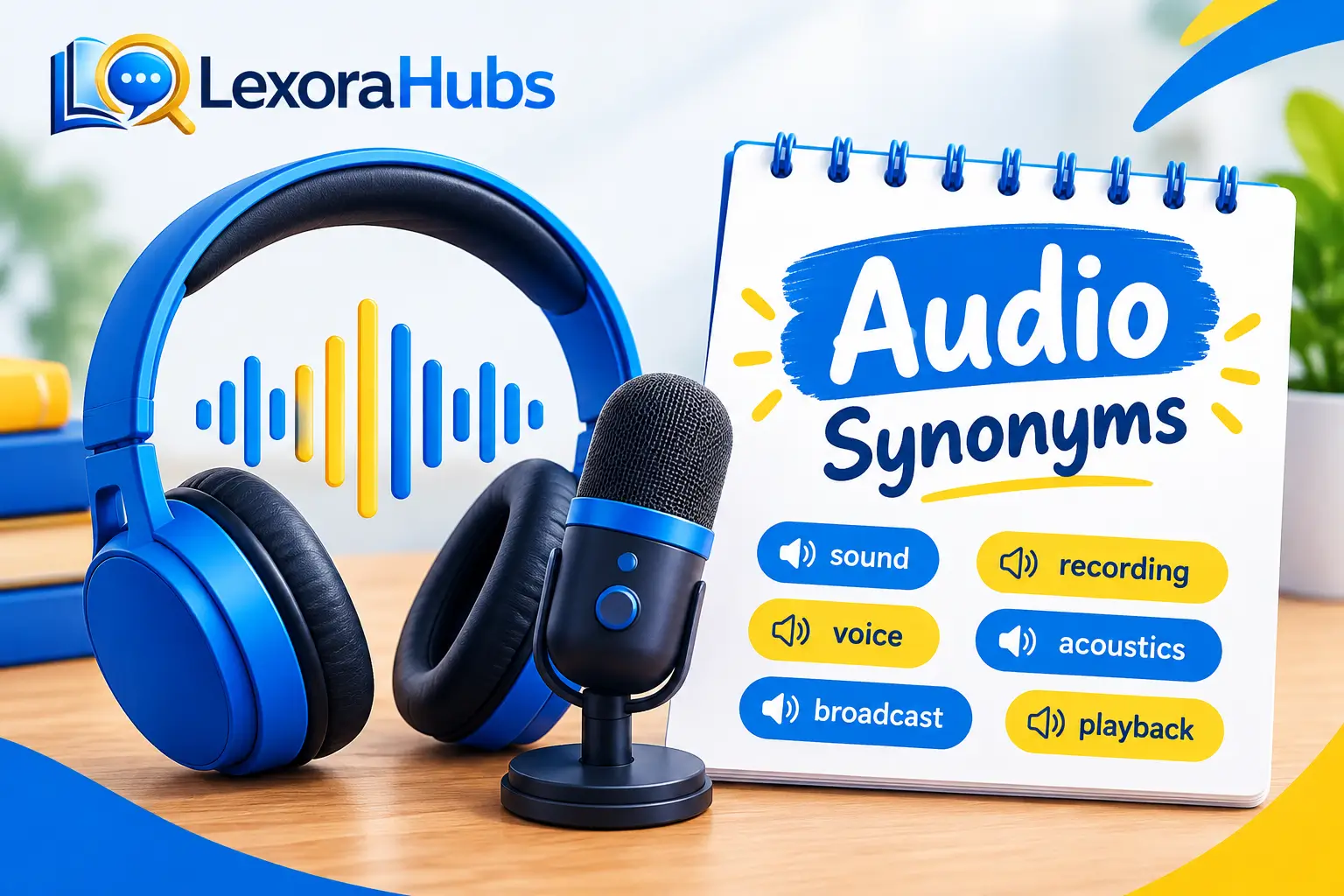
If you are looking for an audio synonym, common choices include sound, recording, voice, acoustics, and sound recording. The best word depends on what you mean by audio. For example, sound is the most general choice, while recording usually refers to saved audio that can be played again.
In simple English, audio means something related to sound that can be heard. It can describe spoken words, music, effects, or recorded sound. For example, “The video has clear audio” means that the sound in the video is easy to hear and understand.
The word is common in technology, media, music, education, and everyday communication. This guide explains useful audio synonyms, their meanings, differences, examples, and the situations where each word works best.
What Does Audio Mean?
Audio refers to sound that can be heard, recorded, transmitted, or played through a device. It is commonly used for spoken words, music, sound effects, and other forms of audible information.
For example, you might say, “Please turn up the audio.” Here, audio refers to the sound coming from a television, computer, phone, or another device.
Audio can also describe a type of media. An audio recording contains sound without necessarily showing visual images. Podcasts, voice messages, songs, audiobooks, and recorded conversations are all examples of audio content.
The word is especially common in technology. You may see terms such as audio file, audio player, audio quality, audio recording, audio system, and audio device.
In general, audio is neutral. It does not normally express a positive or negative feeling. Its meaning depends on the context in which it is used.
Quick List of Synonyms of Audio
Here are some useful words related to audio:
| Word | Simple Meaning |
| Sound | Something that can be heard |
| Recording | Saved sound that can be played later |
| Voice | Sound produced by a person’s speech |
| Acoustics | The way sound behaves in a place |
| Tones | Particular qualities or levels of sound |
| Noise | Unwanted or unpleasant sound |
| Music | Organized sound made for listening |
| Speech | Spoken words |
| Vocal | Related to the human voice |
| Soundtrack | Recorded music or sound accompanying media |
| Broadcast | Audio or other content transmitted to an audience |
| Transmission | Sending sound or information from one place to another |
| Dialogue | Conversation spoken by people |
| Voice recording | A saved recording of someone’s voice |
| Soundtrack | Sound or music used with a film or video |
| Podcast | Recorded spoken audio published for listeners |
These words are related to audio, but they are not all exact replacements. Sound is usually the closest general synonym, while words such as voice, music, and recording describe particular types of audio.
1. Sound
Sound means something that can be heard.
The sound from the speakers was very clear.
Sound is probably the most common and flexible audio synonym. It can describe anything that reaches the ears, including speech, music, noise, or natural sounds.
Unlike audio, sound is also used in everyday conversation. People often say “I heard a strange sound” rather than “I heard strange audio.”
For example, audio is commonly used when discussing technology, while sound can be used in both technical and ordinary situations.
Example
The sound of the rain helped me relax.
Use sound when you want a broad, natural word for anything that can be heard.
2. Recording
Recording means saved audio, video, or other content that can be played again.
I listened to the recording of the meeting.
A recording is a particularly useful synonym when audio refers to saved sound. A recording could contain a conversation, speech, song, interview, or lecture.
However, not every type of audio is necessarily a recording. Live sound from a microphone is audio, but it becomes a recording only after it has been saved.
Example
She sent me a recording of her presentation.
Use recording when the sound has been captured and saved.
3. Voice
Voice means the sound produced by a person’s speech.
Her voice sounded calm and confident.
Voice is narrower than audio. It specifically relates to human speech or singing rather than every kind of sound.
For example, a song can contain vocals, instruments, and sound effects. The person’s singing is the voice, while the complete track is audio.
Example
The speaker has a deep and powerful voice.
Use voice when the audio specifically comes from a person speaking or singing.
4. Acoustics
Acoustics refers to the way sound behaves in a particular environment.
The room has excellent acoustics for live music.
Acoustics is more technical than audio. It is often used when discussing rooms, buildings, studios, theaters, and sound quality.
A recording studio may have good acoustics because its design helps control echoes and reflections.
Example
The concert hall is famous for its excellent acoustics.
Use acoustics when discussing how sound behaves in a physical space.
5. Tones
Tones are particular qualities, levels, or types of sound.
The instrument produced several beautiful tones.
Tone can describe pitch, sound quality, or the character of a sound. It is useful when discussing music, voices, instruments, and communication.
Because tone has several meanings, it should not always replace audio.
Example
Her voice had a warm and friendly tone.
Use tones when you want to describe specific qualities or characteristics of sound.
6. Noise
Noise means a sound, especially one that is unwanted, unpleasant, or distracting.
The microphone picked up too much background noise.
Noise is related to audio, but it has a more specific meaning. It often describes unwanted sound rather than useful sound.
For example, a microphone may record a person’s voice along with traffic noise. The voice is useful audio, while the traffic may be unwanted noise.
Example
The headphones reduced the background noise.
Use noise when referring to unwanted or distracting sound.
7. Music
Music is organized sound created for listening, performance, or artistic expression.
The video includes background music.
Music is a type of audio, but audio is much broader. Audio can include speech, effects, interviews, and environmental sounds, while music specifically involves musical sound.
Example
I listen to music while working.
Use music when the audio specifically consists of musical content.
8. Speech
Speech means spoken words produced by a person.
The speech was recorded for later use.
Speech is another context-specific audio term. It focuses on spoken communication rather than sound in general.
It is especially useful for presentations, lectures, public speaking, interviews, and communication technology.
Example
The software converted the speech into written text.
Use speech when the audio consists mainly of spoken words.
9. Vocal
Vocal means related to the human voice.
The song has strong vocal performances.
Vocal is often used in music and audio production. It can describe singing, spoken sound, or voice-related material.
For example, a music producer may discuss vocal tracks separately from instrumental tracks.
Example
The producer adjusted the vocal track.
Use vocal when you want to emphasize the human voice.
10. Soundtrack
Soundtrack refers to music, dialogue, or other sound associated with a film, television show, game, or video.
The movie has an impressive soundtrack.
A soundtrack is a particular collection or layer of audio connected to visual media. Therefore, it is not a complete synonym for audio.
Example
The game’s soundtrack creates a dramatic atmosphere.
Use soundtrack when discussing audio that accompanies visual or interactive media.
11. Broadcast
Broadcast means content transmitted to an audience through radio, television, or another communication system.
We listened to the live broadcast on the radio.
A broadcast can contain audio, video, or both. In an audio context, it may refer to a radio program, live audio stream, or transmitted speech.
Example
The radio broadcast began at eight o’clock.
Use broadcast when the important idea is that audio is being transmitted to an audience.
12. Transmission
Transmission means the sending of information or signals from one place to another.
The audio transmission was interrupted.
Transmission is more technical than audio. It focuses on the process of sending sound or information rather than the sound itself.
Example
The wireless transmission remained clear throughout the call.
Use transmission when discussing the technical process of sending audio.
13. Dialogue
Dialogue means spoken conversation between two or more people.
The dialogue in the recording was easy to understand.
Dialogue is a type of audio content when people are speaking. It is commonly used in movies, podcasts, interviews, plays, and recorded conversations.
Example
The editor removed unnecessary dialogue from the video.
Use dialogue when the audio consists of conversation.
14. Voice Recording
Voice recording means saved audio containing someone’s spoken voice.
I made a voice recording of the instructions.
This term is more specific than audio because it tells the reader exactly what kind of audio has been saved.
Voice recordings are common in phones, messaging applications, interviews, notes, and accessibility tools.
Example
He sent a voice recording instead of typing the message.
Use voice recording when referring specifically to recorded human speech.
15. Podcast
Podcast refers to an audio program published for people to listen to, usually through the internet.
I listened to a podcast about language learning.
A podcast is not a direct synonym for audio because it describes a specific type of audio content.
Example
She started a podcast about English vocabulary.
Use podcast when referring to an organized spoken-audio program.
Audio vs. Sound
Audio and sound are closely related, but they are not always interchangeable.
Audio is commonly used in technology, media, and recording. Sound is broader and more natural in everyday English.
The audio in the video is too quiet.
I heard a strange sound outside.
The first sentence focuses on recorded or transmitted media. The second describes something that was heard.
Practical rule: Use audio for media and technology, and use sound for general audible experiences.
Audio vs. Recording
Audio can be live or recorded, while a recording is specifically saved content.
The audio is working now.
I saved a recording of the lecture.
The first sentence does not tell us whether the audio is saved. The second clearly refers to stored content.
Practical rule: Choose recording when the sound has been captured and saved.
Audio vs. Voice
Voice is specifically connected to a person’s speech or singing. Audio can refer to any audible content.
The audio includes music and sound effects.
Her voice is easy to recognize.
Practical rule: Use voice when talking about human speech or singing; use audio for the broader sound content.
Audio vs. Noise
Audio is neutral, while noise often suggests unwanted sound.
The audio quality is excellent.
The microphone captured too much noise.
Noise can be part of an audio recording, but not all audio is noise.
Practical rule: Use noise when the sound is unwanted, distracting, or interfering with useful audio.
Audio vs. Music
Music is one type of audio, but audio can include much more than music.
The audio contains a person’s voice.
The music begins after the introduction.
Practical rule: Use music only when the sound is specifically musical.
Positive Synonyms of Audio
Because audio is normally a neutral word, it does not have many inherently positive synonyms. However, several related terms can describe desirable audio qualities:
- Clear sound — audio that is easy to hear and understand.
- High-quality recording — audio captured with good technical quality.
- Crisp audio — clean and distinct sound.
- Rich sound — full and detailed audio.
- Balanced sound — audio in which different elements work well together.
- Excellent acoustics — an environment that produces pleasing sound.
For example, “The recording has crisp audio” gives a more positive impression than simply saying “The recording has audio.”
Audio Synonyms for Different Situations
For Students
Students commonly encounter audio in lectures, language lessons, audiobooks, and educational recordings.
Useful terms include recording, speech, voice, sound, lecture audio, and podcast.
I listened to the audio recording of today’s English lesson.
For students, recording is often the most useful word when referring to saved classroom material.
For Athletes
Audio is less central to sports than movement or performance, but sound is still important in training, broadcasts, interviews, and instructions.
Words such as sound, voice, broadcast, recording, and commentary can fit sports-related contexts.
The coach’s voice could be heard clearly across the field.
For Business
Business communication often involves audio calls, meetings, interviews, presentations, and recorded messages.
Useful alternatives include voice recording, speech, recording, broadcast, and transmission.
The team listened to the recording of the client meeting.
In professional writing, recording is often more precise than simply saying audio.
For Personal Challenges
In personal communication, people may talk about voice messages, recordings, conversations, and sounds.
I listened to the voice recording again before replying.
Here, voice recording clearly communicates that a person saved spoken words.
For Formal Writing
In formal writing, choose the most precise word rather than automatically replacing audio with another term.
Use sound for general sound, recording for saved material, speech for spoken content, and acoustics for the behavior of sound in a physical environment.
The study examined the effects of background noise on recorded speech.
Precision makes formal writing clearer.
Audio Synonyms in Example Sentences
Audio:
The audio in the presentation was difficult to hear.
Sound:
The sound became clearer after the technician adjusted the speakers.
Recording:
We listened to the recording after the meeting.
Voice:
Her voice was clearly audible during the interview.
Acoustics:
The hall has excellent acoustics.
Noise:
The microphone removed most of the background noise.
Music:
The music played softly in the background.
Speech:
The software analyzed the recorded speech.
Vocal:
The producer improved the vocal track.
Soundtrack:
The film’s soundtrack matched the mood of the story.
Dialogue:
The dialogue was easy to understand.
Podcast:
He listened to a podcast while traveling.
How to Choose the Right Synonym
Choosing an audio synonym is not simply about finding a word with a similar meaning. You should consider the exact context, tone, and type of sound you are describing.
First, use sound when you mean something that can generally be heard.
Next, choose recording when the audio has been saved for later listening.
For human speech, voice or speech is usually more precise.
If you are discussing unwanted sound, noise is the better choice.
For music-related content, use music, vocal, or soundtrack depending on the specific meaning.
If you are talking about how sound behaves in a room, acoustics is more appropriate.
The goal is not to replace audio with the fanciest word. The goal is to choose the word that communicates your exact meaning.
Common Mistakes With Audio Synonyms
One common mistake is treating audio and sound as completely interchangeable in every situation. Although they are closely related, audio is especially common when discussing media and technology.
Another mistake is using recording for all audio. A live microphone signal is audio, but it is not necessarily a recording.
Some learners also confuse voice with audio. Voice refers specifically to sound made by a person, while audio can include music, effects, environmental sounds, and speech.
Another common problem is using noise as a positive synonym. Noise often suggests unwanted or distracting sound.
Finally, music should not automatically replace audio. A podcast, interview, lecture, or voice message is audio but may contain no music.
Always look at the complete sentence before choosing a replacement.
Is Audio Always a Positive Word?
Audio is normally a neutral word.
It does not usually express praise or criticism. For example, “The audio is clear” is positive because of the adjective clear, not because the word audio itself is positive.
Audio can describe excellent sound:
The video has high-quality audio.
It can also describe poor sound:
The audio is distorted and difficult to understand.
The tone comes from the words surrounding audio and from the context.
Words such as clear, crisp, rich, balanced, and high-quality can create a positive meaning, while poor, distorted, unclear, and noisy can create a negative one.
Why Is Audio Important?
Audio is important because sound carries information without requiring visual attention. People use audio for communication, education, entertainment, work, and everyday activities.
In learning, students can use recordings, podcasts, audiobooks, and spoken lessons to receive information.
At work, audio supports phone calls, online meetings, interviews, presentations, and voice messages.
For personal goals, people can use audio recordings to practice pronunciation, review lessons, record ideas, or communicate quickly.
Audio also plays a major role in entertainment. Music, films, podcasts, games, radio programs, and audiobooks all depend on sound.
Clear audio is especially important because poor sound quality can make information difficult to understand. Choosing the right audio-related word also makes communication more precise.
Frequently Asked Questions
What is another word for audio?
The most common general synonym for audio is sound. Depending on the context, other alternatives include recording, voice, speech, music, soundtrack, and sound recording.
The best choice depends on what you mean. Use recording for saved sound, voice for human speech, and music for musical content.
What are the Synonyms of sound?
Common synonyms or closely related alternatives for sound include noise, tone, audio, voice, music, speech, and acoustics. However, these words have different meanings.
For example, noise often refers to unwanted sound, while voice specifically refers to sound made by a person.
What word is related to audio?
Many words are related to audio, including sound, recording, voice, speech, music, acoustics, noise, soundtrack, dialogue, and broadcast.
The right word depends on the type of audio and the situation in which it is being discussed.
What is a synonym for a speaker?
If speaker means a person who talks, related words include orator, presenter, lecturer, narrator, and talker.
If speaker means an electronic device that produces sound, words such as loudspeaker and audio speaker can be used. The meaning depends on the context.
Conclusion
The best audio synonyms include sound, recording, voice, speech, music, acoustics, noise, soundtrack, dialogue, and broadcast. Among these, sound is usually the closest general alternative, while the others describe particular types or aspects of audio.
The important difference is that these words are not exact replacements in every sentence. Recording focuses on saved sound, voice focuses on human sound, noise often describes unwanted sound, and music describes organized musical sound.
When choosing an audio synonym, consider the meaning, context, tone, and purpose of your sentence. Using the most precise word will make your English clearer and more natural.
Understanding these small differences can improve vocabulary, writing, speaking, and everyday communication. Instead of simply searching for another word, learn what each related word actually emphasizes and use it where it fits best.

Ryan is a content writer focused on creating informative and well-structured articles for LexoraHubs readers.