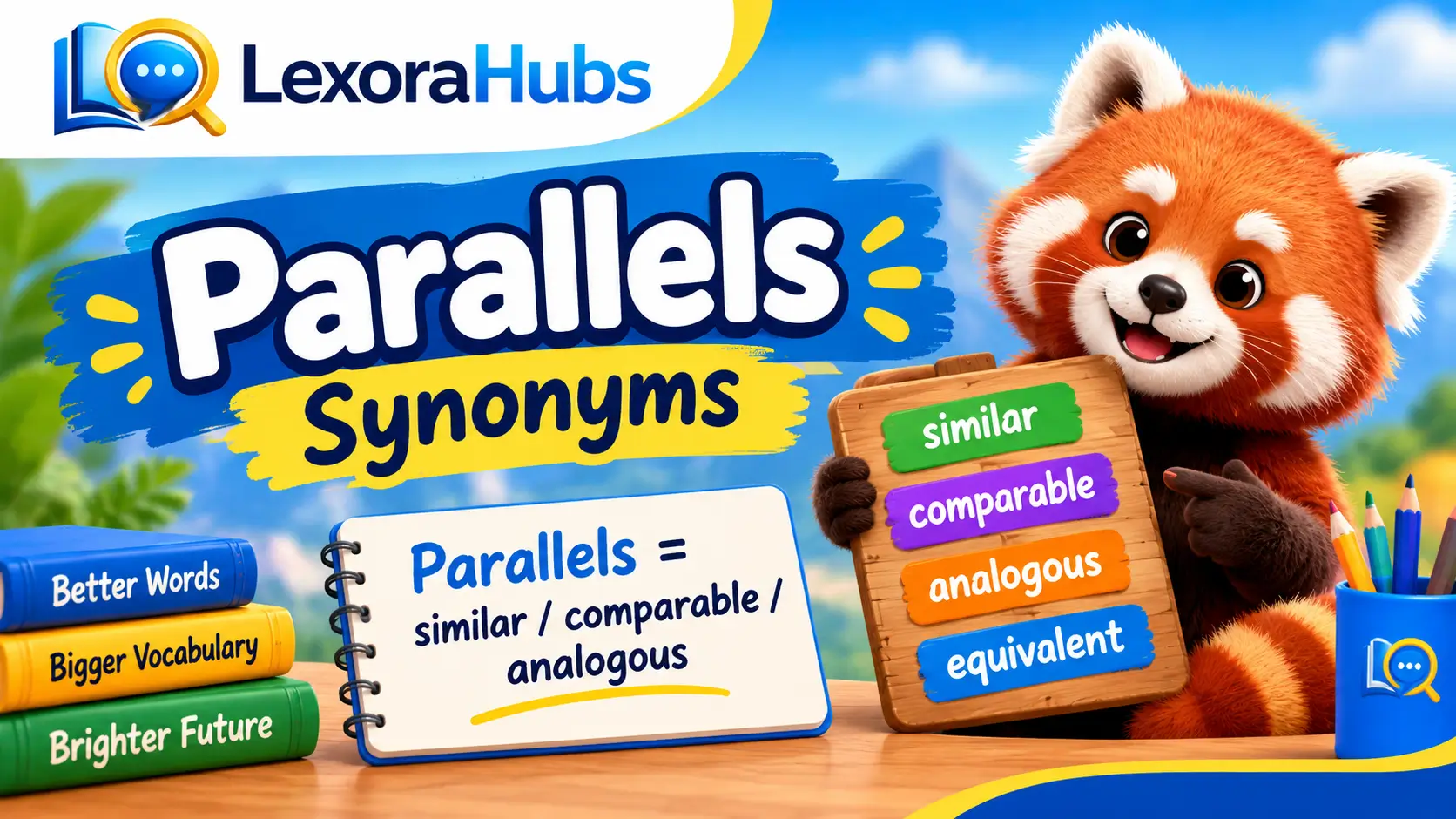
A parallels synonym is a word or phrase that shows a similar idea, pattern, link, or comparison between two things. Words such as similarities, comparisons, connections, and counterparts can fit, depending on the sentence. The best choice depends on whether you discuss ideas, events, shapes, or other things.
Introduction
Imagine writing an essay about two famous leaders. Both faced hard times, made brave choices, and changed their countries. You want to show how their stories match, but using the same word again and again makes your writing dull. Choosing fresh words can make your ideas clearer and more fun to read.
For example, you might write, “There are clear parallels between their lives.” You could also say, “Their lives show many similarities.” The second sentence shares the idea in a simple way.
Learning synonyms helps students explain ideas in essays and classwork. Bloggers can use them to keep readers interested. Content writers can choose words that fit each topic. Daily English users can speak and write with more ease.
However, not every similar word fits every sentence. Some words show a close match, while others show a link or a shared feature. So, it helps to learn their meanings and see them in real examples.
“Words are the building blocks of clear thought.”
A strong word choice can help readers understand your point without extra effort. It can also make your writing sound natural rather than repeated.
“Good writing makes a clear idea easy to see.”
50 Synonyms for Parallels With Meanings and Examples
The best synonym depends on the meaning you want to express. Here are 50 useful choices for essays, conversations, schoolwork, and professional writing.
1. Similarities
Meaning: Similarities are features that two or more things share.
Examples: Their stories have many similarities. I noticed similarities between both paintings.
2. Comparisons
Meaning: Comparisons show how two things are alike or different.
Examples: The teacher made comparisons between both books. These comparisons help explain the main idea.
3. Connections
Meaning: Connections are links that join ideas, people, events, or things.
Examples: I found connections between their stories. These connections helped us understand the lesson.
4. Correspondences
Meaning: Correspondences are close matches between details, ideas, or events.
Examples: There are correspondences between both reports. We found several correspondences in their results.
5. Analogies
Meaning: Analogies explain one thing by showing how another thing is similar.
Examples: The coach used analogies to explain teamwork. Her analogy made the hard topic easier.
6. Equivalences
Meaning: Equivalences describe things that have equal value or meaning.
Examples: The teacher explained equivalences in class. These words have equivalences in another language.
7. Matches
Meaning: Matches are things that fit or share important features.
Examples: Their answers were a close match. This pattern matches the one we studied.
8. Resemblances
Meaning: Resemblances are shared features that make things look or seem alike.
Examples: I noticed resemblances between the twins. Their drawings show strong resemblances in style.
9. Alignments
Meaning: Alignments show that ideas, plans, or actions fit together well.
Examples: Our goals show strong alignment. The team checked alignment before starting work.
10. Associations
Meaning: Associations are links between things that people connect in their minds.
Examples: Many people make associations with certain colors. Her name has associations with kindness.
11. Links
Meaning: Links connect ideas, events, facts, or people in a clear way.
Examples: The report shows links between both events. We found links between sleep and mood.
12. Relationships
Meaning: Relationships describe how two or more things connect or affect each other.
Examples: The study explores relationships between food and health. Their stories share a clear relationship.
13. Similarities in Structure
Meaning: Similarities in structure show that things share a common form or design.
Examples: Both buildings have similarities in structure. Their plans share the same basic design.
14. Commonalities
Meaning: Commonalities are features, beliefs, or interests shared by different people or things.
Examples: We found commonalities during our first meeting. Their commonalities helped build a strong friendship.
15. Affinities
Meaning: Affinities are natural links or strong likenesses between people, ideas, or things.
Examples: She has an affinity for music. Their ideas show an affinity for nature.
16. Analogues
Meaning: Analogues are things that serve similar roles in different settings.
Examples: The two tools are useful analogues. Scientists compared the analogue with the original model.
17. Counterparts
Meaning: Counterparts are people or things with similar roles in different places.
Examples: Our team met its overseas counterparts. The two offices share similar roles.
18. Proportions
Meaning: Proportions show how different parts relate in size or amount.
Examples: The artist checked the proportions carefully. Both drawings use similar proportions throughout.
19. Patterns
Meaning: Patterns are repeated forms or ways that things happen.
Examples: We noticed patterns in their behavior. These patterns appear in both stories.
20. Trends
Meaning: Trends are general directions in which things change or develop.
Examples: The reports show similar trends this year. We tracked trends in student reading habits.
21. Connections Between Ideas
Meaning: Connections between ideas show how thoughts relate or support each other.
Examples: The essay makes connections between history and art. I explained connections between the two lessons.
22. Comparables
Meaning: Comparables are things used to judge others with similar features.
Examples: We reviewed comparables before setting the price. These homes are useful comparables for buyers.
23. Parallels
Meaning: Parallels are similarities between things that share features or follow similar paths.
Examples: The stories contain clear parallels. We found parallels between both leaders’ choices.
24. Reflections
Meaning: Reflections are signs of similar ideas or qualities in another thing.
Examples: Her poem is a reflection of mine. The film contains reflections of real life.
25. Echoes
Meaning: Echoes are repeated ideas, themes, or features found in another place.
Examples: The new story echoes an older tale. I heard echoes of his advice today.
26. Repetitions
Meaning: Repetitions are things that happen or appear again in a similar way.
Examples: The report contains repetitions of earlier findings. We removed repetitions from the final draft.
27. Recurrences
Meaning: Recurrences are events or patterns that happen again after some time.
Examples: The study found recurrences of the same problem. We tracked recurrences across several months.
28. Consistencies
Meaning: Consistencies are features that stay alike across different examples or situations.
Examples: We found consistencies in both reports. These results show consistency across the tests.
29. Agreements
Meaning: Agreements are points where ideas, facts, or opinions match.
Examples: Their accounts show agreement on key details. We reached an agreement about the plan.
30. Convergences
Meaning: Convergences happen when different ideas or paths come together.
Examples: The research shows convergence between both theories. Their views reached convergence after the debate.
31. Intersections
Meaning: Intersections are points where ideas, paths, or areas meet.
Examples: The book explores intersections between art and science. We found an intersection between both topics.
32. Overlaps
Meaning: Overlaps occur when two things share parts, features, or areas.
Examples: The lessons have some overlap in content. Their work overlaps in several important areas.
33. Shared Features
Meaning: Shared features are qualities or parts found in more than one thing.
Examples: Both phones have shared features. We listed shared features before choosing one.
34. Shared Traits
Meaning: Shared traits are qualities that two people, groups, or things both have.
Examples: The brothers have shared traits. Their shared traits include patience and kindness.
35. Similar Characteristics
Meaning: Similar characteristics are qualities that make different things alike in key ways.
Examples: Both plants have similar characteristics. We compared similar characteristics in each animal.
36. Common Features
Meaning: Common features are qualities or parts found across different things.
Examples: The apps have several common features. We checked common features before buying either one.
37. Correspondences Between
Meaning: Correspondences between things show matching details or relationships across them.
Examples: We found correspondences between the two records. These details show correspondences between both cases.
38. Comparisons Between
Meaning: Comparisons between things help explain their shared and different qualities.
Examples: The essay makes comparisons between two novels. Our class made comparisons between both methods.
39. Similar Relations
Meaning: Similar relations describe links that work in much the same way.
Examples: The diagrams show similar relations. We studied similar relations between the numbers.
40. Equivalents
Meaning: Equivalents are things with the same or nearly the same purpose or value.
Examples: These words are equivalents in this context. The guide lists equivalents for common terms.
41. Parity
Meaning: Parity means that two things are equal or have the same level.
Examples: The teams reached parity in points. The report compares pay parity across offices.
42. Likenesses
Meaning: Likenesses are qualities or appearances that make two things look alike.
Examples: The portraits show likenesses between the sisters. I noticed likenesses in their faces.
43. Analogous Features
Meaning: Analogous features serve similar purposes even when they belong to different things.
Examples: Both machines have analogous features. The teacher explained analogous features with examples.
44. Similar Developments
Meaning: Similar developments are changes that happen in much the same way.
Examples: Both towns saw similar developments recently. The reports describe similar developments in trade.
45. Related Ideas
Meaning: Related ideas connect through a shared topic, cause, or meaning.
Examples: We discussed related ideas during class. These related ideas support the main point.
46. Shared Themes
Meaning: Shared themes are main ideas that appear in different works or events.
Examples: Both novels explore shared themes of hope. We found shared themes in their poems.
47. Matching Elements
Meaning: Matching elements are parts that correspond or fit together across different things.
Examples: The designs contain matching elements. We used matching elements in both posters.
48. Similar Outcomes
Meaning: Similar outcomes are results that turn out much alike in different situations.
Examples: Both tests produced similar outcomes. The teams had similar outcomes after training.
49. Comparable Results
Meaning: Comparable results are findings that can be fairly compared because they are alike.
Examples: The studies produced comparable results. We checked comparable results across the groups.
50. Shared Qualities
Meaning: Shared qualities are features or traits that different things have in common.
Examples: The artists have shared qualities in style. Their work shows shared qualities of patience.
Tip: For everyday writing, use similarities, connections, comparisons, or commonalities when they fit. In formal writing, words such as correspondences, convergences, and analogues may be more suitable.
Parallels Synonym and Antonym
A synonym for parallels is similarities, connections, or correspondences. An antonym is a word with an opposite meaning, such as differences or contrasts. For example, two stories may share parallels in their themes but differ in their endings. Choose a synonym when you want to show a link, and choose an antonym when you want to highlight what makes two things different.
Another Word for Parallels in an Essay
When writing an essay, similarities, comparisons, connections, and commonalities are useful alternatives to parallels. Use similarities to show shared features between people or events. Choose comparisons when discussing likenesses and differences. Connections work well when linking ideas or causes. For formal essays, correspondences may fit when details match across texts. Always choose the word that expresses your exact point clearly.
Parallel Synonym Formal
In formal writing, useful alternatives include correspondence, analogy, equivalence, convergence, and alignment. Correspondence works when details match across sources. Analogy helps explain one idea through another. Equivalence suggests equal value or meaning. Convergence describes separate ideas coming together, while alignment shows that goals or views agree. In academic work, check the context carefully because these terms have different meanings and are not always interchangeable.
Another Word for Parallel in Math
In mathematics, parallel describes lines or planes that remain the same distance apart and do not meet in the relevant geometric setting. Depending on the sentence, related terms include equidistant and nonintersecting, but these words do not always replace parallel exactly. For example, parallel lines never cross, while intersecting lines meet at a point. Use the correct mathematical term when describing shapes, graphs, or geometric rules.
Parallel in a Sentence
The word parallel can describe a likeness between ideas or the direction of lines. For example, a writer might say, “The two stories run parallel to each other.” This means their events or themes follow similar paths. In geometry, you could write, “The parallel lines never meet.” The meaning changes with the subject, so always read the whole sentence before selecting a synonym.
A useful writing rule: a synonym should preserve the meaning of your original sentence. A word that sounds similar may still change the point you want to make.
“The right word does more than sound good; it carries the right meaning.”
Frequently Asked Questions About Parallels
What’s the other word for parallel?
The best alternative depends on how you use the word. When discussing ideas, similar, alike, corresponding, or comparable may work. When describing lines in geometry, parallel has a specific meaning, so a loose replacement may cause confusion. For example, two events can be similar, but two straight lines are parallel when they remain the same distance apart and do not intersect in the plane.
What does it mean if something parallels another thing?
If something parallels another thing, it shares a similar feature, pattern, course, or development. The two things do not have to be exactly the same. For instance, a character in a modern novel might face challenges similar to those of a historical figure. Their experiences parallel each other because they follow a related pattern. The word can describe events, stories, behavior, trends, and other connected ideas.
What do parallels mean?
Parallels usually means similarities or matching patterns between two or more things. The term often appears when people compare events, people, stories, or ideas. For example, a reader may notice parallels between two novels because both explore courage and friendship. In another context, parallels can refer to lines or circles used in geography or mathematics. The surrounding sentence tells you which meaning is intended.
What are some synonyms for parallels in thesaurus?
A thesaurus may list similarities, analogies, comparisons, correspondences, connections, resemblances, and commonalities as alternatives for parallels. However, each word has its own use. Similarities highlight shared features, while analogies explain one thing through another. Correspondences suggest matching details, and connections emphasize links. Before replacing the original word, read the full sentence and select the alternative that best fits the subject and tone.
Conclusion
Learning synonyms for parallels can make your English stronger and your writing more interesting. Instead of repeating one word many times, you can choose words that fit your ideas. Similarities, connections, comparisons, and commonalities are useful choices for daily English. More formal words, such as correspondences and convergences, can help when writing essays or reports.
Students can use these words to compare books, people, events, and lessons. Bloggers can make their posts easier to read by choosing clear, natural language. Content writers can improve their articles by using words that match each topic. In daily conversations, knowing different words helps you explain your thoughts with greater confidence.
However, remember that synonyms do not always mean exactly the same thing. A word that fits an essay may not fit a math problem. Always check the meaning and read your sentence again before making a change.
“Every new word gives you another way to share an idea.”
Start small. Pick three words from this list and write your own sentences. Try using them in emails, school assignments, blog posts, and everyday conversations. With regular practice, you will learn which words work best in different situations.
“Clear words help your ideas reach the right people.”
Keep building your vocabulary, and let each new word help you write with more clarity, variety, and confidence.

Ryan is a content writer focused on creating informative and well-structured articles for LexoraHubs readers.