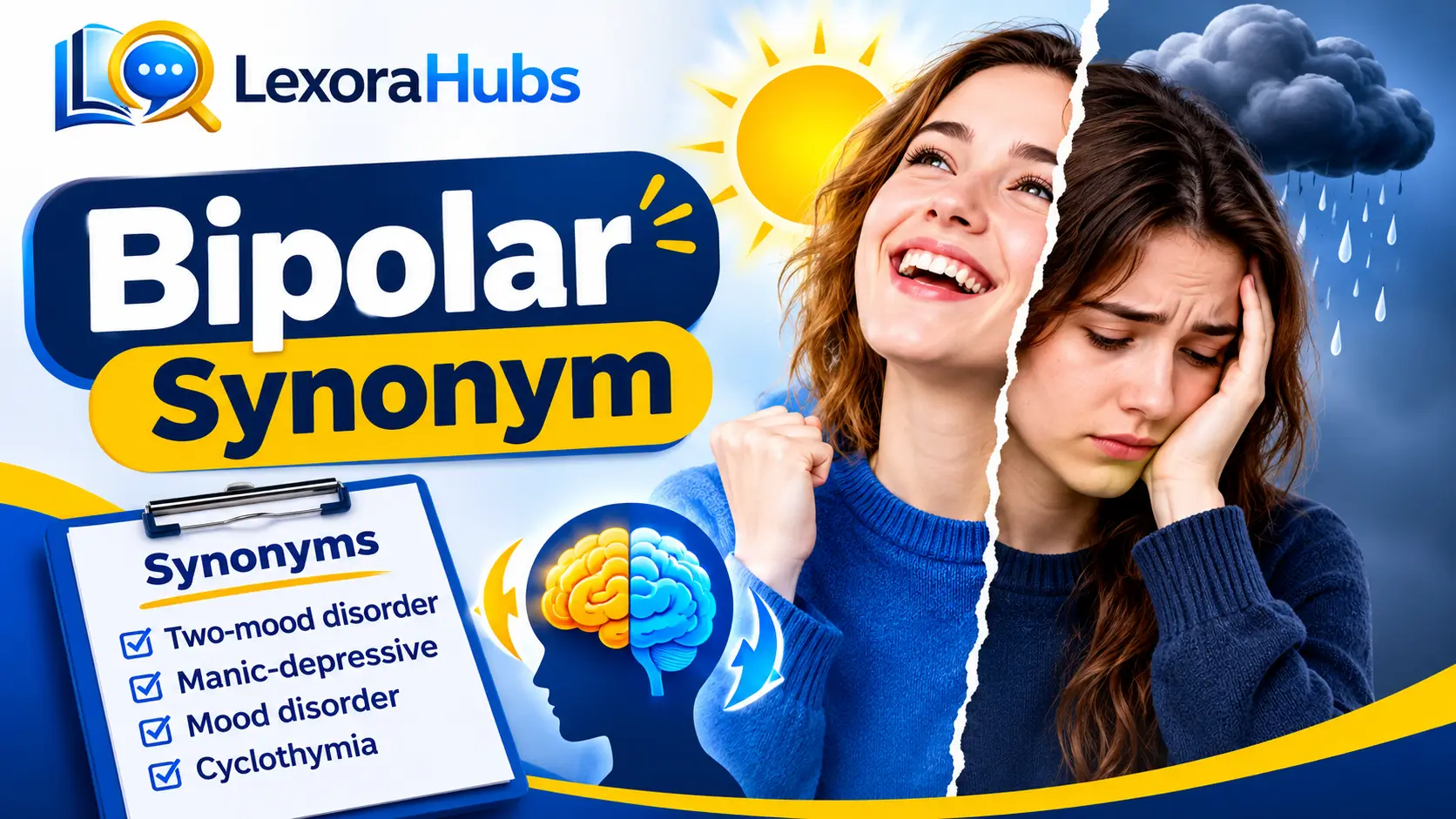
Bipolar describes something characterized by two opposite poles, extremes, or contrasting conditions; in mental health, it specifically relates to bipolar disorder, a condition involving episodes of depression and mania or hypomania. The closest synonyms and related expressions include two-sided, dual, dichotomous, polarized, contrasting, opposite, divided, ambivalent, and having two extremes. Other useful alternatives include conflicting, double-sided, dual-natured, and opposing.
For example, polarized describes sharply divided opinions, while two-sided refers to something having two distinct aspects. Similarly, ambivalent describes mixed or conflicting feelings rather than two poles. However, these expressions have different meanings, so the best choice depends on your context. This guide explains the closest synonyms, their differences, and how to use them naturally in everyday writing, academic work, and fiction.
Quick Answer: What Are the Synonyms of Bipolar?
The closest general alternatives to bipolar include two-pole, dual, two-sided, and having two opposite poles. Depending on the context, you can also use dichotomous, polarized, contrasting, divided, opposing, conflicting, or dual-natured.
However, these alternatives are not interchangeable in every sentence. In particular, bipolar has a specific medical meaning when referring to bipolar disorder, so general descriptive words should not replace the clinical term.
List of Synonyms of Bipolar
Bipolar can describe two opposing ends of a spectrum, contrasting characteristics, or a specific mental health condition. The following alternatives cover different meanings and writing situations. As a result, you can quickly identify the word that best expresses your intended meaning.
| Synonym or alternative | Meaning | Best context | Example |
|---|---|---|---|
| Two-pole | Having two distinct poles | Scientific and technical writing | The system uses a two-pole electrical connection. |
| Dual | Consisting of two parts or functions | General and professional writing | The organization has a dual purpose. |
| Two-sided | Having two different aspects | Everyday descriptions | Every argument has a two-sided nature. |
| Dichotomous | Divided into two contrasting categories | Academic writing | The survey presented a dichotomous choice. |
| Polarized | Divided into opposing positions | Political and social discussions | The debate became increasingly polarized. |
| Contrasting | Showing noticeable differences | Descriptive writing | The painting uses contrasting colors. |
| Opposing | Directly against another position or force | Formal writing | The opposing viewpoints created tension. |
| Divided | Separated into different groups or positions | Social and political contexts | The community remained divided. |
| Conflicting | Inconsistent or incompatible | General and professional writing | The report contained conflicting information. |
| Ambivalent | Experiencing mixed or opposing feelings | Emotional descriptions | She felt ambivalent about moving abroad. |
| Double-sided | Having two sides or aspects | Physical and figurative descriptions | The document contains a double-sided illustration. |
| Dual-natured | Having two distinct characteristics | Literary and descriptive writing | The character has a dual-natured personality. |
Keep in mind: Two-pole, dual, and two-sided are among the closest general descriptive alternatives. Words such as polarized, ambivalent, and conflicting describe particular features or situations rather than the complete meaning of bipolar. None of these words should be treated as a medical synonym for bipolar disorder.
What Does Bipolar Mean?
Bipolar generally means having or involving two poles, opposite extremes, or distinct sides. It can describe physical systems, contrasting characteristics, divided positions, and, in medicine, a mental health condition known as bipolar disorder.
The word commonly appears in scientific discussions, psychology, electrical engineering, political analysis, and everyday descriptions. Its meaning changes according to the subject being discussed.
For example:
- The bipolar electrical system operates through two distinct poles.
- Public opinion became increasingly polarized during the election.
- Her experience with bipolar disorder required professional treatment and ongoing support.
Grammatically, bipolar is primarily an adjective. It describes a noun, as in bipolar disorder, bipolar personality, or bipolar system. The related noun bipolarity refers to the condition or quality of having two poles or opposing extremes. Meanwhile, bipolar disorder is the established clinical name of a mental health condition and should not be replaced with informal descriptive alternatives.
The Best Synonyms of Bipolar Explained
The following alternatives help explain the different meanings associated with bipolar. Some are close descriptive substitutes, while others work only in particular contexts.
1. Two-Pole
Meaning: Having two distinct poles, endpoints, or opposite positions.
Two-pole is one of the closest literal alternatives to bipolar because both expressions can describe something organized around two poles. However, two-pole is more commonly used in technical and scientific descriptions, while bipolar has broader applications.
Best context: Electrical engineering, physics, scientific explanations, and technical writing.
Example: The technician installed a two-pole switch to control the electrical circuit.
2. Dual
Meaning: Consisting of two parts, functions, aspects, or purposes.
Dual is a useful general alternative when something has two distinct components. However, it does not necessarily suggest that those components are opposite or conflicting, which is an important distinction when using bipolar.
Best context: Professional writing, technology, education, and everyday descriptions.
Example: The company introduced a dual-purpose device for home and office use.
3. Two-Sided
Meaning: Having two different sides, aspects, or perspectives.
Two-sided works when discussing situations that have two distinct dimensions. Unlike bipolar, it does not necessarily indicate extreme differences or opposing poles.
Best context: Arguments, discussions, relationships, and descriptive writing.
Example: The journalist presented a two-sided account of the controversial decision.
4. Dichotomous
Meaning: Divided into two distinct or contrasting categories.
Dichotomous is a particularly useful alternative in academic and analytical writing. However, it usually describes a division into two categories rather than a continuous spectrum with opposite extremes.
Best context: Research papers, psychology, philosophy, and formal analysis.
Example: The researchers used a dichotomous question to classify the participants’ responses.
5. Polarized
Meaning: Divided into two strongly opposing groups, positions, or opinions.
Polarized is especially useful when describing disagreement or division. However, bipolar can refer to a system with two poles without implying conflict, whereas polarized often emphasizes separation or disagreement.
Best context: Politics, public opinion, social issues, and group discussions.
Example: The controversial proposal left the community deeply polarized.
6. Contrasting
Meaning: Showing noticeable differences between two or more things.
Contrasting works when highlighting differences in appearance, behavior, ideas, or characteristics. However, it does not necessarily mean that something has exactly two poles.
Best context: Literature, visual descriptions, comparisons, and academic essays.
Example: The author uses contrasting personalities to make the central conflict more interesting.
7. Opposing
Meaning: Directly different from or in conflict with another position, idea, or force.
Opposing is useful when two things stand against each other. Therefore, it can describe one important aspect of bipolarity, but it does not communicate the complete meaning of having two poles.
Best context: Debates, arguments, political discussions, and formal writing.
Example: The two opposing teams presented completely different strategies.
8. Ambivalent
Meaning: Experiencing mixed, uncertain, or conflicting feelings about something.
Ambivalent is sometimes confused with bipolar because both words can involve two contrasting aspects. However, ambivalence describes mixed feelings or uncertainty, not a mental health diagnosis or a two-pole system.
Best context: Emotional descriptions, personal experiences, literature, and psychology.
Example: He felt ambivalent about accepting a job that required moving overseas.
9. Conflicting
Meaning: Inconsistent, incompatible, or difficult to reconcile.
Conflicting is appropriate when two ideas, statements, interests, or emotions do not agree. However, not everything bipolar is conflicting, because two poles can simply represent different ends of a spectrum.
Best context: Research, professional communication, disagreements, and analytical writing.
Example: The investigation uncovered conflicting accounts of what happened.
10. Dual-Natured
Meaning: Having two distinct or seemingly different characteristics.
Dual-natured is a useful descriptive expression for something that displays two different qualities. However, it is not a standard clinical synonym for bipolar and should not be used as a substitute for bipolar disorder.
Best context: Fiction, personality descriptions, character development, and creative writing.
Example: The novel explores a dual-natured character who appears confident but struggles with insecurity.
Additional note: Words such as dichotomous and ambivalent can be tricky because they describe specific relationships between two ideas or feelings. Similarly, two-pole is more technical, while dual-natured is primarily descriptive.
Which Synonym of Bipolar Should You Use?
Choose an alternative according to the specific meaning you want to communicate. The following table makes the selection easier.
| Your intended meaning | Best choice | Reason |
|---|---|---|
| Something has two poles | Two-pole | Expresses two distinct endpoints. |
| Something has two functions | Dual | Describes two parts or purposes. |
| Something has two aspects | Two-sided | Highlights two separate dimensions. |
| Two categories are involved | Dichotomous | Clearly describes a two-part division. |
| People strongly disagree | Polarized | Emphasizes opposing opinions. |
| Two things look different | Contrasting | Highlights noticeable differences. |
| Two positions oppose each other | Opposing | Communicates direct disagreement. |
| Someone has mixed feelings | Ambivalent | Describes emotional uncertainty. |
For general readers, dual, two-sided, and contrasting are easy-to-understand choices. Academic writers may prefer dichotomous or two-pole, while creative writers can use dual-natured or ambivalent when the intended meaning fits. For medical discussions, always retain the established term bipolar disorder.
Choosing Words for Different Writing Situations
The right alternative depends on your audience, subject, and writing purpose. Consider these recommendations before replacing bipolar in a sentence.
Literature and Essays
Use contrasting, dichotomous, or two-sided when discussing opposing ideas, themes, or perspectives in literature. These expressions help explain differences without making the writing unnecessarily complicated.
Creative Writing
Choose dual-natured, ambivalent, or conflicting when describing complicated characters or emotional experiences. These alternatives provide more specific descriptions than using bipolar as a general personality label.
Formal or Political/Professional Analysis
Use polarized, opposing, or divided when discussing disagreements between organizations, political groups, or communities. Meanwhile, dichotomous is appropriate when an issue is organized into two distinct categories.
Scientific or General Scenarios
Use two-pole when describing technical systems and dual when referring to two functions or components. For everyday descriptions, two-sided is often more natural and easier to understand.
Bipolar vs. Similar Words
Several English words share certain characteristics with bipolar, but their meanings are not identical. Understanding these differences helps you avoid incorrect substitutions.
Bipolar vs. Dual
Bipolar describes something involving two poles or opposite extremes, whereas dual simply means having two parts or functions. Therefore, dual does not always communicate opposition or contrast.
Example: The device has a dual function, but its electrical design uses a bipolar configuration.
Bipolar vs. Dichotomous
Bipolar can describe two opposing poles or extremes, while dichotomous refers to something divided into two distinct categories. The latter is especially common in research and classification.
Example: The study used a dichotomous question that required a yes-or-no answer.
Bipolar vs. Polarized
Bipolar refers to two poles or extremes, while polarized describes a situation in which people, opinions, or groups become divided into opposing positions. Polarized usually emphasizes disagreement more strongly.
Example: Public opinion became polarized after the government announced its new policy.
Bipolar vs. Ambivalent
Bipolar can describe two poles or a specific mental health condition, whereas ambivalent describes mixed or conflicting feelings. Consequently, these terms should not be used interchangeably in psychological or everyday writing.
Example: She felt ambivalent about the decision because it offered both opportunities and challenges.
Bipolar vs. Contradictory
Bipolar can describe two opposite poles, while contradictory refers to statements, ideas, or claims that cannot both be true in the same sense. The two words overlap in some discussions but communicate different ideas.
Example: The witness provided two contradictory explanations of the incident.
As a result, choosing between these words requires understanding the relationship you want to describe. Use bipolar for two poles, polarized for divided positions, and contradictory for incompatible statements or claims.
Common Mistakes When Using Bipolar Synonyms
Replacing bipolar with a similar word may change the meaning of your sentence. Here are five common mistakes to avoid.
1. Treating Dual as an Exact Synonym
Dual means having two parts or functions, but those parts do not have to be opposite. Using it as a complete replacement for bipolar can remove the idea of opposing poles.
Better choice: Use two-pole or two-sided when the original meaning specifically involves two poles or aspects.
2. Confusing Ambivalent With Bipolar
Ambivalent describes mixed or uncertain feelings about a situation. It does not describe bipolar disorder or necessarily indicate two extreme positions.
Better choice: Use ambivalent for mixed feelings and bipolar disorder when referring to the clinical condition.
3. Using Polarized for Every Two-Part Situation
Polarized suggests strong division or opposing positions. However, something with two components is not automatically polarized.
Better choice: Use dual for two components and polarized for strongly divided opinions or groups.
4. Using Bipolar as a Casual Personality Label
Calling someone bipolar simply because their mood changes can be misleading and stigmatizing. Bipolar disorder is a recognized mental health condition that requires appropriate clinical assessment.
Better choice: Use moody, unpredictable, or emotionally inconsistent when those descriptions accurately communicate the observed behavior without implying a diagnosis.
5. Confusing the Noun With Its Adjective Form
Bipolar is primarily an adjective, while bipolarity is the related noun describing the quality or condition of having two poles. Using these grammatical forms incorrectly can make a sentence sound unnatural.
Better choice: Use each form according to its grammatical role.
- Correct: The system demonstrates bipolarity.
- Correct: The system has a bipolar structure.
- Incorrect: The system demonstrates bipolar.
- Incorrect: The bipolarity system has two poles.
Related Words and Antonyms
Related Words
The following words are connected to bipolar through their meanings or applications, but they are related concepts rather than direct synonyms.
- Mania: A state of unusually elevated energy, activity, or mood that can occur during a manic episode.
- Depression: A mental health condition or a period of persistent low mood and related symptoms.
- Polarity: The quality of having two opposite poles or contrasting directions.
- Duality: The condition of having two distinct or contrasting aspects.
- Extremes: The furthest or most pronounced points of a range.
- Spectrum: A continuous range of different positions, qualities, or conditions.
- Contrast: A noticeable difference between two or more things.
Antonyms of Bipolar
There is no single perfect antonym for bipolar in every context. However, unipolar is the clearest opposite when discussing a system or condition involving one pole rather than two.
Other contrasting expressions include:
- Single-pole: Having one pole rather than two.
- Undivided: Not separated into different parts or groups.
- Unified: Existing as one connected or coordinated whole.
- Monopolar: Having or involving a single pole.
These expressions are not exact substitutes in every sentence because the opposite of bipolar depends on whether you are discussing a physical system, an abstract concept, or a medical condition.
Example: Unlike a bipolar electrical arrangement, a unipolar configuration involves a single pole.
Frequently Asked Questions
1. What Is the Closest Synonym of Bipolar?
The closest general synonyms of bipolar include two-pole, dual, and two-sided. However, two-pole is the most precise choice when describing something that literally has two poles or opposite endpoints.
2. What Is Another Word for Bipolarity?
Another word for bipolarity is duality when referring to the existence of two distinct aspects. However, polarity is more precise when the discussion specifically involves two opposite poles.
3. Is Dual the Same as Bipolar?
No, dual and bipolar are related but have different meanings. Dual describes two parts or functions, while bipolar specifically involves two poles or opposing extremes.
4. Is Polarized a Synonym for Bipolar?
Polarized can be a contextual alternative when discussing two strongly opposing groups or opinions. However, it does not describe every situation involving two poles, and it is not a substitute for bipolar disorder.
5. What Is the Opposite of Bipolar?
Unipolar is the clearest opposite of bipolar when discussing something with one pole instead of two. Other contrasting expressions include single-pole, monopolar, and undivided, depending on the context.
6. Can I Use Moody Instead of Bipolar?
Moody can describe someone whose mood changes frequently, but it is not a synonym for bipolar disorder. Use it only when describing ordinary mood changes without suggesting a clinical diagnosis.
7. What Is the Difference Between Bipolar and Bipolarity?
Bipolar is an adjective used to describe something involving two poles or the related mental health condition. Bipolarity is a noun that refers to the quality or condition of having two poles or opposing extremes.
Conclusion
The closest general synonyms of bipolar include two-pole, dual, and two-sided. Other useful alternatives include dichotomous, polarized, contrasting, opposing, ambivalent, and conflicting. Each word communicates a slightly different meaning, so choosing the right alternative depends on the sentence.
For literary writing, consider dual-natured or contrasting; for political analysis, use polarized or opposing; and for scientific descriptions, choose two-pole or dual where appropriate. When discussing mental health, retain the accurate clinical term bipolar disorder rather than replacing it with a general synonym. Ultimately, selecting words carefully helps you communicate ideas clearly and precisely.

Emily writes simple, useful, and reader-friendly content, helping LexoraHubs provide valuable information to its audience.