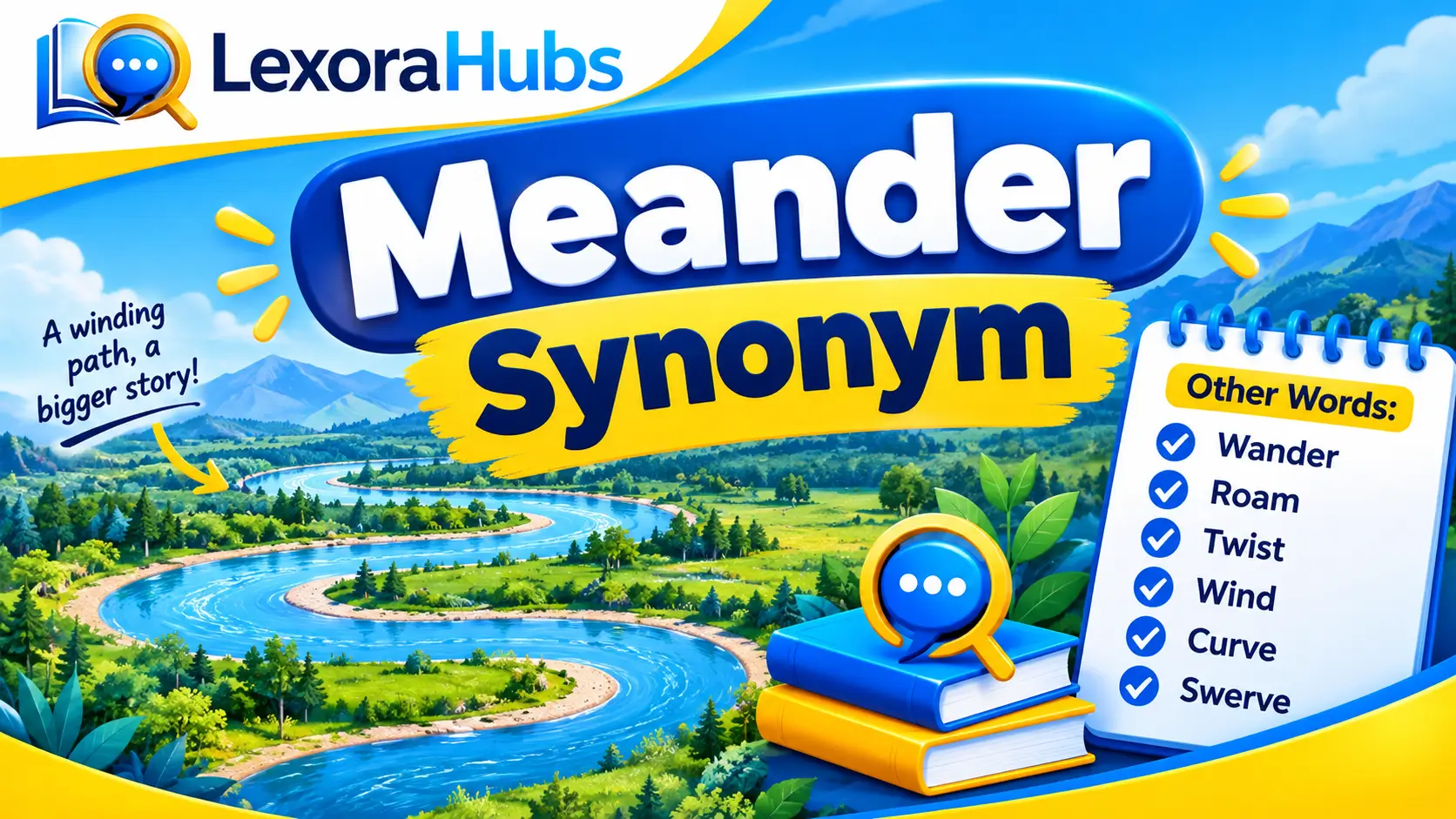
A meander synonym is a word like wander, roam, stroll, or drift. These words describe moving without a fixed path or clear goal. Some suggest a slow walk, while others describe winding roads, rivers, or thoughts that move from one idea to another.
Introduction
Imagine walking through a quiet park on a sunny afternoon. You have no plans and no reason to hurry. You follow a small path, look at colorful flowers, and stop to watch birds. This is a simple way to enjoy a peaceful walk.
For example, a student may wander through a bookshop after school, looking at books without searching for anything special.
Learning words like these makes your English more interesting. Students can use them in essays and schoolwork. Bloggers can make their stories more lively and clear. Content writers can avoid using the same word again and again. Daily English users can express their thoughts with greater ease.
However, not every similar word has the same meaning. Some words describe a relaxed walk, while others suggest moving around without direction. Therefore, understanding each word helps you choose the right one.
“A good word can make a simple idea shine.”
With a little practice, you can use these words in conversations, stories, emails, and everyday writing.
“Clear words help readers see the picture in your mind.”
50 Synonyms of Meander With Meanings and Examples
1. Wander
Meaning: To move around without a fixed plan or clear destination.
Examples: We wandered through the old market.
She likes to wander after lunch.
2. Roam
Meaning: To travel freely around an area without following one set path.
Examples: The children roamed around the garden.
We roamed through town all afternoon.
3. Stroll
Meaning: To walk slowly and enjoy the places around you.
Examples: Dad and I strolled beside the river.
They strolled through the park after dinner.
4. Ramble
Meaning: To walk or talk for a long time without a clear direction.
Examples: We rambled along the country road.
His story began to ramble near the end.
5. Drift
Meaning: To move slowly without much control or a clear direction.
Examples: Clouds drift across the blue sky.
We drifted toward the small café.
6. Stray
Meaning: To move away from the right path or planned direction.
Examples: The puppy strayed from its owner.
Our talk strayed from the main topic.
7. Meander
Meaning: To follow a winding path instead of moving straight ahead.
Examples: The river meanders through the green valley.
We meandered along narrow village streets.
8. Roam Around
Meaning: To move freely from place to place without a set plan.
Examples: We roamed around the busy town.
The tourists roamed around the market square.
9. Saunter
Meaning: To walk slowly and calmly without feeling any need to hurry.
Examples: He sauntered into the quiet café.
She sauntered down the sunny street.
10. Amble
Meaning: To walk at a slow and relaxed pace without rushing.
Examples: We ambled along the beach together.
Grandpa ambled toward the garden gate.
11. Loiter
Meaning: To stay or move around a place without a clear purpose.
Examples: The boys loitered near the school gate.
Please do not loiter outside the shop.
12. Explore
Meaning: To travel around a place to learn what it contains.
Examples: We explored the old city together.
She explored a new trail on Sunday.
13. Trek
Meaning: To travel a long distance on foot, often across rough land.
Examples: They trekked across the rocky hills.
We trekked for hours to reach camp.
14. Journey
Meaning: To travel from one place to another over some distance.
Examples: We journeyed across the wide valley.
Their family journeyed north during the summer.
15. Travel
Meaning: To move between places for work, fun, or another reason.
Examples: We travel to different towns each year.
She traveled across the country last summer.
16. March
Meaning: To walk with firm steps, often toward a clear goal.
Examples: The team marched toward the field.
He marched out after the meeting ended.
17. Pace
Meaning: To walk back and forth, often while thinking or feeling worried.
Examples: Dad paced beside the front door.
She paced around the room before speaking.
18. Circle
Meaning: To move around something by following a curved path.
Examples: The plane circled above the airport.
We circled the lake before going home.
19. Wind
Meaning: To follow a twisting or turning path through an area.
Examples: The road winds through green hills.
A narrow path winds behind our house.
20. Twist
Meaning: To turn in different directions instead of going straight.
Examples: The trail twists through the woods.
The road twists around the rocky hill.
21. Weave
Meaning: To move from side to side around people or objects.
Examples: She weaved through the crowded market.
The cyclist weaved between parked cars.
22. Zigzag
Meaning: To move forward by making sharp turns from side to side.
Examples: The little path zigzagged up the hill.
We zigzagged between trees in the forest.
23. Curve
Meaning: To bend gently instead of following a straight line.
Examples: The road curves near the bridge.
A walking path curves around the pond.
24. Bend
Meaning: To change direction by turning away from a straight line.
Examples: The river bends behind the farm.
Our path bends near the tall tree.
25. Wind Around
Meaning: To follow a curved path around something instead of going straight.
Examples: The road winds around the mountain.
A small trail winds around the garden.
26. Wander About
Meaning: To move around a place without choosing a specific direction.
Examples: We wandered about the museum for hours.
He wandered about town on his day off.
27. Roam Freely
Meaning: To move wherever you like without being held to one route.
Examples: The horses roam freely across the field.
Visitors can roam freely around the park.
28. Drift Along
Meaning: To move slowly without making a strong effort to choose a direction.
Examples: We drifted along the quiet riverbank.
The boat drifted along with the current.
29. Mosey
Meaning: To walk slowly and casually without worrying about time.
Examples: We moseyed down the dusty road.
He moseyed over to his friend’s house.
30. Amble Along
Meaning: To keep walking slowly and comfortably without trying to hurry.
Examples: They ambled along the garden path.
I ambled along while enjoying the sunshine.
31. Saunter Along
Meaning: To walk in a relaxed way, often showing no hurry.
Examples: She sauntered along the busy street.
He sauntered along toward the school entrance.
32. Meander Through
Meaning: To move through an area by following a winding or indirect route.
Examples: We meandered through the narrow lanes.
The river meanders through the open fields.
33. Meander Along
Meaning: To keep moving slowly along a path that changes direction.
Examples: We meandered along the country trail.
The stream meanders along the grassy bank.
34. Ramble On
Meaning: To continue talking or writing without staying focused on the main point.
Examples: He rambled on about his holiday.
The speaker rambled on for several minutes.
35. Loaf
Meaning: To spend time relaxing without doing much useful or planned work.
Examples: We loafed around the house all day.
He loafed on the porch after lunch.
36. Roam About
Meaning: To travel around different places without following a planned route.
Examples: The cat roamed about the backyard.
We roamed about the village after breakfast.
37. Range
Meaning: To move across a wide area instead of staying in one place.
Examples: Deer range across the open forest.
The hikers ranged over the nearby hills.
38. Saunter Off
Meaning: To walk away slowly and casually without showing any rush.
Examples: He sauntered off after the game.
She sauntered off toward the bus stop.
39. Stagger
Meaning: To move with unsteady steps, often because of weakness or dizziness.
Examples: He staggered toward the nearest chair.
The tired runner staggered across the finish line.
40. Shuffle
Meaning: To walk slowly while sliding your feet along the ground.
Examples: Grandpa shuffled across the living room.
She shuffled toward the kitchen in slippers.
41. Trudge
Meaning: To walk slowly with effort because the journey feels hard or tiring.
Examples: We trudged through the deep snow.
He trudged home after a long shift.
42. Hike
Meaning: To take a long walk outdoors, often on natural trails.
Examples: We hiked through the pine forest.
They hiked up the hill before sunrise.
43. Wander Off
Meaning: To leave a group or place without telling others where you are going.
Examples: The child wandered off near the pond.
Our dog wandered off during the picnic.
44. Roam the Streets
Meaning: To walk around streets without a fixed place to visit.
Examples: We roamed the streets after dinner.
Tourists roamed the streets of the old town.
45. Drift Away
Meaning: To move slowly away from a place or lose focus on something.
Examples: The small boat drifted away from shore.
My thoughts drifted away during the long speech.
46. Tour
Meaning: To visit several places to see or learn about them.
Examples: We toured the old castle together.
They toured the city during their holiday.
47. Scout
Meaning: To move around an area while looking for useful places or things.
Examples: We scouted the park for a picnic spot.
The team scouted the area before the match.
48. Perambulate
Meaning: To walk around an area, often in a slow or formal way.
Examples: They perambulated around the public gardens.
The officer perambulated along the old street.
49. Navigate
Meaning: To find and follow a route through an area or place.
Examples: We navigated the winding village roads.
She navigated the maze without any help.
50. Proceed Indirectly
Meaning: To move toward a goal by taking a route that is not straight.
Examples: We proceeded indirectly through the side streets.
The path proceeded indirectly around the large hill.
Meander Synonym and Antonym
A useful meander synonym is wander, because both words can describe moving without a fixed route. Other choices include roam, ramble, stroll, and drift. An antonym is march when it suggests purposeful movement, or advance when it means moving forward toward a goal. The best choice depends on the sentence and the type of movement you want to describe.
Meander Antonyms
Common antonyms of meander include march, advance, proceed directly, head straight, and go straight. These expressions suggest moving with a clear direction rather than following a winding route. For example, a road may meander through a valley, while a direct road heads straight to town. Remember that the opposite can change when meander describes wandering thoughts instead of physical movement.
Meander Synonym Slang
In casual English, people may use mosey, wander around, drift, or mess about when describing relaxed movement without a clear plan. For example, friends might say, “Let’s mosey around the shops.” These expressions sound informal and friendly. However, mess about can also mean wasting time, so it is not always a direct replacement for meander.
Meander Synonym 4 Letters
If you need a four-letter word for a crossword, roam is a strong answer. It means moving freely from place to place without a fixed route. Another possible answer is drift, but it has five letters. Always check the number of boxes and the crossing letters because crossword clues may use slightly different meanings.
Meander Synonym Crossword
The best crossword answer depends on the number of letters. Roam has four letters, stroll has six, wander has six, and ramble has six. For a five-letter answer, drift may fit some clues. Check the crossing words before choosing, since a clue about a winding river may need a different answer from one about walking aimlessly.
Meander Pronunciation
The word meander is usually pronounced mee-AN-der. It has three syllables, with the strongest stress on the middle syllable. Say it slowly first: “mee,” “AN,” “der.” Then join the sounds together. Practicing the word aloud can help you use it with confidence in class, at work, or during everyday conversation.
Frequently Asked Questions
What does it mean for someone to meander?
When someone meanders, they move or act without following a direct path. A person may meander through a park, walk around a town without a plan, or let a conversation move from one topic to another. It does not always mean the person is lost. Often, it suggests a relaxed pace or an indirect route. The exact meaning depends on whether the word describes walking, speaking, or thinking.
What is meander in simple words?
In simple words, meander means to wander or follow a winding path. Imagine a river that bends left and right instead of flowing in a straight line. That river meanders. The word can also describe a person walking slowly without a set destination. It is useful when you want to show that something moves in a curved, indirect, or unplanned way rather than going straight toward a goal.
What are 5 synonym words?
Five common synonyms for meander are wander, roam, ramble, stroll, and drift. Wander means moving without a fixed plan. Roam suggests traveling freely across an area. Ramble can describe a long walk or unfocused speech. Stroll means walking slowly for pleasure, while drift suggests moving gently without much control. Although these words are related, each one adds a slightly different meaning to a sentence.
What is the antonym of meander?
There is no single antonym that works in every sentence, but proceed directly is a useful opposite when meander describes an indirect route. Other choices include march, advance, and head straight. For example, “The trail meanders through the woods” contrasts with “The road goes straight to the village.” When meander describes speech, an opposite might be “stay focused” or “get straight to the point.”
Conclusion
Learning synonyms helps you express your ideas in better and clearer ways. Instead of using the same word again and again, you can choose a word that matches the meaning and mood of your sentence. For example, stroll sounds peaceful, trudge suggests a hard walk, and wander often means moving without a clear plan.
These small differences can make a big change in your writing. Students can improve essays and stories. Bloggers can make articles more engaging for readers. Content writers can create varied sentences without losing meaning. In daily conversation, the right word can help you explain your thoughts more clearly.
Start by choosing five words from this list. Write one sentence for each word, then use them in an email, a short essay, or a conversation with a friend. You can also read the examples aloud to improve your speaking skills.
“Small steps in learning lead to big gains in language.”
Remember that synonyms are not always perfect replacements. Check the meaning and context before using a new word. With regular practice, your vocabulary will grow, and your English will become more natural.
“The best word is the one that says exactly what you mean.”

Ryan is a content writer focused on creating informative and well-structured articles for LexoraHubs readers.