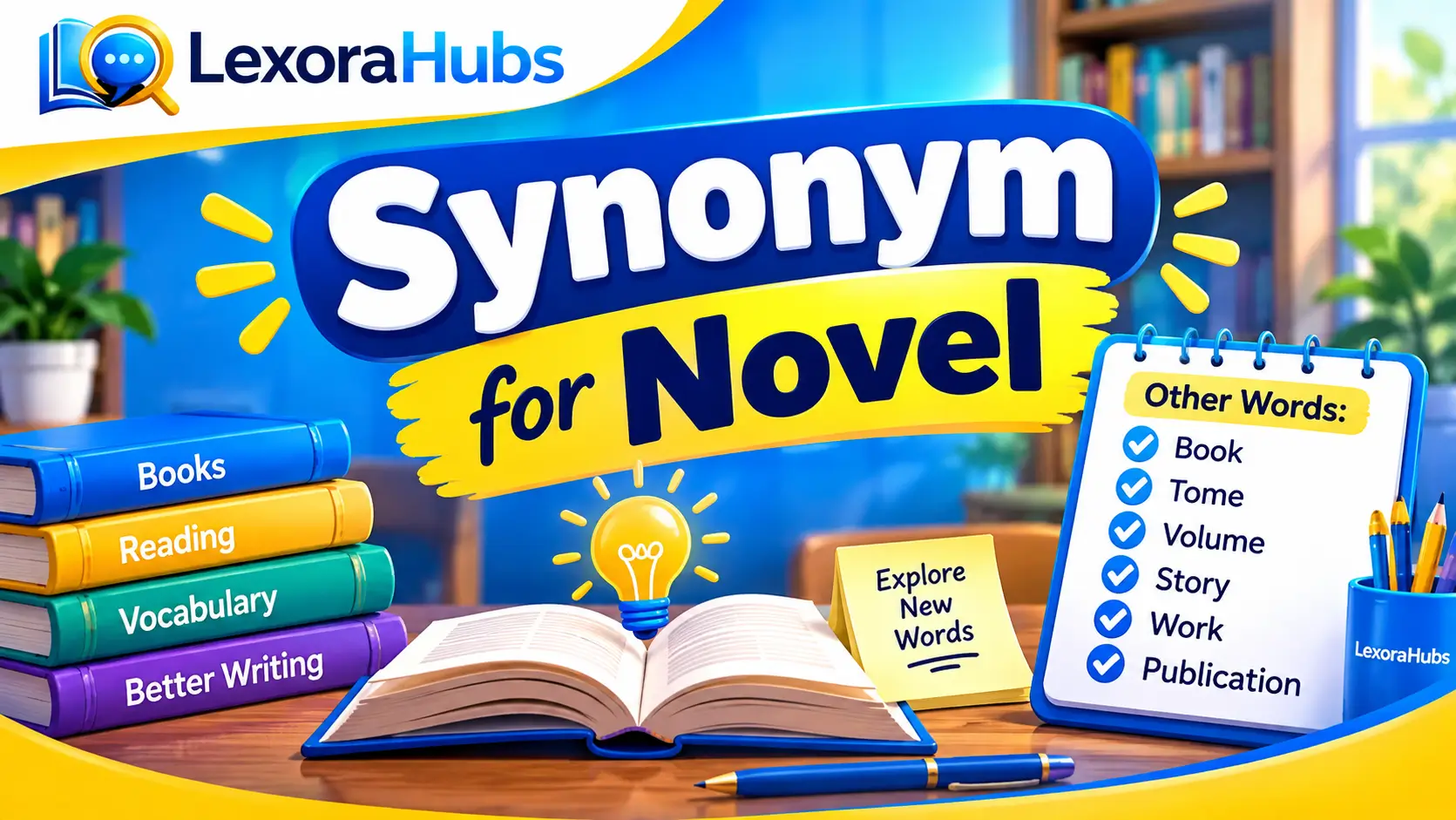
A synonym for novel can be new, original, fresh, or innovative, depending on the meaning. When novel means a book, similar words include fiction, story, and literary work. The best choice depends on whether you are talking about something new or a long work of fiction.
Introduction
Imagine you are writing a school essay about a new idea that could help your town. You use the word novel several times, and your writing starts to sound dull. Choosing different words can make your message clearer and more interesting.
For example, instead of saying, “She found a novel way to solve the problem,” you could say, “She found an original way to solve the problem.” Both sentences share a similar meaning, but the second may feel easier to understand.
Learning a synonym for novel helps you choose words that fit your message. Students can use these words to improve essays and homework. Bloggers can make their posts more engaging. Content writers can avoid repeated words and explain ideas clearly. Daily English users can speak with greater confidence.
However, context matters. Novel can describe something new and unusual, or it can mean a long work of fiction. Therefore, you should choose an alternative that matches the meaning you want to express.
“The right word can make a simple idea shine.”
A little practice can help you build a stronger vocabulary. You do not need to learn every word at once. Start with a few useful alternatives, understand their meanings, and try them in your own sentences.
“Clear words help readers understand your thoughts.”
50 Synonyms for Novel With Meanings and Examples
The word novel has different alternatives depending on its use. When describing a new idea, words like original and innovative may fit. When discussing a book, fiction or story may be better.
1. New
Meaning: Something that has recently appeared or has not been used before.
Examples: I bought a new notebook yesterday. She shared a new idea today.
2. Original
Meaning: Something created from your own ideas rather than copied from others.
Examples: His original design won the contest. Maria wrote an original story for class.
3. Fresh
Meaning: Something new that brings energy, interest, or a different feeling.
Examples: We need a fresh plan today. Her fresh ideas helped our small team.
4. Innovative
Meaning: Using new ideas or methods to solve problems in different ways.
Examples: The company built an innovative tool. His innovative plan saved us time.
5. Unique
Meaning: Something special that is unlike anything else around it.
Examples: Each student has a unique style. This shop sells unique handmade gifts.
6. Modern
Meaning: Relating to present times or using current ideas and methods.
Examples: They live in a modern house. Our teacher uses modern learning tools.
7. Unusual
Meaning: Something that is different from what people normally see or expect.
Examples: We heard an unusual sound outside. She wore an unusual hat yesterday.
8. Unprecedented
Meaning: Something that has never happened or been seen before.
Examples: The team achieved unprecedented success this year. Such growth was unprecedented in our town.
9. Creative
Meaning: Showing imagination by making new things or finding different solutions.
Examples: His creative answer surprised the class. We need creative ways to save water.
10. Inventive
Meaning: Good at thinking of clever ideas or making useful new things.
Examples: The inventive child built a toy. Her inventive solution fixed the problem quickly.
11. Groundbreaking
Meaning: Introducing an important idea that changes how people think or work.
Examples: Scientists made a groundbreaking discovery yesterday. Her groundbreaking research changed the field.
12. Pioneering
Meaning: Being among the first to try or develop something new.
Examples: He led a pioneering research project. Their pioneering work helped many families.
13. Revolutionary
Meaning: Causing a major change in how something is done or understood.
Examples: The revolutionary device changed farming methods. This discovery brought revolutionary changes to medicine.
14. Cutting-edge
Meaning: Using the newest ideas, tools, or technology available today.
Examples: The lab uses cutting-edge equipment. Their cutting-edge software works very fast.
15. Unconventional
Meaning: Different from usual methods, rules, or ways of thinking.
Examples: She chose an unconventional career path. His unconventional plan worked very well.
16. Novelty
Meaning: The quality of being new, unusual, or interesting to people.
Examples: The novelty of the game attracted visitors. Its novelty soon caught everyone’s attention.
17. Originality
Meaning: The quality of having fresh ideas that are not copied.
Examples: Her originality makes each painting special. Teachers value originality in student projects.
18. Ingenuity
Meaning: The ability to create clever solutions using imagination and skill.
Examples: His ingenuity helped repair the machine. We admired her ingenuity during the challenge.
19. Innovation
Meaning: The act of introducing new ideas, products, or ways of working.
Examples: Innovation helps small businesses grow. The school encourages innovation in science.
20. Novelty-driven
Meaning: Focused on new experiences, ideas, or things that attract attention.
Examples: The novelty-driven campaign gained many views. Novelty-driven products often attract curious buyers.
21. Untried
Meaning: Not tested or used before, so its results remain unknown.
Examples: We tested an untried method today. The untried plan could bring better results.
22. Unexplored
Meaning: Not yet studied, visited, or understood by people.
Examples: The team entered unexplored territory. This topic remains unexplored in class.
23. Unfamiliar
Meaning: Not known or recognized because you have not seen it before.
Examples: The word looked unfamiliar to me. We visited an unfamiliar town last week.
24. Original-minded
Meaning: Willing to think independently and develop ideas in personal ways.
Examples: Our original-minded artist tried new styles. The original-minded student questioned old rules.
25. Imaginative
Meaning: Showing strong imagination and the ability to picture new possibilities.
Examples: She wrote an imaginative bedtime story. His imaginative drawings filled the page.
26. Resourceful
Meaning: Good at finding clever ways to handle difficult situations.
Examples: The resourceful camper built a shelter. We stayed resourceful during the power cut.
27. Visionary
Meaning: Having bold ideas about what the future could become.
Examples: The visionary leader planned a better city. Her visionary ideas inspired young designers.
28. Experimental
Meaning: Using tests or new methods to discover what works best.
Examples: The chef tried an experimental recipe. Our class created an experimental garden.
29. Unorthodox
Meaning: Different from accepted rules or common ways of doing things.
Examples: His unorthodox method solved the puzzle. The coach tried an unorthodox training plan.
30. Fresh-thinking
Meaning: Using clear new ideas instead of repeating familiar ways of thinking.
Examples: Fresh-thinking helped the group find answers. We need fresh-thinking for this project.
31. Different
Meaning: Not the same as another thing in look, form, or nature.
Examples: Her idea was different from mine. We chose different colors for the room.
32. Distinctive
Meaning: Having a special quality that makes something easy to recognize.
Examples: The artist has a distinctive style. Its distinctive shape caught my eye.
33. Rare
Meaning: Not common or often found, seen, or experienced by people.
Examples: We spotted a rare bird outside. Rare books can be hard to find.
34. Exceptional
Meaning: Much better or more unusual than what people normally expect.
Examples: She showed exceptional skill in art. His exceptional effort helped the whole team.
35. Remarkable
Meaning: Worth noticing because something is special, surprising, or impressive.
Examples: The garden showed remarkable growth this spring. Her remarkable progress made us proud.
36. Striking
Meaning: So unusual or impressive that it quickly catches people’s attention.
Examples: The painting has a striking design. His striking idea changed our discussion.
37. Freshly conceived
Meaning: Recently thought of or planned as a new idea or project.
Examples: They shared a freshly conceived plan. The freshly conceived project excited everyone.
38. Uncommon
Meaning: Not seen or found often among ordinary people or things.
Examples: This plant has an uncommon shape. He chose an uncommon name for his dog.
39. Forward-thinking
Meaning: Planning for the future and welcoming useful changes or new ideas.
Examples: Our forward-thinking manager supports new tools. The forward-thinking school teaches digital skills.
40. State-of-the-art
Meaning: Using the most advanced design, equipment, or technology currently available.
Examples: The hospital bought state-of-the-art machines. Their state-of-the-art lab supports new research.
41. Fiction
Meaning: A made-up story that comes from imagination rather than actual events.
Examples: I enjoy reading fiction before bed. Her fiction book has a brave hero.
42. Story
Meaning: A set of events told to entertain, inform, or share an experience.
Examples: Dad told us a funny story. I finished the story on Sunday.
43. Tale
Meaning: A story about people, events, or imagined adventures.
Examples: Grandma shared a tale about dragons. The tale ended with a happy family.
44. Narrative
Meaning: A spoken or written account that explains connected events.
Examples: The narrative follows a young explorer. His narrative made the journey easy to imagine.
45. Fictional work
Meaning: A creative piece that describes imagined people, places, or events.
Examples: Her fictional work won a prize. We discussed a fictional work in class.
46. Prose fiction
Meaning: An invented story written in normal sentences rather than verse.
Examples: The library has plenty of prose fiction. I chose prose fiction for my report.
47. Literary work
Meaning: A written creation valued for its story, ideas, language, or style.
Examples: The class studied a famous literary work. This literary work explores family and friendship.
48. Book-length story
Meaning: A long story developed across enough pages to form a complete book.
Examples: She planned a book-length story this year. His book-length story follows two friends.
49. Manuscript
Meaning: A writer’s original text before it is printed or published.
Examples: The author sent her manuscript today. His manuscript needs a few final edits.
50. Long-form fiction
Meaning: An extended invented story that develops characters and events over time.
Examples: Long-form fiction gives characters room to grow. He enjoys long-form fiction on weekends.
A useful note: Words such as new, original, and innovative usually describe something novel in the sense of being new. Words such as fiction, tale, and prose fiction relate to a novel as a book. They are not interchangeable in every sentence.
“A strong vocabulary gives every idea a better voice.”
Synonym for Novel Writing
In novel writing, words such as original, imaginative, creative, and inventive help describe fresh ideas and storytelling methods. For example, an original character feels different from familiar characters, while an imaginative plot can surprise readers. Writers should also consider words like narrative and fiction when discussing the form of their work. The best choice depends on whether you mean a new approach or a written story.
Synonym for Novel in English
In English, novel has two common meanings. It can describe something new or unusual, as in “a novel solution.” It can also name a long fictional book, as in “a historical novel.” For the first meaning, try new, original, or innovative. For the second, use fiction, story, or literary work when the sentence allows it. Always check the full sentence before choosing an alternative.
Synonym for Novel Romance
When discussing a romance novel, useful related terms include romance fiction, love story, and romantic fiction. These expressions describe stories focused on romantic relationships and emotional connections. However, they are not exact replacements for novel in every sentence. A novel is a book-length form, while a love story can also be a short story, film, or personal account. Choose the term that best matches the work you are describing.
Novel Synonyms and Antonyms
Common synonyms for novel in the sense of new include fresh, original, innovative, unusual, and unprecedented. Possible antonyms include old, familiar, traditional, common, and conventional. The correct opposite depends on context: traditional contrasts with a new method, while familiar contrasts with something unfamiliar. When novel means a fictional book, these words are not direct synonyms or antonyms. Understanding the sentence helps you choose accurately.
Another Word for Novel in Science
In science, novel often describes a new finding, method, material, or approach. Suitable alternatives include innovative, new, original, and unprecedented, depending on the evidence. For example, researchers may report a novel treatment or a new testing method. Scientists should avoid calling a discovery unprecedented unless they have good evidence that it has not happened before. Precise word choice helps research sound clear, accurate, and trustworthy.
Frequently Asked Questions About Synonyms for Novel
1. What is a new synonym for “novel”?
A good synonym for novel is fresh, especially when you describe a new idea or approach. You can also use original, innovative, or unusual. For example, “The team developed a fresh plan” sounds natural when the plan offers something new. If you are describing a book, however, words like fiction or story may fit better. Always select a word that matches your intended meaning.
2. What is a fancy word for book?
A more formal word for a book is volume, especially when discussing a published work or one part of a collection. Other choices include publication, literary work, and manuscript, but each has a different meaning. A manuscript is usually a text prepared for publication, while a publication is something made available to readers. For creative writing, literary work can sound polished without making your sentence difficult to understand.
3. What is a synonym for “novel idea”?
The best synonyms for novel idea include original idea, fresh idea, innovative concept, and new approach. Each phrase highlights a slightly different quality. An original idea may be created independently, while an innovative concept may offer a useful way to solve a problem. For example, “The student suggested an innovative concept for saving energy.” In professional writing, choose the phrase that describes the idea accurately rather than simply sounding impressive.
4. What is another word for “novel” or “unique”?
When novel and unique describe something different from the usual, useful alternatives include unusual, distinctive, original, and uncommon. However, these words have slightly different meanings. Unique often suggests that something is one of a kind, while unusual means it is not common. Original can describe something created independently. In essays and everyday conversation, these alternatives help you explain what makes an object, idea, or experience stand out.
Conclusion
Learning a synonym for novel can help you become a clearer writer and a more confident English speaker. Words such as original, fresh, innovative, and creative can make your writing more interesting. Meanwhile, fiction, story, and literary work can help you discuss books with greater accuracy.
Students can use these words in essays, assignments, and classroom discussions. Bloggers can make their articles more engaging by avoiding repeated words. Content writers can improve readability by choosing alternatives that match their topics. In daily conversations, a wider vocabulary helps you explain your thoughts without struggling to find the right expression.
Start by learning three or four synonyms from this list. Write a simple sentence for each word, then use those words in an email, essay, or conversation. Pay attention to context because words with similar meanings do not always work in the same sentence.
“Small steps in learning lead to big changes in writing.”
Keep practicing, and your vocabulary will grow over time. You do not need complicated words to communicate well. You need the right words for the right situation.
“Every new word is another way to share your ideas.”

Emily writes simple, useful, and reader-friendly content, helping LexoraHubs provide valuable information to its audience.