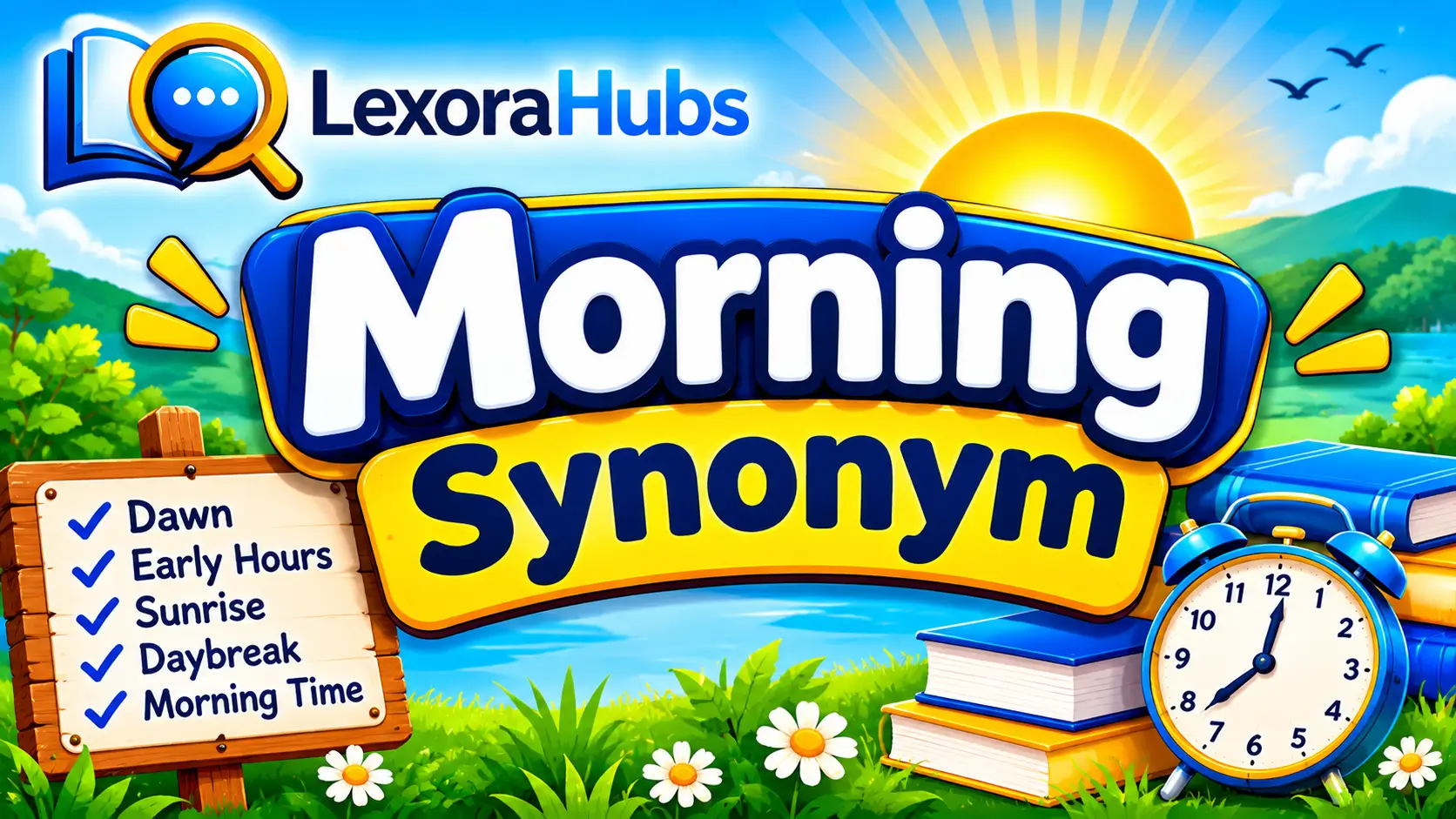
A synonym for morning can be daybreak, dawn, sunrise, daybreak, early hours, or forenoon. These words describe the early part of the day, but each has a slightly different meaning. The best alternative depends on whether you mean the time after waking, the first light of day, or the hours before noon.
Key Takeaways
- Dawn and daybreak describe the first appearance of daylight.
- Sunrise refers to the moment the sun appears above the horizon.
- Forenoon is a formal word for the hours before noon.
- Early hours and early morning are useful alternatives in everyday writing.
- Daylight and first light can describe the beginning of a new day.
- Choose a synonym based on the time, mood, and meaning you want to express.
What Is Another Word for Morning?
Another word for morning is daybreak, dawn, sunrise, early hours, or forenoon. These alternatives describe different parts of the period between midnight and noon.
For everyday conversations, early hours and early morning work well. However, writers often choose dawn or daybreak when describing the first light of a new day. Similarly, sunrise creates a clear picture of the sun appearing in the sky.
The word forenoon is another option, especially in formal or traditional writing. Therefore, the right choice depends on whether you are discussing a daily routine, a specific time, or a scene in nature.
Best Synonyms for Morning and Their Meanings
Several words can replace morning, but they do not all describe exactly the same period. Here are 12 useful alternatives with simple meanings and examples.
| Synonym | Meaning | Example |
|---|---|---|
| Dawn | The first appearance of daylight | We started our journey at dawn. |
| Daybreak | The time when daylight first appears | Birds begin singing at daybreak. |
| Sunrise | The moment the sun rises above the horizon | We watched the sunrise from the beach. |
| Daylight | Natural light during the day | The garden looked beautiful in the daylight. |
| Forenoon | The period between morning and noon | The meeting is scheduled for the forenoon. |
| Early hours | The first hours of the day | She enjoys walking during the early hours. |
| Early morning | The beginning of the day | I exercise in the early morning. |
| First light | The first natural light before sunrise or at daybreak | The fishermen left at first light. |
| Break of day | The time when daylight begins | They reached the village at the break of day. |
| Morning hours | The period from early morning until noon | I complete most of my work during the morning hours. |
| Morn | A poetic or literary word for morning | A fresh morn brought new hope. |
| A.M. hours | The hours from midnight until noon | The appointment is available during A.M. hours. |
Some alternatives focus on the beginning of daylight, while others describe a wider period. For example, sunrise refers to a specific event, whereas morning hours can cover several hours before noon.
Deep and Descriptive Words for Morning
Writers sometimes need more expressive words to describe the beginning of a day. In this case, descriptive alternatives can create a stronger picture and set a particular mood.
Here are eight useful choices:
1. Daybreak: The moment daylight begins. It works well in travel stories and nature writing.
- Example: The hikers continued their journey at daybreak.
2. First light: The earliest light of the day. It creates a peaceful and natural feeling.
- Example: The village looked magical in the first light.
3. Aurora: A poetic word associated with dawn or the glow of sunrise. It can also refer to natural polar lights.
- Example: The poet described the aurora of a new day.
4. Sunup: An informal American English term for sunrise.
- Example: We planned to leave at sunup.
5. Break of dawn: An expressive phrase describing the beginning of daylight.
- Example: The workers arrived at the farm at the break of dawn.
6. Morn: A short, poetic form of morning.
- Example: A quiet morn welcomed the travelers.
7. Golden hour: The period shortly after sunrise when sunlight appears warm and soft.
- Example: The photographer captured beautiful pictures during the morning golden hour.
8. Cockcrow: The time when roosters begin crowing, traditionally associated with early morning.
- Example: The farmers were already awake at cockcrow.
These words add atmosphere to creative writing. However, they are not always direct replacements for morning. Choose them when their specific meanings match your sentence.
Common and Everyday Synonyms for Morning
In daily conversations, people usually prefer simple expressions. These alternatives sound natural in messages, conversations, and general writing.
- Early morning: The first part of the morning.
- Morning time: A simple expression for the morning period.
- Morning hours: The hours before noon.
- Early hours: The beginning hours of the day.
- Before noon: Any time earlier than 12 p.m.
- A.M.: The time period between midnight and noon.
- Daytime: The period when it is light outside, including morning and afternoon.
- Start of the day: The beginning of someone’s daily activities.
For example, instead of saying, “I prefer working in the morning,” you could say, “I prefer working during the early hours.”
Similarly, “Let’s meet before noon” provides a clear alternative when arranging an appointment.
Formal and Professional Synonyms for Morning
Formal writing often requires more specific expressions. Business emails, schedules, reports, and official notices can use the following alternatives.
| Alternative | Meaning | Example |
|---|---|---|
| Forenoon | The hours before noon | The interview will take place in the forenoon. |
| Morning session | A scheduled period of morning activity | The morning session begins at 9 a.m. |
| First half of the day | The period before midday | We will finish the report during the first half of the day. |
| Before midday | Any time before noon | Please submit the form before midday. |
| A.M. period | The time between midnight and noon | The service operates throughout the A.M. period. |
| Morning appointment | A scheduled meeting before noon | She has a morning appointment with her manager. |
| Early business hours | The first working hours of a business | Customers can call during early business hours. |
| Morning shift | A work period that begins in the morning | He works the morning shift at the hospital. |
In professional communication, before midday and morning session are especially useful. However, forenoon may sound old-fashioned in some modern business settings.
Positive and Peaceful Words Associated With Morning
Morning often represents fresh beginnings, hope, energy, and new opportunities. Therefore, writers may use expressions that create a positive feeling.
Here are eight useful alternatives and related expressions:
1. Fresh start: A new beginning after a previous experience.
- Example: Monday morning gave her a fresh start.
2. New beginning: The start of something different.
- Example: Every morning offers a new beginning.
3. Bright dawn: A hopeful or beautiful beginning of the day.
- Example: A bright dawn welcomed the new season.
4. First light: The first daylight, often linked with peace and beauty.
- Example: He enjoyed reading by the first light.
5. New day: The beginning of another day and another opportunity.
- Example: A new day brought fresh opportunities.
6. Daybreak: The arrival of daylight.
- Example: The countryside looked peaceful at daybreak.
7. Sunrise glow: The warm light created by the rising sun.
- Example: The mountains shone in the sunrise glow.
8. Golden morning: An expressive phrase for a beautiful or pleasant morning.
- Example: We enjoyed a golden morning in the countryside.
These expressions are useful in motivational writing, greeting messages, poems, and lifestyle articles. However, some describe feelings or ideas rather than the exact time of day.
Morning Synonyms in Sentences
Seeing synonyms in complete sentences makes their meanings easier to understand. The following examples show how to use different alternatives naturally.
- Morning: I enjoy drinking coffee every morning before work.
- Dawn: The birds started singing at dawn.
- Daybreak: We left home at daybreak to avoid traffic.
- Sunrise: The sunrise looked beautiful over the ocean.
- Forenoon: The doctor has several appointments this forenoon.
- First light: The fishermen prepared their boats at first light.
- Early hours: She prefers studying during the early hours.
- Sunup: The construction workers arrived at sunup.
- Break of day: They began their journey at the break of day.
- Morn: A peaceful morn brought happiness to the village.
- Before noon: Please complete your assignment before noon.
- Morning session: Students attended the morning session at school.
Notice how each word creates a slightly different meaning. For example, sunrise describes a natural event, while morning session describes a scheduled activity.
Morning vs. Its Closest Synonyms
Some words have very similar meanings, but their usage depends on timing and context. This comparison explains the main differences.
| Word | Main Meaning | Best Used For | Tone |
|---|---|---|---|
| Morning | The period from early day until noon | Everyday conversations | Neutral |
| Dawn | The first appearance of daylight | Nature and descriptive writing | Poetic |
| Daybreak | The beginning of daylight | Travel and storytelling | Descriptive |
| Sunrise | The sun appearing above the horizon | Nature and photography | Neutral |
| Forenoon | The period before noon | Formal or traditional writing | Formal |
| Sunup | The time when the sun rises | Casual conversations | Informal |
| First light | The earliest daylight | Nature and storytelling | Literary |
| Morn | A poetic word for morning | Poetry and creative writing | Literary |
Morning vs. Dawn: Morning describes a wider period, while dawn refers to the beginning of daylight. Therefore, dawn usually occurs near the start of the morning.
Morning vs. Sunrise: Sunrise is a specific event when the sun appears above the horizon. In contrast, morning continues for several hours after sunrise.
Morning vs. Forenoon: Both describe time before noon. However, morning is much more common in everyday English, while forenoon sounds more formal or traditional.
Morning vs. Daybreak: Daybreak refers to the first appearance of daylight. Meanwhile, morning includes the entire period before noon.
Different Ways to Say “Morning”
The best alternative depends on your audience and writing style. Here are some natural expressions grouped by their purpose.
Casual expressions
- Early morning
- Morning time
- Bright and early
- First thing in the morning
- At sunup
- Before noon
Example: “Let’s discuss the project first thing in the morning.”
Formal expressions
- During the forenoon
- Before midday
- Morning session
- First half of the day
- During A.M. hours
Example: “The presentation will take place before midday.”
Descriptive expressions
- At dawn
- At daybreak
- At first light
- At sunrise
- At the break of day
Example: “The travelers reached the mountain at first light.”
Poetic expressions
- The golden morn
- A new dawn
- The morning glow
- The break of a new day
- The first light of day
Example: “A new dawn brought hope to the quiet village.”
Related Words for Morning
Several words are closely connected to morning. They help describe daily routines, daylight, time, and activities.
| Related Word | Part of Speech | Meaning |
|---|---|---|
| Morningtime | Noun | The period of the morning |
| Daybreak | Noun | The beginning of daylight |
| Sunrise | Noun | The appearance of the sun above the horizon |
| Morning light | Noun phrase | Natural light during the morning |
| Morning routine | Noun phrase | Regular activities performed after waking |
| Morning person | Noun phrase | Someone who feels active early in the day |
| Morning glory | Noun | A flowering plant; also used in poetic descriptions |
| Morning breeze | Noun phrase | A gentle wind during the morning |
| Morning dew | Noun phrase | Water droplets that form on surfaces overnight |
| Morning freshness | Noun phrase | A fresh or pleasant feeling at the start of the day |
Useful Morning Collocations
A collocation is a group of words that commonly appear together. These combinations can make your English sound more natural.
- Early morning walk: A walk taken shortly after waking.
- Morning coffee: Coffee enjoyed at the beginning of the day.
- Morning sunlight: Sunlight that appears during the morning.
- Morning workout: Exercise performed before noon.
- Morning news: News presented or read early in the day.
- Morning greeting: A greeting used when meeting someone in the morning.
- Morning schedule: A plan for activities before noon.
- Morning commute: Travel to work or school in the morning.
Antonyms of Morning
Morning does not have one exact opposite because it describes a period of the day. However, several time-related words contrast with it.
| Antonym or Contrast | Meaning |
|---|---|
| Evening | The later part of the day |
| Night | The dark period after sunset |
| Midnight | The middle of the night |
| Dusk | The time when daylight disappears |
| Sunset | The moment the sun goes below the horizon |
| Nightfall | The beginning of nighttime |
| Late night | The later hours of the night |
| Afternoon | The period between noon and evening |
For example, morning and evening are commonly used as contrasting parts of the day. Similarly, sunrise and sunset describe opposite stages of the sun’s daily movement.
Frequently Asked Questions
1. What is the strongest synonym for morning?
Dawn is one of the strongest descriptive alternatives for morning. It creates a clear image of daylight beginning. However, daybreak is equally useful when describing the start of a new day. The best choice depends on whether your sentence focuses on natural light or the beginning of the day.
2. What is a better word for morning?
Words such as dawn, sunrise, daybreak, and early hours can replace morning. For everyday writing, early hours sounds natural. Meanwhile, dawn and daybreak work better in descriptive writing. Choose an alternative that matches the exact time and meaning of your sentence.
3. What is a formal synonym for morning?
Forenoon is a formal or traditional synonym for morning. It refers to the period before noon. Other professional expressions include before midday, morning session, and first half of the day. These alternatives are useful in business communication, schedules, and formal writing.
4. What is another way to say early morning?
You can say daybreak, dawn, first light, sunup, or the break of day. Additionally, expressions such as bright and early and first thing in the morning work well in casual conversations. Each phrase gives a slightly different feeling and time reference.
5. Is dawn the same as morning?
No, dawn and morning are closely related but not identical. Dawn refers to the first appearance of daylight, while morning covers a much longer period before noon. Therefore, dawn is part of the morning rather than a complete replacement for it.
6. What is the opposite of morning?
Evening is the most common contrast to morning. However, night, midnight, dusk, and nightfall can also provide opposite time references. The best choice depends on the sentence. For example, morning and evening describe daily periods, while sunrise and sunset describe natural events.
7. Can sunrise be used as a synonym for morning?
Sunrise can sometimes replace morning, especially when discussing the beginning of the day. However, the two words have different meanings. Sunrise describes the moment the sun appears above the horizon, whereas morning refers to the wider period before noon.
Final Thoughts
Choosing the right morning synonym can make your writing clearer and more interesting. Words such as dawn, daybreak, and sunrise are useful for describing the beginning of daylight. Meanwhile, early hours, forenoon, and morning session work well in everyday and professional communication.
Ultimately, context matters more than using a complicated word. Choose a simple alternative when writing for general readers, or use a descriptive expression when creating a particular mood. With the right word, you can make your sentences more natural, clear, and engaging.

Ryan is a content writer focused on creating informative and well-structured articles for LexoraHubs readers.