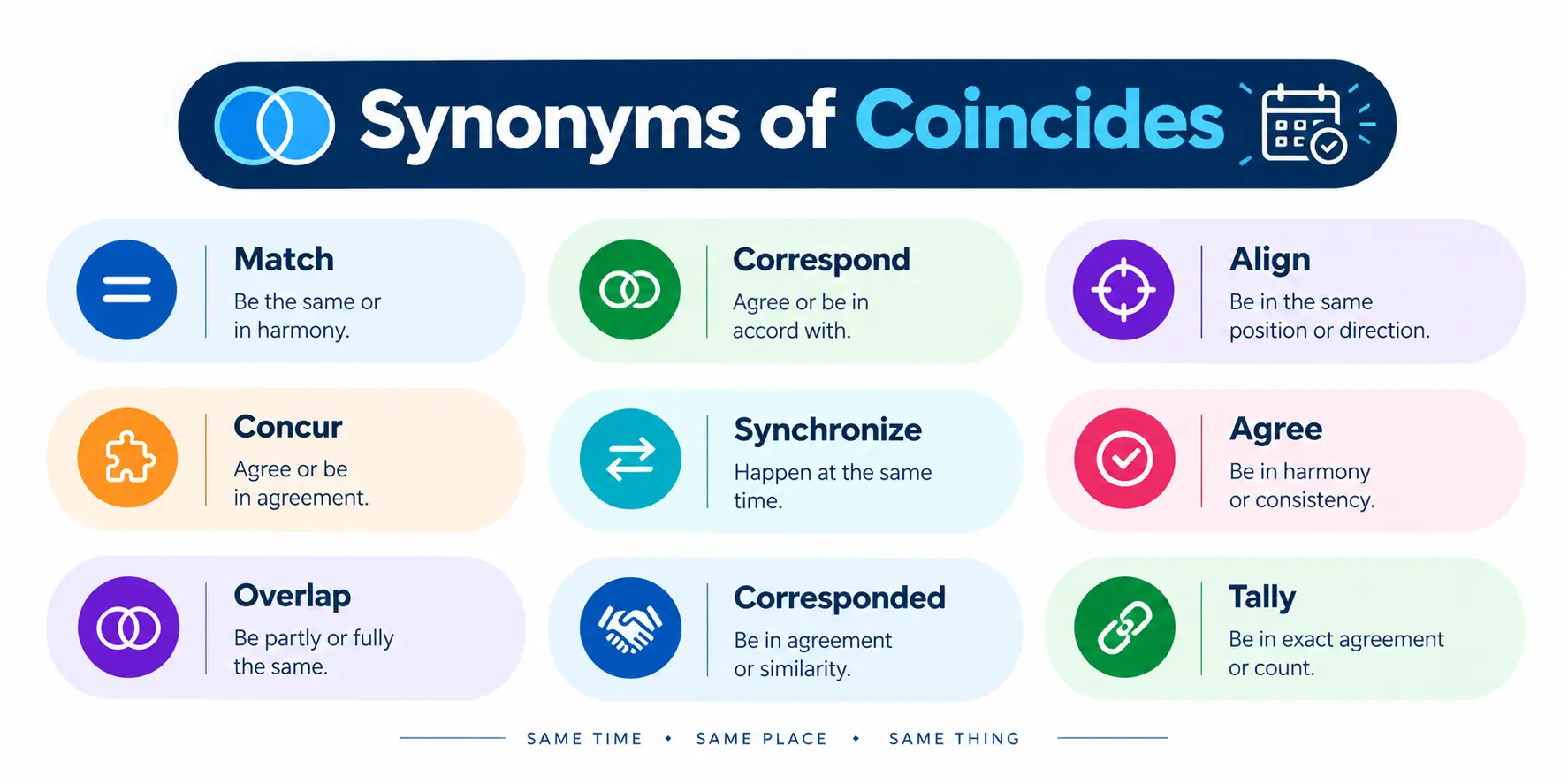
Coincides means two or more things happen at the same time, often by chance. Common synonyms include align, overlap, correspond, match up, and occur simultaneously. The best choice depends on whether you mean timing, agreement, or pure chance.
Key Takeaways
- “Coincides” means two things happen at the same time or line up with each other.
- The word comes from Latin, not internet slang, so it has a long, traceable history.
- Popular synonyms include align, overlap, correspond, and match up.
- It works in formal writing, casual chats, and everyday conversation.
- The tone is neutral. It is neither positive nor negative on its own.
- It still shows up often in news, school writing, and daily speech today.
Introduction
People search for a coincides synonym for a few simple reasons. Sometimes a sentence already uses “coincides” once, so a writer wants a fresh word for the next mention. Other times, someone is filling out a crossword and needs a matching term. Still others just want to sound more precise.
You’ll run into “coincides” almost everywhere. News articles use it to link two events. Teachers use it in essay feedback. Coworkers use it when scheduling meetings that overlap. Even casual texts use it when two people realize their plans line up.
Is it still used today? Yes, constantly. It never went out of style because it fills a specific gap. Few other words describe “happening at the same time” this cleanly. As a result, it remains a staple in both formal and everyday English.
This guide breaks down every angle of the word “coincides.” You’ll get its meaning, its origin, a full list of synonyms, and dozens of real examples. By the end, you won’t need another page to understand it.
What Does Coincides Mean?
“Coincides” means two or more things happen at the same moment, or they match up closely enough to line up in some way. It comes from the verb “coincide,” and “coincides” is simply the form used with he, she, or it.
There are two main shades of meaning here. First, there’s timing. For example, “Her birthday coincides with the holiday.” Second, there’s agreement or overlap. Notably, this second sense shows up when two opinions, plans, or facts line up, even if timing isn’t involved.
Because the word covers both ideas, context matters a lot. Instead of guessing, look at what’s being compared. Is it a date, an event, or an opinion? That answer usually reveals which shade of meaning applies.
H3: Meaning by Example
- Timing sense: “The meeting coincides with lunch.”
- Agreement sense: “Their stories coincide perfectly.”
- Chance sense: “It just so happens their birthdays coincide.”
Quick Meaning Box
| Meaning | Simple Explanation |
| Happens at the same time | Two events land on the same date or moment |
| Matches or lines up | Two facts, stories, or plans agree with each other |
| Happens by chance | An unplanned overlap between two things |
Coincide Pronunciation
“Coincide” is pronounced koh-in-SYDE. The stress falls on the last part of the word, which rhymes with “side.” “Coincides” adds a soft z-sound at the end, so it sounds like koh-in-SYDES.
A lot of people trip up on the middle syllable. Instead of rushing through it, slow down and separate “co” and “in” clearly. That small pause makes the word much easier to say out loud.
Where Does Coincides Come From?
“Coincide” traces back to Latin. It combines “co-,” meaning together, with a form of “incidere,” meaning to fall on or happen. Put together, the original sense was something like “to fall together” in time.
The word passed through Medieval Latin and French before settling into English. It has been part of the language for centuries, long before slang culture or social media existed. So this is not an internet term or a recent coinage. It’s a standard, well-documented English word with a formal background.
Because of that history, “coincides” carries no slang flavor at all. It’s neutral, dictionary-standard English, and it works the same way in a courtroom, a classroom, or a casual chat.
History of the Term
The concept of “coinciding” has stayed remarkably stable over time. Early uses focused mostly on geometry and astronomy, where two lines, points, or events literally lined up. Over time, writers stretched the word to cover everyday scheduling and general agreement.
H3: From Formal to Everyday
By the time the word reached common English usage, it had already picked up its broader sense. People began using it for birthdays, appointments, and simple daily overlaps. Meanwhile, its formal, technical use never disappeared. Scientists and mathematicians still use it in precise, technical ways.
H3: No Recent Resurgence
Unlike slang terms that spike and fade, “coincides” hasn’t had a viral moment or sudden comeback. Instead, it has quietly stayed useful the entire time. That steady, unglamorous consistency is exactly why it’s still common today.
How People Use It Today
“Coincides” shows up constantly in news writing, especially when two events land close together. It also appears often in school essays, work emails, and everyday conversation about schedules.
It isn’t tied to any specific platform, generation, or online community. Unlike slang terms tied to TikTok or gaming spaces, this word crosses every age group equally. A teenager describing two exam dates and a professional describing two deadlines would use the exact same word, the exact same way.
Coincide Meaning
At its core, the meaning stays simple: two things line up, either in time or in content. However, the tone shifts based on context. A scheduling coincidence feels neutral or even lucky. A coincidence in stories, on the other hand, can sound suspicious.
Because the word carries no built-in judgment, the surrounding sentence does all the emotional work. That flexibility is part of why writers reach for it so often.
Coincides Synonym and Antonym
Here’s a side-by-side look at words that mean the opposite and words that mean the same.
| Term | Meaning | Key Difference |
| Coincides | Happens at the same time or matches up | Neutral, standard English word |
| Aligns | Lines up closely with something else | Slightly more formal, often used for plans or values |
| Conflicts | Clashes or happens at odds with something | Direct antonym in the scheduling sense |
| Diverges | Moves apart or differs | Antonym in the “agreement” sense |
Coincides Synonym Slang
There isn’t a true slang version of “coincides.” Because the word is already simple and neutral, casual speech usually just shortens the sentence instead of swapping the word. For example, someone might say “same time, weird right?” instead of using a slang substitute.
This is worth stating clearly: no evidence points to a widely used slang alternative for “coincides” on TikTok, Twitter/X, Reddit, or similar platforms. So if you’re searching for internet slang specifically, it likely doesn’t exist for this term.
Coincide in a Sentence
Seeing the word in context helps more than any definition alone. Here are a few clean examples:
- Her flight coincides with the start of the concert.
- The two reports coincide on almost every major point.
- It’s odd how their vacations always coincide.
- His promotion coincides with the company’s anniversary.
Coincide Synonym Formal
For formal writing, a few words hold up especially well:
- Correspond
- Align
- Coexist temporally
- Occur simultaneously
- Concur
These options fit reports, essays, and professional emails. Instead of repeating “coincides” twice in one paragraph, swapping in “correspond” or “align” keeps the writing smooth and professional.
Coincides Synonym Crossword
Crossword clues often look for short, common synonyms. Based on typical puzzle patterns, likely answers include:
- MATCH
- ALIGN
- AGREE
- MESH
- JIBE
Puzzle answers vary by publication, so always check the letter count and existing crossing letters before locking in a guess.
Not Coincide Synonym
When something does not coincide, a few solid word choices work well:
- Clash
- Conflict
- Diverge
- Differ
- Misalign
For instance, “Their schedules clash” works just as well as “Their schedules do not coincide.” Choosing the negative version often makes a sentence shorter and punchier.
Examples in Everyday Conversation
- “Wait, our lunch breaks coincide today!”
- “It’s strange how both power outages coincide like that.”
- “Do the two deadlines coincide, or is there a gap?”
- “Their opinions on the movie totally coincide.”
- “My day off coincides with the big game.”
- “The two witness accounts coincide almost word for word.”
- “I didn’t expect our trips to coincide.”
- “Does the sale coincide with the holiday weekend?”
- “Their goals for the project finally coincide.”
- “It just happens our anniversaries coincide.”
Text Message Examples
- “lol our schedules coincide again 😂”
- “wait do our exams coincide?? that’s rough”
- “so weird, our flights coincide”
- “our stories need to coincide before we tell mom”
- “does your break coincide with mine today?”
- “our plans keep coinciding, are we twins now”
- “check if the two dates coincide before booking”
- “our vacations coincide this year, finally”
- “his story doesn’t coincide with what she said”
- “our moods always seem to coincide lately”
Social Media Caption Examples
- Instagram: “When your gym days coincide with your best friend’s ☀️”
- TikTok: “POV: your exam dates coincide with your birthday 💀”
- X: “Wild how these two headlines coincide today.”
- Threads: “Our vibes coincide more than I expected.”
- Facebook: “Funny how our anniversaries coincide every year.”
- Instagram: “Coffee dates that coincide with sunsets hit different.”
- TikTok: “When your work shift coincides with the concert 😭”
- X: “Two totally separate reports, yet they coincide perfectly.”
- Threads: “Our travel plans coincide again, small world.”
- Facebook: “So happy our schedules finally coincide this month.”
Is It Positive or Negative?
“Coincides” is a neutral word by default. Its tone depends entirely on context. When it describes lucky timing, like two friends having the same day off, it feels positive.
However, when it describes suspicious overlap, like two stories matching too perfectly, it can sound negative or doubtful. Because of this range, misunderstandings are rare but possible. A listener might read suspicion into a sentence that was only meant to describe a schedule.
Who Uses This Slang?
Since “coincides” isn’t slang, there’s no specific age group or subculture behind it. Teens, adults, teachers, and professionals all use it the same way. It appears in academic writing, business communication, casual texting, and spoken conversation alike.
This universal use is actually one of its strengths. Unlike trend-based slang, it never risks sounding outdated or tied to one generation.
Similar Slang Words
| Slang | Meaning |
| Sync up | Casual way to describe matching schedules |
| Line up | Informal version of aligning or matching |
| Match up | Common way to say two things correspond |
| Fall together | Casual phrase for events happening at once |
Opposite Words
- Clash — happens at odds with something else
- Conflict — directly contradicts or competes
- Diverge — moves in a different direction
- Differ — simply isn’t the same
- Misalign — fails to line up correctly
Common Mistakes
- Spelling it “concides” instead of “coincides.”
- Confusing it with “coincidence,” which is the noun form.
- Using it when “agree” alone would sound more natural.
- Overusing it in one paragraph instead of swapping in a synonym.
When NOT to Use It
In very short, casual writing, “coincides” can feel a bit stiff. For instance, a quick text usually reads better with “match up” or “line up” instead. Still, it fits perfectly in reports, essays, emails, and news writing, where a slightly more formal tone is expected.
Avoid using it repeatedly within the same paragraph, since that reads as repetitive rather than precise. Instead, rotate in one of the synonyms listed above.
Fun Facts
- “Coincide” comes from Latin roots meaning “to fall together.”
- The noun form is “coincidence,” not “coincidance.”
- It was originally used in geometry and astronomy contexts.
- It has no confirmed internet-slang version.
- The word has stayed spelled the same way for a very long time.
- It pairs naturally with the preposition “with,” as in “coincides with.”
Frequently Asked Questions
What is another word for coinciding?
A strong alternative is “aligning,” “overlapping,” or “corresponding.” Each fits slightly different contexts. “Aligning” works well for plans or goals. “Overlapping” fits scheduling situations best. “Corresponding” suits formal writing, especially when comparing facts, reports, or timelines. Pick based on whether you’re describing timing or agreement.
What is meant by coincides? “
Coincides” means two or more things happen at the same time, or they closely match each other. It can describe dates lining up, opinions agreeing, or events happening together by chance. The exact shade of meaning depends on the sentence around it.
What are 5 synonym words?
Five solid synonyms for “coincides” are align, overlap, correspond, match up, and concur. Each works in slightly different settings. “Align” and “correspond” fit formal writing well, while “match up” and “overlap” feel more casual and conversational.
Do not coincide synonyms?
When two things do not coincide, useful words include clash, conflict, diverge, and misalign. “Clash” works best for scheduling conflicts, while “diverge” fits situations involving opinions or paths that split apart rather than line up.
Is “coincides” formal or informal?
It leans formal but still works fine in casual writing. It shows up in news articles and business emails just as often as in everyday conversation, so it isn’t restricted to one register.
Final Thoughts
“Coincides” is a simple, useful word with a long history and no slang baggage. It covers timing, agreement, and pure chance, all in one neat package. Because it’s neutral, it fits almost any writing style, from a quick text to a formal report.
Whenever the word feels repetitive, a synonym like “align,” “overlap,” or “correspond” keeps your writing fresh. And when two things clearly don’t match, “clash” or “diverge” gets the point across quickly. Keep this guide handy the next time you need the perfect word for two things happening at once.

Emily writes simple, useful, and reader-friendly content, helping LexoraHubs provide valuable information to its audience.