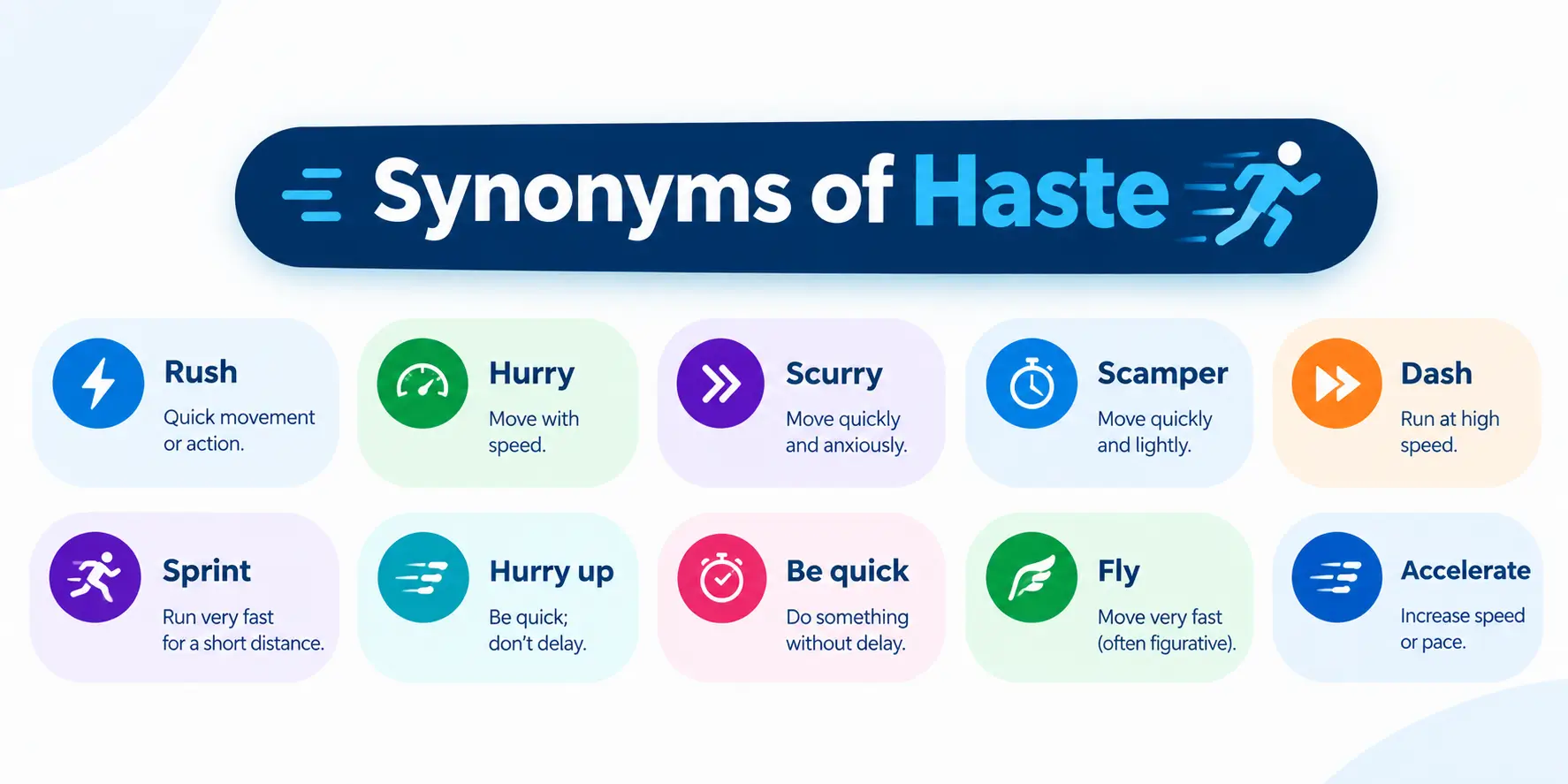
A haste synonym is a word that means acting or moving with speed, urgency, or a rush. Common alternatives include hurry, rush, speed, quickness, and swiftness. People look for a haste synonym while writing, texting, or solving a crossword, so they don’t repeat the same word twice in one sentence.
Key Takeaways
- Haste means quick, often urgent, action or movement.
- The most common haste synonyms are hurry, rush, speed, and swiftness.
- Haste comes from Old French and older Germanic roots, not internet slang.
- English speakers have used haste since the late 1200s.
- The tone shifts with context — haste can sound neutral, positive, or careless.
- Writers, students, and crossword fans all search for this word regularly.
Introduction
Some words show up in searches for a simple reason: people need a fresh way to say something. That’s exactly why “haste synonym” gets typed into Google so often. A student writing an essay wants to avoid repeating “haste” five times. A crossword fan is stuck on a clue. Someone texting a friend wants a word that sounds a little more natural.
Unlike most terms on this site, haste synonym isn’t slang. It’s a standard English word with a long history, still used in books, news articles, and everyday speech. So it earns a spot here because language lovers, writers, and puzzle solvers all need clear, accurate answers about it.
Is it still used today? Absolutely. You’ll spot it in formal writing, in idioms like “act in haste,” and in classic sayings such as “haste makes waste.” It hasn’t faded the way some old words have. Instead, it stays useful because urgency never goes out of style. This guide covers the full meaning, its background, and dozens of real examples so you never need to look elsewhere.
What Does Haste Synonym Mean? {#what-does-haste-synonym-mean}
A haste synonym is simply another word for haste — quick movement, urgent action, or a rush to get something done. It’s used when someone wants variety in their writing or speech.
Haste itself works as a noun and, in older or poetic English, as a verb. As a noun, it describes speed or urgency: “She finished the report in haste.” As a verb, it’s mostly archaic now, replaced by “hasten” in modern English.
The word can carry two shades of meaning. Sometimes it’s neutral or positive, describing simple speed. Other times it leans negative, suggesting carelessness or rushing without thinking things through. Context decides which meaning applies.
For example, “He packed in haste before his flight” sounds practical. However, “He made the decision in haste” hints at a mistake. Because of that flexibility, a haste synonym can shift tone depending on which word you pick.
Quick Meaning Box
| Meaning | Simple Explanation |
| Speed or swiftness | Moving or acting quickly |
| Urgency | A pressing need to act fast |
| Rashness | Acting too fast without thinking |
Haste Pronunciation
Haste is pronounced /heɪst/, rhyming with “paste” or “waste.” It’s a single syllable, so there’s no tricky stress pattern to remember.
Say it like this: “hayst.” The vowel sound is a long A, similar to the word “ace.” Once you hear it once, it’s easy to say correctly every time.
Where Does Haste Synonym Come From? {#where-does-haste-come-from}
Haste entered English in the late 1200s, borrowed from Old French haste, which meant urgency or hastiness. That French word likely traces back further to a Frankish term connected to violence or conflict, and beyond that, to an older Germanic root tied to strife.
So the word’s roots are not really about speed at first. Instead, they lean toward intensity and force. Over time, English speakers narrowed the meaning toward quickness and urgency, which is the sense we use today.
The exact path from “violence” to “quick action” isn’t fully documented in every detail, so some nuance is unclear. Still, the Old French and Germanic connection is well established by language historians and dictionaries.
History of the Term
Early Use in English
By the late 1200s, haste was already being used in English to mean speed or urgency. Soon after, around 1300, it also picked up the sense of “need for quick action.” This early flexibility is part of why the word has lasted so long.
“Make Haste” and Old Idioms
The phrase “make haste,” meaning to act quickly, shows up in English records by the 1530s. This idiom became common in formal and literary writing, and it still appears occasionally in modern English, especially in older-sounding or dramatic phrasing.
By the late 1300s, haste also picked up a more negative shade: rashness or unwise speed. That’s where phrases like “haste makes waste” come from, warning against rushing without care.
Haste in Modern English
Today, haste is less common in casual speech but still very present in writing. News headlines, formal letters, and literature use it often. Meanwhile, its cousin “hasty” (meaning rushed or rash) shows up more in everyday conversation.
How People Use It Today
Haste isn’t really social media slang, so you won’t find it trending on TikTok or Twitch. Instead, it shows up in formal writing, business communication, and everyday phrases like “in haste” or “without haste.”
People still use it in emails when they want to sound urgent but professional: “Please respond with haste.” It also appears in fiction, journalism, and legal writing, where precise, slightly formal language fits the tone.
On texting apps or casual chats, most people reach for simpler words like “hurry” or “rush” instead. Still, haste survives because it sounds a bit more polished, which makes it useful in specific situations.
Haste Meaning
At its core, haste means speed paired with urgency. It’s the feeling of needing to act now, not later. That urgency can come from a deadline, an emergency, or simple impatience.
The word also captures a subtle warning. Because haste can slide into rashness, it often reminds us that fast isn’t always smart. So when someone says “don’t act in haste,” they’re really saying: slow down and think first.
Haste Part of Speech
Haste primarily functions as a noun in modern English: “He left in haste.” It refers to the quality or state of hurrying.
As a verb, haste is archaic. Centuries ago, people said “he hastes to leave,” but that usage faded, replaced almost entirely by “hasten.” You’ll rarely see haste used as a verb outside of old poetry or literature.
Related forms include the adjective “hasty” and the adverb “hastily,” both of which are far more common in everyday speech than the verb form of haste itself.
Haste Sentence
Seeing haste in context makes it easier to use naturally. Here are a few clear examples:
- She packed her bags in haste before the storm hit.
- There’s no need for haste; we have plenty of time.
- He spoke in haste and instantly regretted his words.
- The team worked with haste to meet the deadline.
- In her haste, she forgot her keys on the counter.
Haste Synonyms and Antonyms
Choosing the right haste synonym depends on tone. Some words feel neutral, some feel urgent, and others hint at carelessness.
| Word | Type | Feel |
| Hurry | Synonym | Neutral, everyday |
| Rush | Synonym | Urgent, energetic |
| Speed | Synonym | Neutral, factual |
| Swiftness | Synonym | Formal, elegant |
| Urgency | Synonym | Serious, pressing |
| Recklessness | Near-synonym | Negative, careless |
| Delay | Antonym | Opposite meaning |
| Patience | Antonym | Opposite meaning |
| Leisure | Antonym | Opposite meaning |
With Great Haste Synonyms
The phrase “with great haste” often shows up in formal or dramatic writing. If you need alternatives, try: “with all speed,” “in a great hurry,” “posthaste,” “without delay,” or “at breakneck speed.”
Each option shifts the tone slightly. “Posthaste” sounds old-fashioned and formal, while “at breakneck speed” feels more vivid and modern. Pick based on how dramatic or formal your writing needs to be.
Haste Synonym Crossword
Crossword puzzles often clue haste with short synonym answers. Common crossword answers include HURRY, RUSH, SPEED, and DISPATCH.
If the clue mentions “unnecessary haste” or “rashness,” the answer might instead be HURRY, RASH, or even SPEED, depending on letter count. Always check the number of letters the puzzle requires before locking in an answer.
Examples in Everyday Conversation
- “Why the haste? We still have an hour left.”
- “I finished dinner in haste before the movie started.”
- “Don’t rush — there’s no reason for haste tonight.”
- “She spoke with such haste, I barely understood her.”
- “In his haste, he left the oven on.”
- “We packed the car in haste before the trip.”
- “His haste led to a few careless mistakes.”
- “There’s real haste in getting this contract signed.”
- “Act with haste, but don’t forget to double-check.”
- “Her haste to leave surprised everyone at the party.”
Text Message Examples
- “no time to explain, gotta go in haste 😅”
- “sending this in haste, sorry for typos”
- “why the sudden haste? everything ok?”
- “packed in haste, forgot my charger lol”
- “replying in haste before my meeting starts”
- “no need to act in haste, we’re early”
- “left in such haste I forgot my jacket”
- “haste makes waste, slow down a sec”
- “wrote that email in haste, might’ve sounded rude”
- “moving with haste, be there in 5”
Social Media Caption Examples
- Instagram: “Life moves fast, but I refuse to live in haste. 🌿”
- TikTok: “POV: you did everything in haste and now regret it 😩”
- X (Twitter): “Haste got me here faster, but not smarter.”
- Threads: “Slowing down after a week of pure haste.”
- Facebook: “Packed for vacation in haste — wish me luck!”
- Instagram: “No haste, no rush, just a slow Sunday morning.”
- TikTok: “When you reply in haste and immediately regret it 💀”
- X (Twitter): “Some decisions shouldn’t be made in haste.”
- Facebook: “Grateful I didn’t act in haste on that offer.”
- Threads: “Haste vs. patience: guess which one won today.”
Is It Positive or Negative?
Haste can swing either way, so context matters most. When it simply means speed, it feels neutral or even efficient. However, when it implies rushing without thought, it turns negative.
For instance, “she finished with impressive haste” sounds like a compliment. On the other hand, “he acted in reckless haste” clearly criticizes the decision. So haste isn’t inherently good or bad; the surrounding words shape the tone.
Misunderstandings can happen if tone isn’t clear. Someone might read “in haste” as an insult when it was meant as a simple observation about speed. Adding context helps avoid confusion.
Who Uses This Word?
Haste appears across many groups, though it leans slightly formal. Writers, journalists, and professionals use it often in emails, articles, and reports. Meanwhile, teens and casual texters usually prefer simpler synonyms like “hurry” or “rush.”
Older generations and readers of classic literature encounter haste frequently, since it appears throughout centuries of English writing. Gamers and social media users still use it occasionally, but mostly for dramatic or humorous effect rather than everyday chat.
Haste Antonyms
Antonyms help highlight what haste is not. Here are common opposite words, each explained briefly:
- Delay – putting something off instead of acting quickly
- Patience – calmly waiting without rushing
- Leisure – relaxed, unhurried time
- Calmness – acting steadily, without urgency
- Deliberation – careful, thoughtful action instead of rushing
Common Mistakes
People sometimes misuse haste in a few predictable ways. Below are the most frequent slip-ups.
- Confusing “haste” with “hastiness” — they’re related, but hastiness leans more toward the negative, rash side of the meaning.
- Using haste as a verb in modern writing (“he hastes home”) instead of the correct modern form, “he hastens home.”
- Misspelling it as “hast” or “hasty” when the noun form is intended.
- Assuming haste is slang — it’s a standard dictionary word with centuries of formal use.
When NOT to Use It
Haste can sound overly formal or even judgmental in the wrong setting, so it’s worth knowing when to skip it. In casual texting, simpler words like “hurry” usually fit better and feel more natural.
In professional emails, be careful with phrasing like “please respond with haste,” since it can come across as demanding rather than polite. A softer alternative, such as “please respond promptly,” often lands better.
In academic or school writing, overusing haste (or repeating it too often) can feel stiff. Mixing in synonyms keeps the tone natural and readable.
Fun Facts
- Haste has been part of English since the late 1200s, making it centuries old.
- The word likely traces back to a root meaning “violence” or “strife,” not speed.
- “Make haste” has been recorded in English since the 1530s.
- The proverb “haste makes waste” warns against rushing carelessly.
- Haste as a verb is now archaic, replaced almost entirely by “hasten.”
- The adjective “hasty” is far more common in casual speech than “haste” itself.
Frequently Asked Questions
What are 5 synonym words for haste? Five solid haste synonyms are hurry, rush, speed, swiftness, and urgency. Each one works a little differently depending on tone. “Hurry” feels casual and everyday, while “swiftness” sounds more formal or literary. “Rush” carries energy and urgency, and “speed” stays neutral and factual. “Urgency” leans toward the pressing, time-sensitive side of haste. Picking the right one depends on whether you want a formal, casual, or dramatic tone in your sentence.
What is another word for hasty? Common alternatives for “hasty” include rushed, hurried, quick, impulsive, and rash. “Rushed” and “hurried” describe speed without much judgment attached. “Impulsive” and “rash,” on the other hand, hint at poor judgment or acting without thinking things through. So the right synonym depends on whether you want a neutral description of speed or a criticism of a quick, unwise decision.
What is another word for “hasten”? Good alternatives for “hasten” include hurry, speed up, quicken, expedite, and accelerate. “Hurry” and “speed up” sound casual and fit everyday speech. “Expedite” and “accelerate” feel more formal, often used in business or technical writing. “Quicken” leans slightly poetic or old-fashioned. Since “hasten” itself is a bit formal, most of its close synonyms share that same polished, purposeful tone.
What does “haste” mean? Haste means speed or urgency, especially the need to act or move quickly. It can describe simple swiftness, like finishing a task fast, or it can suggest rushing without enough care or thought. The tone depends on context: “she worked with haste” sounds efficient, while “he decided in haste” suggests a possible mistake. Haste has existed in English since the late 1200s and remains common in formal and literary writing today.
Is haste a positive or negative word? Haste itself is neutral — it simply means speed or urgency. Whether it feels positive or negative depends entirely on the sentence around it. Paired with words like “efficient” or “impressive,” it sounds like a compliment. Paired with “reckless” or “careless,” it clearly criticizes a decision. This flexibility is part of why writers still choose haste over simpler words like “hurry.”
Final Thoughts
Haste has stuck around in English for over 700 years, and it’s not going anywhere soon. It’s not slang, but it’s still a word worth understanding well, especially if you write often or love word puzzles.
Whether you need a formal alternative for an email, a fresh word for an essay, or the missing answer in a crossword, this guide covers every angle. From its Old French roots to modern texting habits, haste remains flexible, useful, and easy to swap out once you know your options.
Next time you reach for “hurry” or “rush,” remember there’s a whole family of words ready to match your tone exactly.

Ryan is a content writer focused on creating informative and well-structured articles for LexoraHubs readers.