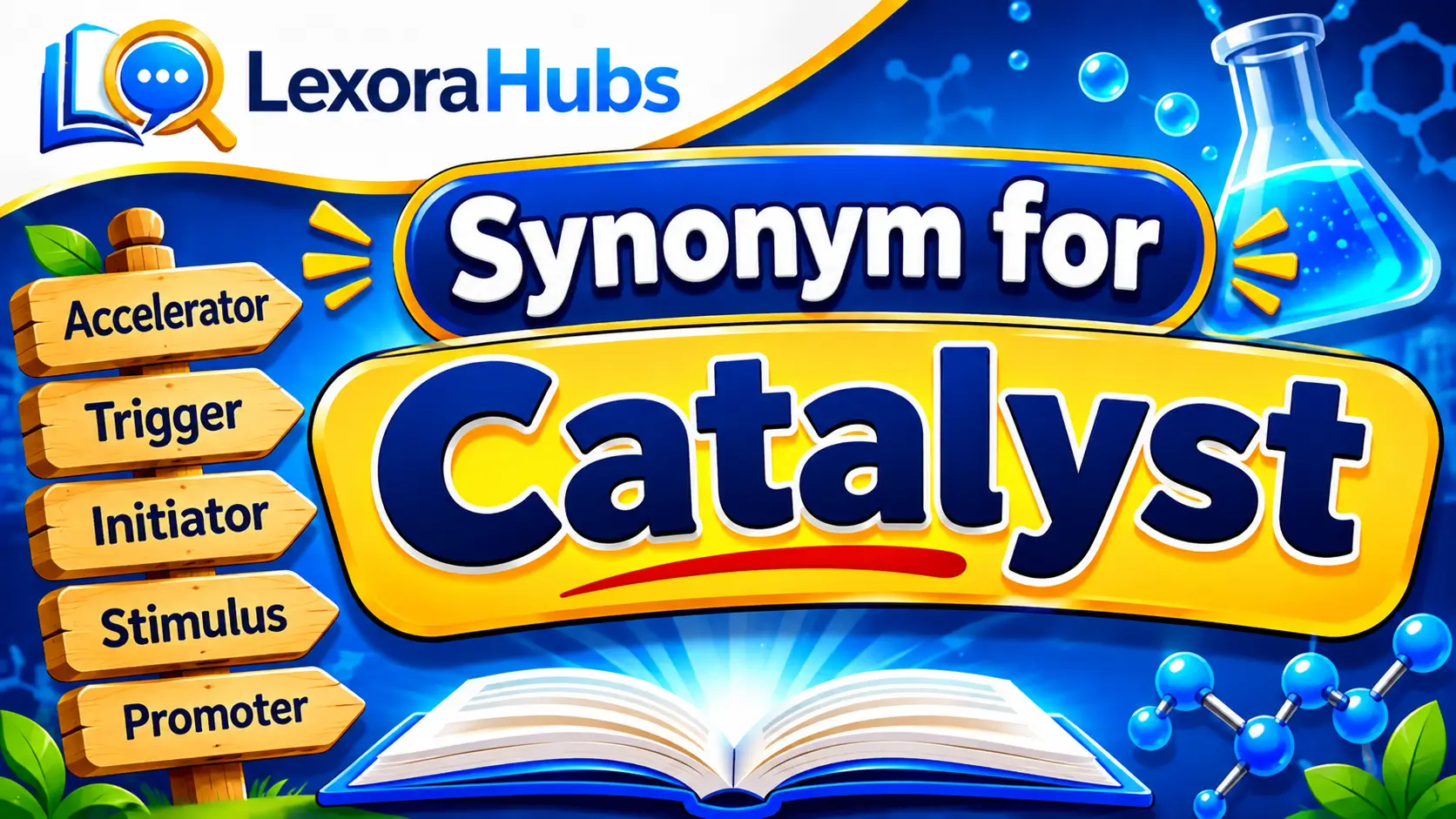
A synonym for catalyst includes trigger, stimulus, driving force, spark, impetus, instigator, accelerator, and motivator. These words describe something or someone that causes an event, encourages change, or makes a process happen. However, they do not always mean exactly the same thing. Some emphasize the beginning of an event, while others focus on motivation, progress, or transformation.
This guide explains the most useful alternatives to catalyst, their meanings, differences, and examples. As a result, you can choose the right word for your sentence and tone.
What Does Catalyst Mean?
A catalyst is a person, event, situation, or substance that causes or encourages an important change or speeds up a process without necessarily being changed itself.
Example: The new company policy became a catalyst for positive workplace changes.
The word is commonly used in everyday conversations, business, science, education, and social discussions. In chemistry, a catalyst is a substance that increases the speed of a chemical reaction without being consumed by it. In everyday English, it often describes something that inspires action or creates change.
Quick Answer: Synonyms of Catalyst
| Synonym | Meaning | Best Used For |
|---|---|---|
| Trigger | Something that causes an event | Starting a reaction |
| Stimulus | Something that encourages activity | Motivation and response |
| Impetus | A force that encourages action | Progress and development |
| Spark | Something that starts interest or change | Inspiration and creativity |
| Driving force | Something that strongly influences progress | Major changes |
| Instigator | Someone or something that initiates an event | Starting an action |
| Accelerator | Something that increases speed | Faster progress |
| Motivator | Someone or something that encourages action | Personal development |
| Incentive | Something that encourages someone to act | Rewards and motivation |
| Impulse | A sudden urge or influence | Immediate action |
10 Best Synonyms for Catalyst With Examples
1. Trigger
A trigger is something that causes a particular event, reaction, or response to happen. Unlike catalyst, which can describe gradual progress, trigger often emphasizes the immediate beginning of something.
Example:
- The unexpected announcement was the trigger for widespread discussion.
- Financial difficulties became the trigger for major changes in the company.
Tone and Usage: Common in everyday English, psychology, business, and discussions about cause and effect.
Catalyst vs. Trigger: A catalyst encourages or speeds up change, while a trigger specifically sets something off.
2. Stimulus
A stimulus is something that encourages a response, activity, or development. It is especially useful when discussing motivation, learning, economic growth, or biological reactions.
Example:
- Positive feedback provided a stimulus for better performance.
- The new investment created a stimulus for economic development.
Tone and Usage: Formal and academic, particularly useful in scientific and professional writing.
Catalyst vs. Stimulus: A catalyst helps bring about change, while a stimulus encourages a particular response or activity.
3. Impetus
Impetus means a force, reason, or influence that encourages someone to take action or move forward. It often suggests the motivation behind progress or a new initiative.
Example:
- Her teacher’s encouragement gave her the impetus to pursue higher education.
- The growing demand provided the impetus for expanding the business.
Tone and Usage: Formal and professional, especially suitable for academic and business writing.
Catalyst vs. Impetus: A catalyst causes or accelerates change, whereas impetus emphasizes the motivation behind taking action.
4. Spark
A spark is something that starts an activity, idea, emotion, or significant change. It often suggests a small beginning that leads to something much bigger.
Example:
- One inspiring conversation was the spark behind their new project.
- The documentary provided a spark for public interest in environmental protection.
Tone and Usage: Informal, expressive, and slightly creative. It works well in storytelling and everyday communication.
Catalyst vs. Spark: A catalyst can influence an entire process, while a spark usually describes the initial moment of inspiration or change.
5. Driving Force
A driving force is a person, idea, or influence that strongly pushes something forward. It emphasizes the power behind continued action or development.
Example:
- Education remains a driving force behind social progress.
- Her determination was the driving force behind the successful campaign.
Tone and Usage: Professional and conversational. It is particularly useful in leadership, business, and social discussions.
Catalyst vs. Driving Force: A catalyst initiates or accelerates change, while a driving force sustains or strongly influences progress.
6. Instigator
An instigator is a person or thing that causes an action, event, or situation to begin. Unlike catalyst, it can carry a negative meaning when referring to someone who deliberately starts trouble.
Example:
- The manager was the instigator of the company’s new improvement program.
- Investigators identified the instigator of the workplace dispute.
Tone and Usage: Neutral in some contexts but often negative when associated with conflict or trouble.
Catalyst vs. Instigator: A catalyst can encourage positive or neutral change, while an instigator often refers to someone who deliberately initiates an action.
7. Accelerator
An accelerator is something that makes a process, activity, or development happen faster. It is a useful alternative when the main idea involves increasing speed rather than starting something new.
Example:
- Modern technology became an accelerator of business growth.
- Additional funding acted as an accelerator for the research project.
Tone and Usage: Professional and technical, particularly common in business, technology, and science.
Catalyst vs. Accelerator: A catalyst can initiate or encourage change, while an accelerator specifically emphasizes increased speed.
8. Motivator
A motivator is a person, factor, or influence that encourages someone to work toward a goal. It focuses more on personal encouragement than on causing a broader transformation.
Example:
- Recognition became an important motivator for the employees.
- Her desire to help others was a powerful motivator throughout her career.
Tone and Usage: Friendly, positive, and suitable for everyday, educational, and professional writing.
Catalyst vs. Motivator: A catalyst produces or accelerates change, while a motivator encourages someone to take action.
9. Incentive
An incentive is something that encourages a person to do something, often through a reward, benefit, or opportunity. It is particularly useful when explaining why someone chooses to act.
Example:
- The company offered financial incentives to encourage better performance.
- Lower prices provided an incentive for customers to try the new product.
Tone and Usage: Formal and professional, especially in business, economics, and workplace communication.
Catalyst vs. Incentive: A catalyst helps bring about change, while an incentive gives someone a reason to take action.
10. Impulse
An impulse is a sudden feeling, desire, or influence that encourages someone to act. It often describes an immediate personal reaction rather than a long-term process of change.
Example:
- On an impulse, she decided to start her own business.
- A sudden impulse led him to volunteer for the community project.
Tone and Usage: Common in everyday English and psychology. It can suggest spontaneous or emotional behavior.
Catalyst vs. Impulse: A catalyst can create lasting change, while an impulse usually describes a sudden urge to act.
Synonyms of Catalyst in Different Contexts
The best synonym for catalyst depends on what kind of change or influence you want to describe. Here are three useful contexts.
1. Catalyst as Something That Starts Change
When catalyst describes something that begins an event or creates a new situation, choose words that emphasize initiation.
Use:
- Trigger
- Spark
- Instigator
- Initiator
- Starting point
Example: The community meeting was a catalyst for neighborhood improvements.
Alternative rewrites:
- The community meeting was the trigger for neighborhood improvements.
- The community meeting provided the spark for neighborhood improvements.
2. Catalyst as Something That Encourages Progress
When discussing development, motivation, or improvement, choose words that emphasize encouragement and forward movement.
Use:
- Impetus
- Stimulus
- Motivator
- Incentive
- Driving force
Example: Government support became a catalyst for local economic growth.
Alternative rewrites:
- Government support provided the impetus for local economic growth.
- Government support became a driving force behind local economic growth.
3. Catalyst as Something That Speeds Up a Process
When catalyst refers to making something happen faster, use words that highlight acceleration or increased activity.
Use:
- Accelerator
- Facilitator
- Boost
- Enabler
- Stimulant
Example: Digital technology became a catalyst for faster communication.
Alternative rewrites:
- Digital technology became an accelerator of communication.
- Digital technology gave communication a significant boost.
Catalyst vs. Closest Synonyms
Understanding the differences between similar words helps you avoid choosing an alternative that changes your intended meaning.
Catalyst vs. Trigger
Both words describe something that causes an event or reaction. However, trigger focuses on the immediate cause, while catalyst can describe a broader influence that encourages lasting change.
- Catalyst: The new leadership became a catalyst for organizational improvement.
- Trigger: The unexpected resignation was the trigger for an internal investigation.
Catalyst vs. Impetus
Both words relate to action and progress. However, impetus emphasizes the motivation or force behind an action, while catalyst describes something that brings about change.
- Catalyst: The new technology was a catalyst for innovation.
- Impetus: Customer demand provided the impetus for developing new technology.
Catalyst vs. Spark
Both can describe the beginning of something important. However, spark often suggests a small initial event that creates excitement or inspiration.
- Catalyst: The new regulations became a catalyst for industry-wide reform.
- Spark: The teacher’s question was the spark that inspired the student’s research.
Catalyst vs. Driving Force
Both describe influences behind change. However, driving force usually emphasizes continued influence, while catalyst often highlights the beginning or acceleration of change.
- Catalyst: The new investment acted as a catalyst for expansion.
- Driving force: Strong leadership remained the driving force behind expansion.
Formal Synonyms for Catalyst
In academic, professional, and business writing, certain alternatives can make your sentences more precise.
- Impetus: A force that encourages action or progress.
- Stimulus: Something that encourages a response or activity.
- Precipitant: Something that directly causes an event to happen.
- Instigator: A person or thing that initiates an action.
- Accelerator: Something that increases the speed of a process.
- Driving force: A powerful influence behind development.
- Initiator: Someone or something that begins an activity.
- Facilitator: Something or someone that makes a process easier.
Not all these words are exact synonyms, so consider the intended meaning and context before using them.
Simple Synonyms for Catalyst
If you want an easy, everyday alternative, these words are useful:
- Trigger
- Spark
- Push
- Boost
- Cause
- Motivation
These simple words work well in conversations, emails, and general writing. However, each has a slightly different meaning.
Positive Words Related to Catalyst
When catalyst describes something that creates beneficial change, these positive words and expressions can communicate the idea effectively.
- Inspiration
- Encouragement
- Motivation
- Opportunity
- Progress
- Innovation
- Improvement
- Transformation
Example: Her leadership became an inspiration and a catalyst for positive change throughout the organization.
Examples of Catalyst in Sentences
Here are ten original sentences using different synonyms and related expressions:
- The new educational program became a trigger for improvements in student performance.
- His encouraging words provided the impetus she needed to start her own company.
- The unexpected discovery was the spark that inspired further scientific research.
- Strong leadership became the driving force behind the organization’s success.
- The new financial policy acted as a stimulus for economic growth.
- The manager was the instigator of several important workplace changes.
- Artificial intelligence has become an accelerator of technological development.
- Personal ambition is a powerful motivator for achieving long-term goals.
- The scholarship served as an incentive for students to pursue higher education.
- The new partnership gave the project a significant boost.
Common Mistakes With Catalyst Synonyms
Using a related word does not always preserve the original meaning. These common mistakes show how to choose more accurate alternatives.
1. Using Trigger When You Mean Ongoing Influence
Less precise: Education was the trigger behind long-term economic development.
Better: Education was a driving force behind long-term economic development.
Explanation: Trigger usually identifies the beginning of an event. Driving force better communicates a continuing influence.
2. Using Incentive When You Mean the Cause of Change
Less precise: The unexpected discovery was an incentive for scientific progress.
Better: The unexpected discovery was a catalyst for scientific progress.
Explanation: An incentive encourages someone to act, often through a reward. A discovery can act as a catalyst by encouraging further development.
3. Using Impulse When You Mean Motivation
Less precise: His career success was driven by a sudden impulse.
Better: His career success was driven by strong motivation.
Explanation: Impulse suggests a sudden urge, while motivation describes a more sustained reason for taking action.
4. Using Spark When You Mean Faster Progress
Less precise: The new software was a spark for faster business operations.
Better: The new software was an accelerator of business operations.
Explanation: Spark emphasizes the beginning of an activity, while accelerator specifically describes something that increases speed.
Related Words to Catalyst
These related words can help expand your vocabulary and improve your understanding of cause, influence, motivation, and change.
- Cause
- Effect
- Reaction
- Influence
- Transformation
- Development
- Innovation
- Progress
- Initiation
- Motivation
- Encouragement
- Stimulation
- Momentum
- Advancement
- Change
Some of these words describe the result of a catalyst rather than the catalyst itself. Therefore, choose them according to the exact meaning of your sentence.
Antonyms of Catalyst
There is no perfect opposite of catalyst because the word describes something that encourages or accelerates change. However, several words express the opposite idea by suggesting inactivity, resistance, or delay.
Common contrasting words include:
- Obstacle: Something that prevents progress.
- Barrier: Something that blocks development or movement.
- Hindrance: Something that makes progress difficult.
- Deterrent: Something that discourages action.
- Inhibitor: Something that slows down or prevents a process.
- Stagnation: A condition in which there is little or no progress.
- Restraint: Something that limits activity or freedom.
Example: Instead of acting as a catalyst for development, the outdated regulations became an obstacle to progress.
FAQs About Synonyms of Catalyst
1. What Is the Closest Synonym for Catalyst?
Trigger is one of the closest everyday synonyms for catalyst because both words describe something that causes an event or change. However, impetus may be more suitable when discussing motivation and progress.
2. What Is Another Word for Catalyst in Life?
In everyday life, words such as inspiration, motivation, turning point, and driving force can describe something that encourages personal growth or change.
3. What Is a Positive Synonym for Catalyst?
Inspiration is a positive alternative when describing something that encourages beneficial action or personal development. Other choices include motivation, encouragement, and stimulus.
4. What Is a Poetic Synonym for Catalyst?
Spark is a poetic and expressive alternative. It often describes a small moment, idea, or experience that inspires something meaningful or creates significant change.
5. Is Catalyst the Same as Trigger?
No. Both words describe something that causes change, but trigger usually emphasizes the immediate beginning of an event. Catalyst can also describe something that encourages gradual development or speeds up an ongoing process.
6. What Is the Opposite of Catalyst?
There is no exact opposite, but obstacle, hindrance, barrier, and inhibitor are useful contrasting words. They describe something that prevents, limits, or slows progress.
Conclusion
Choosing the right synonym for catalyst depends on the message you want to communicate. Words such as trigger, spark, and instigator work well when describing the beginning of an event, while impetus, stimulus, and motivator emphasize encouragement and action. Meanwhile, accelerator and driving force are useful when discussing progress and development.
Before choosing an alternative, consider the context, tone, and exact meaning of your sentence. Understanding these differences will help you use catalyst synonyms more naturally in academic writing, professional communication, and everyday English.

Emily writes simple, useful, and reader-friendly content, helping LexoraHubs provide valuable information to its audience.