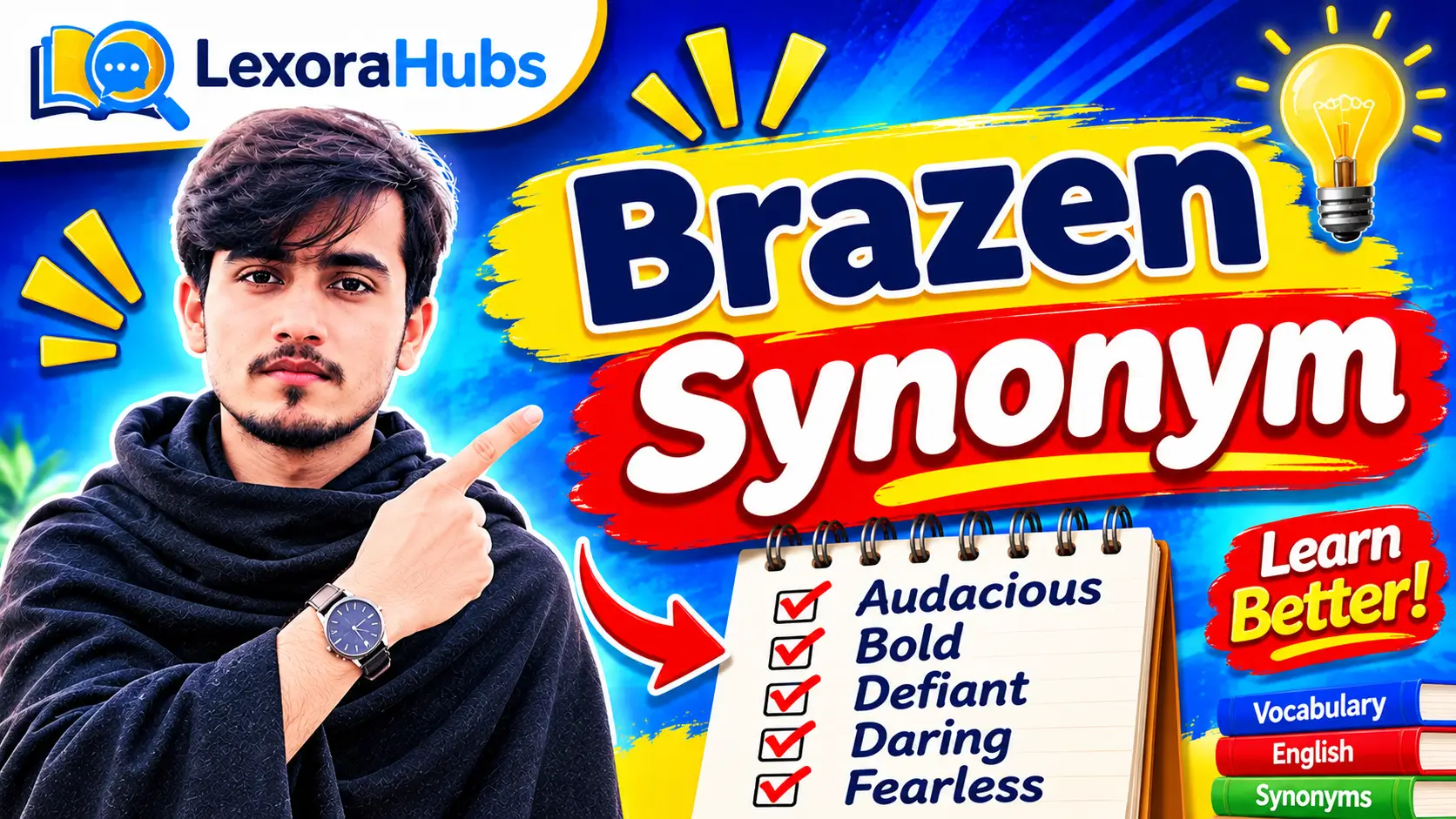
Brazen means bold, shameless, or offensively confident, especially when someone behaves without embarrassment or respect for social rules. The closest synonyms include shameless, audacious, impudent, insolent, and presumptuous. Other useful alternatives include bold, blatant, cheeky, daring, defiant, unapologetic, and forward. However, these expressions have different meanings, so the best choice depends on your context.
For example, shameless describes someone who shows no embarrassment, while audacious emphasizes unusual courage or boldness. Similarly, insolent suggests disrespectful behavior toward someone in authority, whereas blatant describes something openly obvious. This guide explains the closest synonyms, their differences, and how to use them naturally in everyday writing, academic work, and fiction.
Quick Answer: What Are the Synonyms of Brazen?
The closest synonyms of brazen are shameless, audacious, impudent, insolent, and presumptuous. Other context-based alternatives include bold, cheeky, blatant, daring, defiant, unapologetic, and forward.
These words describe different aspects of brazen behavior, such as excessive confidence, disrespect, lack of embarrassment, or open defiance. Therefore, they are not interchangeable in every sentence. Choosing the right alternative helps communicate whether someone is courageous, rude, dishonest, or simply unashamed.
List of Synonyms of Brazen
Brazen can describe a person’s attitude, an openly disrespectful action, or behavior that ignores accepted boundaries. The following alternatives cover its most common meanings and related expressions. As a result, you can quickly identify the word that best expresses your intended meaning.
| Synonym or alternative | Meaning | Best context | Example |
|---|---|---|---|
| Shameless | Showing no embarrassment or guilt | Dishonest or inappropriate behavior | His shameless excuse surprised everyone. |
| Audacious | Extremely bold or daring | Risky decisions and actions | She made an audacious proposal. |
| Impudent | Disrespectfully bold | Rude comments or behavior | The student gave an impudent reply. |
| Insolent | Showing disrespect or arrogance | Authority and formal situations | His insolent tone angered the manager. |
| Presumptuous | Overstepping expected boundaries | Unwelcome assumptions or requests | It was presumptuous to invite himself. |
| Bold | Confident and willing to take risks | General confidence or courage | She made a bold decision. |
| Cheeky | Playfully or disrespectfully bold | Informal conversations | His cheeky remark made us laugh. |
| Blatant | Openly obvious and undisguised | Lies, violations, or misconduct | It was a blatant attempt to deceive us. |
| Daring | Willing to take risks | Adventures and challenging actions | The team attempted a daring rescue. |
| Defiant | Openly resisting authority | Rebellion or opposition | He remained defiant during questioning. |
| Unapologetic | Not expressing regret | Firm attitudes or controversial behavior | She was unapologetic about her decision. |
| Forward | Too confident or familiar in behavior | Social boundaries and manners | His forward approach made her uncomfortable. |
Keep in mind: Shameless, audacious, impudent, and insolent are among the closest alternatives, depending on the intended meaning. However, words such as blatant, daring, and defiant describe particular features of brazen behavior rather than serving as exact replacements in every sentence.
What Does Brazen Mean?
Brazen describes someone or something that is bold, shameless, or offensively confident without showing embarrassment or concern about how others may react. It often suggests that a person ignores social expectations, behaves disrespectfully, or openly does something considered inappropriate.
The word commonly appears in conversations about dishonesty, arrogance, public misconduct, disrespectful attitudes, and surprising acts of confidence. Writers also use it in news reports, political commentary, novels, and everyday discussions to emphasize behavior that seems unusually shameless.
For example:
- The politician made a brazen attempt to avoid answering the reporter’s questions.
- Her brazen attitude shocked everyone at the formal meeting.
- The thief carried out a brazen robbery in broad daylight.
Brazen is primarily an adjective. It describes a person, action, statement, or attitude, while brazenly is its adverb form and brazenness is its noun form. For example, “a brazen decision” describes the decision, “he acted brazenly” describes how he behaved, and “her brazenness surprised everyone” refers to the quality of being brazen.
The Best Synonyms of Brazen Explained
The following words offer different ways to express boldness, shamelessness, disrespect, and excessive confidence. Understanding their distinctions will help you select a natural alternative.
1. Shameless
Meaning: Showing no embarrassment, guilt, or concern about doing something inappropriate.
Shameless is one of the closest synonyms of brazen because both words can describe behavior that ignores social expectations. However, shameless focuses more directly on the absence of embarrassment, while brazen also emphasizes boldness and open confidence.
Best context: Use shameless when describing dishonest behavior, inappropriate actions, or people who refuse to acknowledge wrongdoing.
Example: His shameless attempt to blame someone else made the situation worse.
2. Audacious
Meaning: Extremely bold, daring, or willing to take significant risks.
Audacious often has a positive or admiring meaning, particularly when someone demonstrates courage or originality. However, brazen usually carries a stronger negative suggestion of shamelessness or disrespect.
Best context: Use audacious when discussing ambitious plans, unusual decisions, courageous actions, or impressive risks.
Example: The young entrepreneur presented an audacious plan to transform the company.
3. Impudent
Meaning: Disrespectfully bold, especially toward someone who deserves respect.
Impudent closely resembles brazen when describing rude comments or inappropriate confidence. However, impudent specifically emphasizes poor manners and disrespect, whereas brazen can describe a wider range of shameless behavior.
Best context: Use impudent when writing about disrespectful students, rude employees, or people who challenge authority without proper manners.
Example: The employee made an impudent comment during the manager’s presentation.
4. Insolent
Meaning: Showing open disrespect through arrogant or insulting behavior.
Insolent is a strong alternative when brazen describes someone who openly disrespects another person. Nevertheless, insolent focuses more on disrespectful communication and attitude than on general fearlessness.
Best context: Use insolent in formal writing, workplace situations, school settings, and descriptions of disrespect toward authority.
Example: The customer complained about the employee’s insolent response.
5. Presumptuous
Meaning: Showing excessive confidence by making assumptions or taking liberties without permission.
Presumptuous describes someone who crosses social or personal boundaries because they believe they have the right to do so. However, brazen can describe openly shameless behavior even when no personal boundary has been crossed.
Best context: Use presumptuous when describing inappropriate requests, unwelcome assumptions, or overconfident social behavior.
Example: It was presumptuous of him to make decisions on behalf of the entire team.
6. Bold
Meaning: Showing confidence and a willingness to take risks.
Bold is a broader and often more positive alternative to brazen. Therefore, it works when you want to describe confidence without necessarily suggesting disrespect, shamelessness, or inappropriate behavior.
Best context: Use bold in professional writing, personal development, business discussions, and descriptions of courageous decisions.
Example: She made a bold choice by starting her own business.
7. Cheeky
Meaning: Slightly rude, playful, or disrespectfully confident.
Cheeky can describe behavior that resembles brazen conduct, particularly when someone makes an unexpected or inappropriate remark. However, cheeky is usually more informal and can communicate humor rather than serious disrespect.
Best context: Use cheeky in casual conversations, informal storytelling, entertainment writing, and descriptions of playful rudeness.
Example: His cheeky response made the entire classroom laugh.
8. Blatant
Meaning: Completely obvious, open, and difficult to hide or ignore.
Blatant is useful when brazen describes an openly dishonest or unacceptable action. However, blatant usually describes how obvious something is rather than the personality or attitude of the person responsible.
Best context: Use blatant when discussing lies, discrimination, rule violations, deception, or obvious misconduct.
Example: The investigation revealed a blatant violation of company policy.
9. Defiant
Meaning: Openly resisting authority, instructions, or expectations.
Defiant and brazen can both describe people who refuse to follow accepted rules. Nevertheless, defiant emphasizes resistance and opposition, while brazen emphasizes shameless boldness.
Best context: Use defiant when describing protests, arguments, rebellion, or resistance to authority.
Example: The student remained defiant despite repeated warnings from the principal.
10. Unapologetic
Meaning: Not expressing regret or offering an apology for an opinion, action, or decision.
Unapologetic can replace brazen when the main idea is that someone refuses to feel sorry or change their position. However, it does not necessarily suggest rudeness or inappropriate behavior.
Best context: Use unapologetic in opinion articles, personal essays, interviews, and descriptions of strong personalities.
Example: She remained unapologetic about defending her creative choices.
Extra note: Some alternatives have more specific meanings than brazen. For instance, impudent and insolent emphasize disrespect, while audacious can communicate admirable courage. Similarly, forward is a somewhat old-fashioned or context-dependent choice for someone who behaves too familiarly or aggressively.
Which Synonym of Brazen Should You Use?
The best alternative depends on the specific quality you want to emphasize. Consider the following comparisons before choosing a replacement.
| Your intended meaning | Best choice | Reason |
|---|---|---|
| Showing no embarrassment | Shameless | Emphasizes a lack of guilt or shame |
| Taking an unusually bold risk | Audacious | Highlights courage and daring |
| Speaking disrespectfully | Impudent | Communicates poor manners |
| Showing arrogance toward authority | Insolent | Emphasizes disrespect |
| Crossing personal boundaries | Presumptuous | Highlights excessive assumptions |
| Demonstrating confidence | Bold | Provides a more neutral meaning |
| Making an obvious violation | Blatant | Emphasizes openness and visibility |
| Refusing to follow authority | Defiant | Highlights resistance |
For general readers, shameless, bold, and audacious are familiar and easy to understand. Academic writing often benefits from precise choices such as impudent, presumptuous, or insolent, while creative writing can use cheeky, defiant, and unapologetic to create a stronger sense of personality.
Choosing Words for Different Writing Situations
Different writing situations require different levels of formality and emotional intensity. Therefore, consider your audience and purpose before replacing brazen with another expression.
1. Literature and Essays
In literature and essays, use audacious, impudent, or insolent when discussing characters who demonstrate unusual confidence or disrespect. Shameless is particularly useful when analyzing characters who refuse to acknowledge their wrongdoing.
2. Creative Writing
Creative writers can use cheeky, defiant, or unapologetic to create distinct personalities and memorable dialogue. Similarly, presumptuous works well when a character crosses another person’s boundaries or makes inappropriate assumptions.
3. Formal or Political and Professional Analysis
In professional and political writing, blatant, audacious, and presumptuous can communicate misconduct, controversial decisions, or excessive confidence. However, insolent is more appropriate when the discussion specifically concerns disrespectful communication.
4. General and Everyday Situations
For everyday conversations, bold, shameless, and cheeky are accessible alternatives that readers understand easily. By contrast, audacious and impudent may sound more formal or emphatic, depending on the sentence.
Brazen vs. Similar Words
Several English words resemble brazen but communicate different levels of confidence, disrespect, and shamelessness. Understanding these distinctions prevents awkward word choices.
1. Brazen vs. Shameless
Brazen emphasizes bold, openly inappropriate behavior, while shameless focuses on having little or no embarrassment about one’s actions. Both can describe dishonest conduct, but shameless does not always suggest the same level of boldness.
Example: His brazen behavior during the meeting showed how shamelessly he ignored professional standards.
2. Brazen vs. Audacious
Brazen usually suggests shameless confidence or disrespect, whereas audacious emphasizes daring and willingness to take risks. Audacious can be positive, but brazen is more commonly critical.
Example: The company made an audacious investment, while its competitor made a brazen attempt to copy the strategy.
3. Brazen vs. Impudent
Brazen can describe openly shameless actions, while impudent specifically refers to disrespectful or improperly bold behavior. Therefore, impudent is more suitable when the main issue is someone’s rude attitude.
Example: The teenager gave an impudent answer when his teacher asked him to explain his behavior.
4. Brazen vs. Insolent
Both words can describe disrespectful conduct, but insolent places greater emphasis on arrogance and insulting behavior toward another person. Brazen has a broader meaning and can also describe dishonest or openly improper actions.
Example: His brazen refusal to follow the rules was accompanied by an insolent remark to the supervisor.
5. Brazen vs. Bold
Bold generally communicates confidence, courage, or a willingness to accept challenges, whereas brazen often suggests a lack of shame or respect. As a result, bold is usually more appropriate when you want to praise someone’s confidence without criticizing their behavior.
Example: Her bold presentation impressed the audience, but her brazen interruption of the speaker offended several guests.
As a result, these distinctions matter when writing about people, decisions, and actions. A person can be bold without being brazen, but brazen behavior usually involves a stronger sense of shamelessness or inappropriate confidence.
Common Mistakes When Using Brazen Synonyms
Although many alternatives have similar meanings, replacing brazen without considering context can change the message. Avoid these common mistakes to make your writing more accurate.
1. Treating Every Alternative as an Exact Synonym
Words such as bold, daring, and audacious can communicate confidence without suggesting shamelessness. Therefore, using them in every sentence containing brazen may weaken the original meaning.
Better choice: Use shameless or impudent when the sentence specifically describes inappropriate confidence or disrespect.
2. Confusing Audacious With Negative Behavior
Audacious does not always have a negative meaning. It can describe impressive courage, innovation, or ambition, whereas brazen generally carries a critical tone.
Better choice: Use audacious for courageous achievements and brazen for openly shameless conduct.
3. Using Blatant to Describe a Person’s Personality
Blatant generally describes something obvious, such as a lie, violation, or attempt at deception. It does not directly describe someone’s personality in the same way as brazen.
Better choice: Write “a brazen individual” or “a shameless individual” instead of “a blatant individual.”
4. Confusing Cheeky With Seriously Disrespectful
Cheeky often communicates playful rudeness or humorous confidence. However, it may sound too lighthearted when describing serious misconduct or deliberate disrespect.
Better choice: Use insolent or impudent when the behavior is genuinely insulting or disrespectful.
5. Confusing the Noun and Adjective Forms
Brazen is an adjective, brazenly is an adverb, and brazenness is a noun. Using these forms incorrectly can create grammatical problems and make sentences sound unnatural.
Better choice: Match the word form to its role in the sentence.
- Correct: His brazen behavior surprised the entire team.
- Correct: He spoke brazenly during the interview.
- Correct: Her brazenness offended several colleagues.
- Incorrect: His brazenly behavior surprised everyone.
Related Words and Antonyms
Related Words
The following terms are connected to brazen because they describe confidence, disrespect, shamelessness, or unusual behavior. However, they are related concepts rather than direct synonyms.
- Arrogance: An exaggerated sense of one’s importance or abilities.
- Hubris: Excessive pride or self-confidence that can lead to poor decisions.
- Audacity: The quality of being bold, daring, or willing to take risks.
- Impudence: Disrespectful confidence or inappropriate boldness.
- Defiance: Open resistance to authority or accepted rules.
- Presumption: An assumption made without sufficient evidence or permission.
- Shamelessness: A lack of embarrassment or concern about inappropriate conduct.
Antonyms of Brazen
The clearest antonym of brazen is modest, particularly when brazen describes someone who displays excessive confidence or lacks humility. Other contrasting expressions include humble, respectful, timid, and reserved.
However, these words are not exact substitutes in every sentence because brazen can describe different qualities, including boldness, shamelessness, and disrespect.
Example: Unlike her brazen colleague, Maria remained modest and respectful during the discussion.
Frequently Asked Questions
1. What Is the Closest Synonym of Brazen?
Shameless is one of the closest synonyms of brazen because both describe behavior that shows little or no embarrassment. However, audacious, impudent, and insolent may be more suitable when the context emphasizes boldness or disrespect.
2. What Is Another Word for Brazenness?
Another word for brazenness is shamelessness, which describes a lack of embarrassment or guilt about inappropriate behavior. Impudence and audacity are also related alternatives, depending on the intended meaning.
3. Is Audacious the Same as Brazen?
No, audacious and brazen are similar but not identical. Audacious often describes impressive courage or willingness to take risks, while brazen usually suggests shamelessness or disrespectful confidence.
4. Is Blatant a Synonym for Brazen?
Blatant can work as a contextual alternative when brazen describes something openly dishonest or inappropriate. However, blatant emphasizes how obvious an action is rather than how shameless or confident someone behaves.
5. What Is the Opposite of Brazen?
Modest is one of the clearest opposites of brazen when describing excessive confidence or a lack of humility. Humble, respectful, reserved, and timid are other contrasting words, depending on the situation.
6. Can I Use Bold Instead of Brazen?
Yes, bold can replace brazen when you want to describe confidence, courage, or willingness to take risks. However, bold is generally more positive and neutral, so it may not communicate the shamelessness or disrespect implied by brazen.
7. What Is the Difference Between Brazen and Brazenness?
Brazen is an adjective used to describe a person, action, or attitude, while brazenness is the noun that identifies the quality of being brazen. For example, “His brazen behavior was surprising” uses the adjective, while “His brazenness surprised everyone” uses the noun.
Conclusion
The closest synonyms of brazen include shameless, audacious, impudent, insolent, and presumptuous. Other useful alternatives include bold, cheeky, blatant, daring, defiant, and unapologetic. Each word expresses a slightly different quality, making context important when selecting the right replacement.
For literary writing, consider impudent or shameless when describing inappropriate behavior and audacious when emphasizing courage. In political or professional discussions, blatant and presumptuous can communicate misconduct or excessive confidence, while cheeky and bold work well in everyday descriptions. Ultimately, choosing the right synonym helps you communicate your intended meaning while writing clearly and precisely.

Ryan is a content writer focused on creating informative and well-structured articles for LexoraHubs readers.