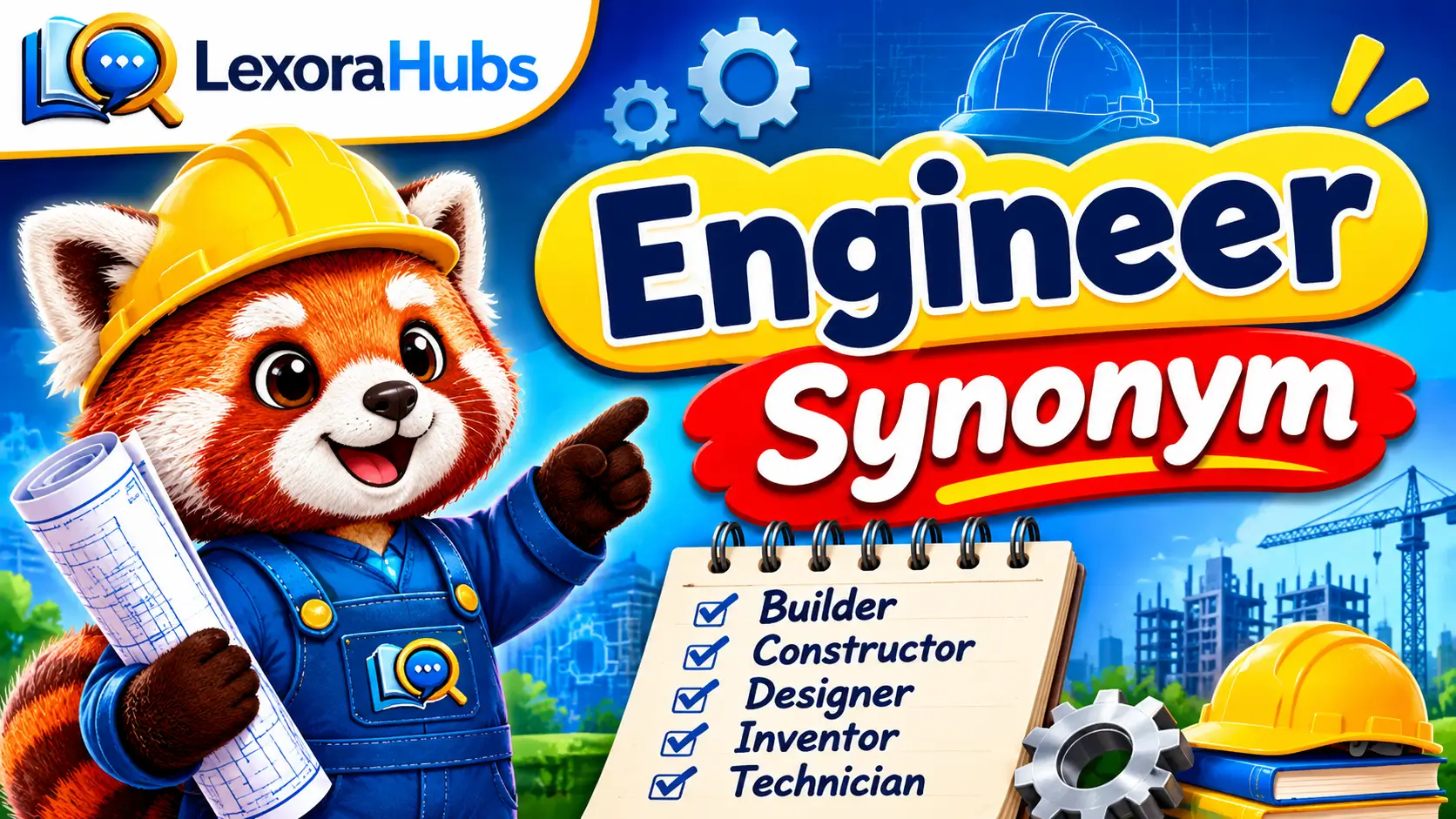
An engineer is a person who applies scientific knowledge, mathematics, and technical skills to design, build, develop, or maintain machines, structures, systems, and other practical solutions. The closest synonyms include designer, developer, technician, constructor, and technical specialist, while other useful alternatives include inventor, builder, architect, problem-solver, and engineering professional. However, these expressions have different meanings, so the best choice depends on your context.
For example, a designer develops plans for a product or structure, while a technician usually works with equipment, testing, installation, or maintenance. Similarly, a developer creates systems, products, or software, whereas an engineer may be responsible for designing and improving the entire technical solution. This guide explains the closest synonyms, their differences, and how to use them naturally in everyday writing, academic work, and fiction.
Quick Answer: What Are the Synonyms of Engineer?
The closest synonyms of engineer include designer, technical specialist, engineering professional, and constructor. These words describe people who use technical knowledge to design, develop, or build practical solutions.
Other context-based alternatives include developer, inventor, technician, builder, architect, and problem-solver. Some alternatives describe particular engineering responsibilities rather than the entire profession. Therefore, they are not interchangeable in every sentence.
List of Synonyms of Engineer
Different words can describe an engineer depending on their specialization, responsibilities, and professional environment. The following alternatives cover technical work, creative design, construction, and problem-solving. As a result, you can quickly identify the word that best expresses your intended meaning.
| Synonym or alternative | Meaning | Best context | Example |
|---|---|---|---|
| Designer | Someone who plans how something will look or function | Product and system design | The designer developed a more efficient machine. |
| Developer | Someone who creates or improves products and systems | Software and technology | The developer created a new monitoring system. |
| Technician | A trained person who operates or maintains technical equipment | Practical technical work | The technician repaired the laboratory equipment. |
| Constructor | Someone who builds or assembles structures | Construction and infrastructure | The constructor completed the bridge project. |
| Technical specialist | Someone with advanced knowledge in a technical field | Professional and formal writing | The technical specialist evaluated the new equipment. |
| Builder | Someone who constructs buildings or other physical structures | Construction | The builder followed the engineer’s structural plans. |
| Inventor | Someone who creates a new device, process, or technology | Innovation and research | The inventor developed an energy-saving device. |
| Architect | Someone who plans and designs buildings or systems | Architecture and software | The architect prepared the building’s design. |
| Problem-solver | Someone who identifies problems and develops solutions | General and professional writing | The engineer became a valuable problem-solver. |
| Engineering professional | Someone qualified or employed in engineering | Formal and academic writing | Every engineering professional must understand safety standards. |
| Fabricator | Someone who makes products or components from materials | Manufacturing and metalworking | The fabricator produced the custom steel components. |
| Systems specialist | Someone who works with complex technical systems | IT and systems engineering | The systems specialist improved network performance. |
Keep in mind: Designer, technical specialist, and engineering professional are among the closest alternatives when describing an engineer’s professional role. However, technician, builder, inventor, and fabricator describe particular responsibilities or skills. An inventor creates something new, while a technician often installs, tests, or maintains existing equipment. Therefore, choose an alternative that accurately reflects the person’s actual work.
What Does Engineer Mean?
An engineer is a professional who uses scientific principles, mathematics, and technical knowledge to develop, design, test, and improve products, structures, machines, or systems. Engineers typically combine analytical thinking, creativity, and practical problem-solving to address real-world challenges.
The word commonly appears in discussions about construction, manufacturing, transportation, software development, electronics, environmental protection, and industrial technology. Engineers may specialize in fields such as mechanical, civil, electrical, chemical, or computer engineering.
For example:
- The civil engineer designed a safe and durable highway bridge.
- A software engineer developed an application that helps businesses manage their operations.
- The mechanical engineer improved the factory’s production equipment.
Grammatical forms of engineer:
The word engineer can function as both a noun and a verb. As a noun, it describes a person who works in an engineering profession. For example, “My brother is an electrical engineer.”
As a verb, engineer means to design, develop, arrange, or bring something about through careful planning and technical knowledge. For example, “The research team engineered a more efficient cooling system.”
The adjective engineering describes something connected with the profession or its activities, as in “engineering principles” or “engineering design.” The word engineered is the past tense and past participle of the verb, and it can also describe something deliberately designed or developed.
The Best Synonyms of Engineer Explained
The following ten alternatives explain different meanings associated with the word engineer. Understanding their distinctions will help you select accurate vocabulary for professional, academic, and everyday writing.
1. Designer
Meaning: A person who plans and creates the appearance, structure, or functionality of something.
A designer focuses on developing plans and deciding how a product, structure, or system should work. An engineer may also perform design work, but engineering often involves additional responsibilities such as calculations, testing, safety, and technical implementation.
However, not every designer has engineering qualifications. Therefore, use this word when the main responsibility involves planning or creating a design.
Best context: Product development, architecture, technology, and creative industries.
Example: The designer created an innovative structure that reduced material waste.
2. Developer
Meaning: A person who creates, builds, or improves products, systems, or applications.
A developer works on turning ideas into functional products or solutions. This term is particularly common in software development, technology, and product development.
However, developers do not necessarily perform the same technical calculations or engineering responsibilities as engineers. Consequently, this alternative works best when the emphasis is on creating or improving something.
Best context: Software development, technology, research, and product creation.
Example: The developer introduced new features to improve the company’s mobile application.
3. Technician
Meaning: A trained professional who operates, tests, installs, or maintains technical equipment.
A technician generally performs practical technical tasks and supports engineering operations. By contrast, an engineer may be responsible for designing systems, evaluating technical requirements, and making complex decisions.
Nevertheless, experienced technicians can possess substantial technical knowledge. The two professions are valuable but should not be treated as identical.
Best context: Laboratories, manufacturing, equipment maintenance, and technical support.
Example: The technician inspected the electrical equipment before production resumed.
4. Constructor
Meaning: A person or organization responsible for building or assembling structures.
A constructor focuses primarily on the physical construction process. An engineer may prepare structural calculations, technical specifications, and designs, while the constructor carries out construction activities.
Therefore, this word is useful when discussing infrastructure and building projects. However, it does not describe every type of engineer.
Best context: Construction, infrastructure, civil engineering, and building projects.
Example: The constructor completed the commercial building according to the approved plans.
5. Technical Specialist
Meaning: A professional with advanced knowledge and skills in a particular technical area.
A technical specialist may focus on a specific subject, such as electrical systems, computer networks, manufacturing equipment, or industrial processes. Similarly, engineers often develop specialized knowledge within their professional fields.
However, technical specialist is a broader occupational description rather than a specific engineering title. It is particularly useful when the person’s exact professional designation is unknown.
Best context: Corporate communication, technical reports, engineering projects, and professional descriptions.
Example: The technical specialist identified the cause of the equipment failure.
6. Builder
Meaning: A person who constructs buildings, structures, or physical objects.
A builder concentrates on construction and assembling materials to create something useful. By contrast, an engineer may plan the structure, calculate its strength, and ensure that it meets technical and safety requirements.
Therefore, builder is a suitable alternative when referring to hands-on construction. However, it is not an accurate replacement for engineers working in software, electronics, or chemical industries.
Best context: Construction, home improvement, infrastructure, and physical projects.
Example: The builder followed the approved construction drawings to complete the house.
7. Inventor
Meaning: A person who creates a new product, device, method, or technology.
An inventor introduces original ideas and develops new solutions to existing problems. Engineers can also become inventors, but their professional responsibilities often include improving, testing, and maintaining existing systems.
Consequently, inventor is appropriate when highlighting creativity and innovation. However, not every engineer creates something entirely new.
Best context: Scientific discoveries, technological innovation, research, and product development.
Example: The inventor designed a portable device that converts sunlight into electricity.
8. Architect
Meaning: A professional who plans and designs buildings or, in certain fields, complex systems.
An architect develops plans that consider functionality, appearance, structure, and practical requirements. However, architects and engineers have different professional responsibilities, qualifications, and areas of expertise.
For example, a software architect designs the overall structure of a software system, while a software engineer may develop and implement its components. Therefore, this alternative should be used only when the context supports it.
Best context: Building design, software architecture, and system planning.
Example: The architect prepared a detailed plan for the new residential complex.
9. Problem-Solver
Meaning: Someone who identifies challenges and develops practical solutions.
Engineers regularly use analytical thinking and technical knowledge to solve complicated problems. Similarly, a problem-solver can describe someone who approaches challenges creatively and finds effective solutions.
However, problem-solver is a general descriptive expression rather than a formal job title. It works well when emphasizing an engineer’s abilities instead of professional qualifications.
Best context: Professional biographies, workplace descriptions, educational writing, and creative content.
Example: The engineer proved to be an effective problem-solver during the factory upgrade.
10. Engineering Professional
Meaning: A person who works in the engineering profession and applies specialized technical knowledge.
Engineering professional is a broad, formal expression that can describe people working in different engineering disciplines. Unlike narrower alternatives, it does not limit the person’s responsibilities to design, construction, or maintenance.
Nevertheless, this phrase is longer than engineer and may sound unnecessary in ordinary conversation. Use it when a formal or professional tone is appropriate.
Best context: Academic writing, employment documents, industry reports, and professional communication.
Example: Every engineering professional should understand the importance of workplace safety.
A note on rare or tricky alternatives: Constructor and fabricator are more specialized terms than engineer. Similarly, architect can refer to different professional roles depending on the industry. Always consider the person’s qualifications and responsibilities before choosing one of these alternatives.
Which Synonym of Engineer Should You Use?
The best alternative depends on what you want to communicate about someone’s professional responsibilities, technical abilities, or creative contributions.
| Your intended meaning | Best choice | Reason |
|---|---|---|
| Someone who creates technical designs | Designer | Emphasizes planning and design. |
| Someone who develops software | Developer | Commonly describes software creation. |
| Someone who maintains equipment | Technician | Highlights practical technical work. |
| Someone who constructs buildings | Builder | Focuses on physical construction. |
| Someone with specialized technical knowledge | Technical specialist | Emphasizes expertise in a particular field. |
| Someone who creates new technology | Inventor | Highlights originality and innovation. |
| Someone who plans buildings | Architect | Describes architectural design responsibilities. |
| Someone who solves complicated challenges | Problem-solver | Highlights analytical and practical abilities. |
For general readers, designer, developer, and technical specialist are understandable alternatives when their meanings match the situation. Academic writing usually benefits from precise expressions such as engineering professional or systems specialist. Meanwhile, creative writing can use inventor, builder, and problem-solver to describe a character’s abilities more naturally.
Choosing Words for Different Writing Situations
Literature and Essays
In academic essays, use engineering professional, technical specialist, or designer when discussing professional responsibilities. These expressions communicate expertise while helping readers understand the specific role being described.
Creative Writing
In fiction and storytelling, inventor, builder, and problem-solver can make character descriptions more engaging. For example, describing someone as an inventor highlights creativity, while calling someone a builder emphasizes practical construction skills.
Formal or Professional Analysis
Business reports and professional documents benefit from expressions such as systems specialist, developer, and engineering professional. However, use the person’s actual job title whenever possible to avoid confusion about qualifications or responsibilities.
Descriptive and General Scenarios
For everyday descriptions, designer, technician, and developer are useful when they accurately represent someone’s work. Similarly, builder can describe someone involved in construction, while problem-solver highlights a valuable personal or professional skill.
Engineer vs. Similar Words
Several words are closely associated with engineering, but they describe different professional roles and activities. Understanding these distinctions helps prevent inaccurate word choices.
Engineer vs. Technician
An engineer typically designs, develops, evaluates, or improves technical systems, while a technician generally installs, operates, tests, or maintains equipment. However, both professionals may work together on the same technical project.
Example: The engineer designed the electrical system, while the technician installed and tested its components.
Engineer vs. Designer
A designer focuses on planning the appearance, structure, or functionality of a product or system. By contrast, an engineer also considers technical feasibility, calculations, performance, and safety requirements.
Example: The designer prepared the product concept, and the engineer evaluated its technical requirements.
Engineer vs. Developer
A developer creates or improves products, software, or systems, whereas an engineer may also evaluate their technical architecture, performance, and reliability. Nevertheless, the responsibilities can overlap, particularly in software engineering.
Example: The developer created the application, while the software engineer reviewed its performance and architecture.
Engineer vs. Architect
An architect specializes in planning and designing buildings or complex systems, depending on the profession. An engineer focuses more broadly on technical design, calculations, implementation, and system performance.
Example: The architect planned the office building, while the structural engineer calculated its load-bearing requirements.
Engineer vs. Inventor
An inventor creates an original device, process, or technology, while an engineer may design, test, improve, or manufacture existing products. However, an engineer can also be an inventor when developing an original solution.
Example: The inventor introduced a new machine, and the engineer improved its efficiency for commercial production.
As a result, these words should be selected according to the activity being described rather than treated as direct replacements for one another.
Common Mistakes When Using Engineer Synonyms
Choosing an alternative without considering its meaning can make a sentence confusing or professionally inaccurate. Here are five common mistakes to avoid.
1. Treating Technician as an Exact Synonym
A technician and an engineer may work in the same industry, but their responsibilities are not necessarily identical. A technician often handles practical equipment-related tasks, while an engineer may design and evaluate technical systems.
Better choice: Use engineer for an engineering professional and technician for someone whose primary responsibilities involve operating, testing, or maintaining equipment.
2. Using Architect for Every Engineer
Architect is not a universal replacement for engineer. Although architects and engineers may collaborate, their professional roles and qualifications are different.
Better choice: Use architect for building or software architecture professionals and engineer for engineering specialists.
3. Confusing Developer With Engineer
A developer creates or improves products and applications, but the term does not automatically establish engineering qualifications. Similarly, not every engineer works in software development.
Better choice: Use developer when describing product or software creation and engineer when referring to the relevant engineering profession.
4. Using Inventor When Describing Routine Technical Work
An inventor creates something original, while many engineers work on improving, maintaining, or evaluating existing products. Calling every engineer an inventor can exaggerate their responsibilities.
Better choice: Use inventor when the person has genuinely created an original device, technology, or process.
5. Confusing Engineer With Engineering
Engineer and engineering have different grammatical functions. Engineer is usually a noun describing a person or a verb describing the act of designing or developing something, whereas engineering is a noun referring to the profession, discipline, or activity.
Correct: She is an electrical engineer.
Incorrect: She is an electrical engineering.
Correct: He studies mechanical engineering.
Incorrect: He studies mechanical engineer.
Better choice: Use engineer for the professional or action and engineering for the field of study, profession, or technical activity.
Related Words and Antonyms
Related Words
The following terms are connected to engineering and technical work. However, they represent related concepts rather than direct synonyms of engineer.
- Engineering: The application of scientific and mathematical principles to practical problems.
- Innovation: The introduction of new ideas, products, or methods.
- Technology: The practical application of scientific knowledge and tools.
- Design: The process of planning how something will look or function.
- Mechanics: The branch of physics concerned with forces and motion.
- Construction: The process of building structures and infrastructure.
- Development: The process of creating, improving, or expanding something.
Antonyms of Engineer
There is no universally accepted direct antonym for engineer because it primarily identifies a profession or describes a technical activity. However, depending on the context, the clearest contrast is nontechnical worker, which describes someone whose responsibilities do not primarily involve technical work.
Other contrasting expressions include:
- Nontechnical professional
- Unskilled worker
- Nonengineering specialist
These expressions are not exact substitutes or universal opposites. Their appropriateness depends on the responsibilities and qualifications being discussed.
Example: Unlike the engineering team, the nontechnical staff focused on administrative and customer service responsibilities.
Frequently Asked Questions
1. What Is the Closest Synonym of Engineer?
Designer, technical specialist, and engineering professional are among the closest alternatives when referring to someone who performs engineering-related work. However, the most accurate choice depends on the person’s actual responsibilities and qualifications.
2. What Is Another Word for Engineering?
Another word for engineering depends on the intended meaning. Technical design, applied science, and technological development are related expressions, but they do not cover every aspect of the engineering profession.
3. Is Designer the Same as Engineer?
No, designer and engineer are not exactly the same. A designer focuses on planning the appearance or functionality of something, while an engineer also considers technical performance, safety, and practical implementation.
4. Is Technician a Synonym for Engineer?
Technician is a related occupational term, but it is not an exact synonym for engineer. Technicians generally operate, maintain, and test equipment, while engineers often design, develop, and evaluate technical systems.
5. What Is the Opposite of Engineer?
Engineer does not have one universally accepted opposite because it describes a professional role. Depending on the context, nontechnical worker or nonengineering professional can express a contrasting meaning.
6. Can I Use Developer Instead of Engineer?
Yes, developer can replace engineer in certain situations, particularly when discussing software or product creation. However, developer does not always communicate the same professional qualifications or technical responsibilities as engineer.
7. What Is the Difference Between Engineer and Engineering?
Engineer is a noun referring to a person who works in the engineering profession, although it can also function as a verb. Engineering is a noun describing the professional field, discipline, or activity of applying technical and scientific knowledge to practical problems.
Conclusion
The closest synonyms of engineer include designer, technical specialist, and engineering professional. Other useful alternatives include developer, technician, constructor, builder, inventor, architect, fabricator, and problem-solver. Each word highlights a different aspect of technical knowledge, professional responsibilities, or practical skills.
When writing literary descriptions, inventor and problem-solver can emphasize creativity and practical abilities. For professional or technical discussions, engineering professional, developer, and technical specialist are often more appropriate, while builder and constructor suit construction-related contexts. Ultimately, understanding the differences between these alternatives will help you choose the right words and communicate clearly and precisely.

Emily writes simple, useful, and reader-friendly content, helping LexoraHubs provide valuable information to its audience.