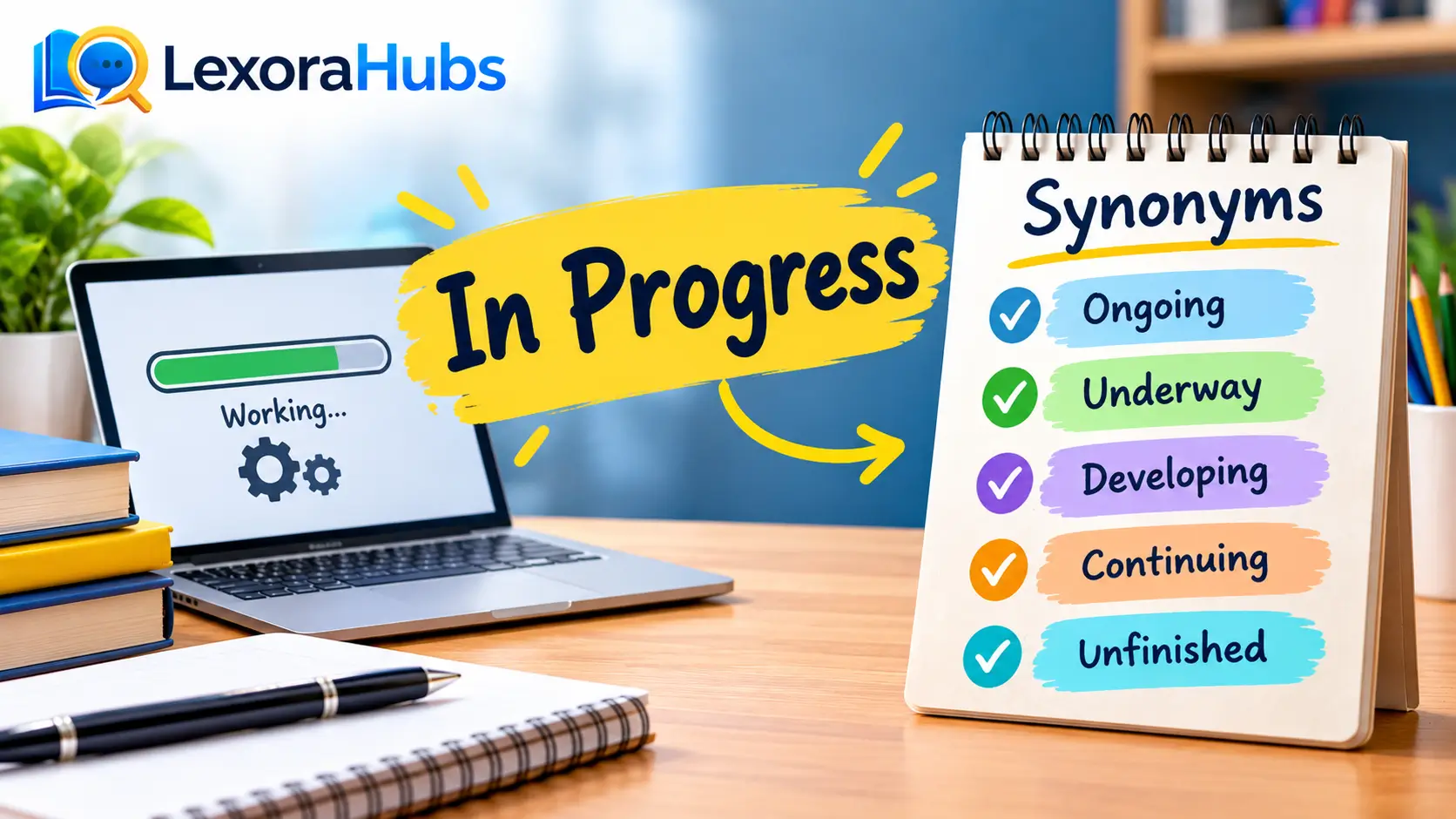
Synonyms for “in progress” help you express ongoing work with variety and precision. Common alternatives include underway, ongoing, in the works, in motion, pending, advancing, proceeding, happening, continuing, and developing. These words let you describe projects, tasks, and activities that aren’t finished yet in fresh, powerful ways.
INTRODUCTION
Picture this: You’re writing an email to your boss about a big project. You’ve already used “in progress” three times in two short sections. It feels boring and dull. However, imagine having many other ways to say the same thing. Each one brings a slightly different tone or feel. That’s the power of knowing strong synonyms for “in progress.”
For example, saying “Our website redesign is in the works” feels more sure and strong than “Our website redesign is in progress.” The meaning stays the same, yet the word choice changes how your reader feels.
Why does this matter? Students need many word choices for essays. This keeps them from sounding like a machine. Bloggers also need fresh synonyms to keep readers interested. Meanwhile, content writers need options to match different tones. For example, formal tones work for reports, while casual tones work for social media. Finally, everyday English users simply sound smarter when they use fresh phrases instead of tired old ones.
“Variety in language is the spice of good writing.” —Unknown
Learning new ways to express ongoing actions is important for all writers. Moreover, it’s about talking with clear, sure words. When you text a friend, write a memo, or write a story, the right synonym for “in progress” can change your message.
“Words are, of course, the most powerful drug used by mankind.” —Rudyard Kipling
Ways to Say “In Progress”: Professional & Casual Alternatives
When you describe something happening right now, you have many options. In fact, you have far more than just “in progress.” Each synonym has its own feel. For instance, some feel formal and business-like. Meanwhile, others feel quick and lively. Still others feel easy and kind. As a result, knowing which one to use when makes good writers better.
Ongoing vs. In Progress: Understanding the Difference
“Ongoing” and “in progress” are like cousins, but they’re not the same. “Ongoing” tells you about something that started before and keeps going. It could be a friendship, a job, or a health issue. However, “in progress” tells you about right now—something is active and happening this second.
For example: “We have an ongoing partnership with our vendors” (this friendship lasts a long time) versus “The training class is in progress” (it’s happening this moment). Both work fine, but the difference matters when you write for work.
- Ongoing = something that lasts for a long time
- In progress = something active and happening now
- Both sound formal and work-like in most cases
In Progress Meaning: A Complete Breakdown
“In progress” simply means something is active and happening right now. It also means it’s not done yet. The word “progress” means “to move ahead.” So when you say something is “in progress,” you’re saying it’s moving ahead toward the end.
Think of a building site: the house is “in progress.” It has a base, some walls, and maybe some water pipes. It’s not done, but people are working on it now. The phrase tells you three things: (1) someone started it, (2) it’s happening now, (3) it will be done later.
- Used at work, school, art projects, and in daily life too
- Always means movement toward an end goal
- Shows that work and effort are happening right now
Formal Alternatives to “In Progress”: Workplace Language
At work, you might want to sound more fancy and nice. Words like “underway,” “pending,” and “forthcoming” sound more formal. Yet they mean the same thing. These words belong in emails to bosses, reports for clients, and talks with workers.
- Underway works great in formal reports and serious papers
- Pending means you’re waiting for an answer or okay
- Forthcoming means something good is coming very soon
- Each one makes any message sound more professional and strong
Why “In Progress” Is Such a Powerful Word
The phrase “in progress” has real power. It tells people that work is active and happening, not stuck. It shows speed, hard work, and movement forward in a clear way. That’s why you see it all the time in business and in talk with others. For example, doctors use it (surgery in progress). Teachers use it (learning in progress). Managers use it a lot too. In fact, people want to know things are moving ahead.
THE 50 SYNONYMS FOR “IN PROGRESS”
1. Underway
- Meaning: Currently happening or being carried out at this moment.
- Examples: The construction project is underway and should finish by December. Our annual audit is underway in the accounting department.
2. Ongoing
- Meaning: Continuing over time without stopping or ending right away.
- Examples: The research is ongoing and may take several more months. We have ongoing discussions about budget improvements this year.
3. In the Works
- Meaning: Being prepared, developed, or created behind the scenes now.
- Examples: A new product line is in the works for next quarter. Changes to policy are in the works at this moment.
4. Pending
- Meaning: Awaiting decision, approval, or completion of something soon.
- Examples: Your application is pending review by the committee members. The final report is pending the client’s feedback and approval.
5. In Motion
- Meaning: Already started and actively moving forward toward a goal.
- Examples: The renovation project is now in motion with the team. Plans for expansion are in motion as we speak right now.
6. Advancing
- Meaning: Moving forward step-by-step toward completion or progress.
- Examples: The investigation is advancing quickly with new evidence appearing. Our campaign is advancing well across all platforms today.
7. Proceeding
- Meaning: Moving forward steadily according to a plan or schedule.
- Examples: The meeting is proceeding as scheduled in the main conference room. Construction is proceeding ahead of expectations this month.
8. Happening
- Meaning: Taking place or occurring at the present time right now.
- Examples: The grand opening is happening this Saturday at noon. The interview process is happening tomorrow afternoon.
9. Continuing
- Meaning: Going on without stopping or interruption at this moment.
- Examples: The training continues through Friday of next week for all staff. Our efforts are continuing to improve customer satisfaction daily.
10. Developing
- Meaning: Growing, expanding, or becoming more complete gradually over time.
- Examples: The business strategy is developing with input from all departments involved. Our ideas are developing into a comprehensive action plan.
11. Unfolding
- Meaning: Opening up or revealing itself slowly as events happen naturally.
- Examples: The story is unfolding exactly as we predicted it would. The investigation is unfolding with surprising new discoveries every day.
12. Evolving
- Meaning: Changing and improving gradually as time passes naturally forward.
- Examples: The project is evolving based on feedback from team members. Our strategy is evolving as market conditions change rapidly.
13. Active
- Meaning: Currently working or operating with energy and movement.
- Examples: The recruitment drive is active across all social media platforms. Development is active in the software engineering department.
14. Running
- Meaning: Continuing to operate or function without stopping at present.
- Examples: The experiment is running in the laboratory this week. The campaign is running successfully in three states now.
15. Afoot
- Meaning: Currently happening or being put into action right now.
- Examples: Major changes are afoot in the organization starting Monday next. Something exciting is afoot behind the scenes here.
16. In Effect
- Meaning: Currently operating or having real impact and influence.
- Examples: The new policy is in effect starting January first of next year. These safety measures are in effect throughout the building today.
17. Transpiring
- Meaning: Happening or taking place as events unfold naturally now.
- Examples: The negotiations are transpiring in the downtown conference center. Something important is transpiring in the market today.
18. Undergoing
- Meaning: Experiencing or going through a process of change currently.
- Examples: The facility is undergoing major renovations this quarter. The student is undergoing intensive training this summer.
19. Ensuing
- Meaning: Following as a result or happening immediately after something.
- Examples: The chaos ensuing from the announcement lasted for hours afterward. Discussions are ensuing about the new direction forward.
20. Prospective
- Meaning: Expected or likely to happen in the near future ahead.
- Examples: Prospective changes to the system are being tested now. Prospective candidates are being interviewed throughout October.
21. Forthcoming
- Meaning: About to happen soon or being prepared for release soon.
- Examples: Our forthcoming product launch is scheduled for spring. The forthcoming report will address all major concerns.
22. Initiated
- Meaning: Started or begun with an official action or decision made.
- Examples: The investigation has been initiated by the board today. A review process has been initiated for all applications submitted.
23. Commenced
- Meaning: Officially started or begun in a formal manner today.
- Examples: The conference has commenced with opening remarks. Construction has commenced on the new parking facility.
24. Embarked
- Meaning: Started a journey or begun a new venture with commitment.
- Examples: We have embarked on an ambitious growth strategy. The team has embarked on a three-month sprint project.
25. Launched
- Meaning: Released or started something new with energy and fanfare.
- Examples: The new campaign was launched yesterday morning. The product launch was launched across all markets today.
26. Set in Motion
- Meaning: Started or activated an action that will continue forward.
- Examples: Plans are set in motion for the expansion project. The process has been set in motion by management today.
27. Transitioning
- Meaning: Moving from one state or condition to another gradually.
- Examples: The company is transitioning to remote work next month. Our systems are transitioning to the new software platform.
28. Circulating
- Meaning: Moving around or being distributed among a group actively.
- Examples: The proposal is circulating among all board members now. Updates are circulating through all department email lists today.
29. Proliferating
- Meaning: Growing or increasing rapidly in number or quantity steadily.
- Examples: New ideas are proliferating throughout the team now. Opportunities are proliferating in the technology sector today.
30. Escalating
- Meaning: Increasing in size, intensity, or importance over time now.
- Examples: The situation is escalating faster than we expected. Complaints are escalating from multiple customer sources today.
31. Accelerating
- Meaning: Speeding up or moving faster toward completion now.
- Examples: Production is accelerating to meet the deadline. Growth is accelerating in the Asia-Pacific region now.
32. Momentum
- Meaning: Forward movement or increasing speed toward a goal currently.
- Examples: The project is building momentum with each passing week. Our sales are gaining momentum in new markets.
33. Brewing
- Meaning: Slowly developing or building toward a point of action.
- Examples: Something big is brewing behind the scenes here. Change is brewing in the organization right now.
34. Incubating
- Meaning: Developing or growing slowly in protected conditions now.
- Examples: New ideas are incubating in our innovation lab. The startup is incubating in the accelerator program.
35. Gestating
- Meaning: Developing gradually like a baby during pregnancy currently.
- Examples: The business plan is gestating and will launch soon. New concepts are gestating in the creative department.
36. Maturing
- Meaning: Growing and developing toward full strength and capability.
- Examples: The relationship is maturing through consistent effort daily. The technology is maturing before full deployment.
37. Budding
- Meaning: Beginning to grow or show early signs of development now.
- Examples: A promising career is budding for the young executive. New partnerships are budding in the marketplace today.
38. Sprouting
- Meaning: Starting to grow or emerge visibly for the first time.
- Examples: New ideas are sprouting from the brainstorming sessions. Growth opportunities are sprouting across the company.
39. Taking Shape
- Meaning: Beginning to have a clear form or structure now.
- Examples: The final design is taking shape in our studio. The team structure is taking shape this week.
40. Mounting
- Meaning: Building up or accumulating in force or importance currently.
- Examples: Evidence is mounting against the original theory offered. Pressure is mounting to complete the project soon.
41. Accruing
- Meaning: Gradually accumulating or adding up over passing time.
- Examples: Interest is accruing on your savings account monthly. Benefits are accruing for long-term employees here.
42. Compounding
- Meaning: Becoming greater or more complex by addition gradually.
- Examples: Compound interest is compounding your investment growth. The problems are compounding without intervention today.
43. Festering
- Meaning: Growing worse or more serious without proper attention given.
- Examples: The conflict is festering between the two teams. Health issues are festering without medical treatment.
44. Simmering
- Meaning: Building or developing slowly like heat just below boiling.
- Examples: Tension is simmering beneath the surface currently. Change is simmering in the corporate culture.
45. Percolating
- Meaning: Slowly spreading or developing through a group steadily.
- Examples: New ideas are percolating through the organization. Awareness is percolating among the general public.
46. Crystallizing
- Meaning: Becoming clear and definite in form gradually now.
- Examples: The plan is crystallizing with each meeting we hold. Ideas are crystallizing into concrete strategies.
47. Materializing
- Meaning: Becoming real and actually happening before our eyes.
- Examples: The opportunity is materializing right on schedule. Our dreams are materializing into actual achievements.
48. Actualized
- Meaning: Made real or turning into actual tangible form now.
- Examples: The vision has been actualized through hard work. Plans are being actualized by the dedicated team.
49. Manifesting
- Meaning: Showing up or appearing in visible form very clearly.
- Examples: Results are manifesting in our quarterly reports. Changes are manifesting across all business units.
50. Transpired
- Meaning: Happened or occurred just as events are unfolding naturally.
- Examples: Everything transpired according to our detailed plan. The meeting transpired smoothly with positive outcomes.
LONG-TAIL KEYWORD SECTIONS
In Progress Synonyms List: Complete Guide for Writers
When you look for the right synonym for “in progress,” a good list saves you time and makes your writing better. The words in this article go from easy and kind to formal and business-like. Also, some show speed and rush. Others show slow, steady work. The best writers pick synonyms that match their reader, tone, and time. This list gives you 50 great options to show ongoing work in any place you see today.
- Use easy synonyms (happening, going on) for emails and text messages
- Choose formal words (underway, pending) for reports and plans
- Pick lively words (accelerating, escalating) when you need energy
Ongoing vs. In Progress: Know When to Use Each
“Ongoing” works best when you talk about something that started before. It keeps going with no clear end date. Meanwhile, “in progress” talks about right now—action happening this second toward being done. Think of a building site to see this. The house is “in progress” (they’re building it now). Your tie with the builder might be “ongoing” (it keeps going). Both work, but they mean different things. Therefore, in work writing, use “ongoing” for long friendships, standing orders, or steady work. Use “in progress” for jobs with an end date. This split shows up a lot in work writing and reports.
- Ongoing = no clear end date in sight at all
- In progress = moving to a set finish date soon
- The case decides which word works best each time
In Progress Meaning: Understanding the Phrase Completely
The phrase “in progress” has two ideas that work as one. “In” means “during” a point in time. “Progress” means “to move ahead.” Together, “in progress” means “moving ahead right now.” When work is “in progress,” three things are true: something began (the past), work is active now (today), and it will finish later (the future). So this three-step view explains why “in progress” helps in all fields. Doctors use it (surgery in progress). Teachers use it (class in progress). Bosses use it all the time. Also, knowing this helps you pick the right words every single time.
- Always shows forward movement to the end
- Used in every job and place worldwide
- Shows effort, time, and hard work given
Professional Synonyms for “In Progress”: Workplace Edition
At work, you need to use different words than you use with friends in texts. Professional words like “underway,” “pending,” and “forthcoming” sound nicer and more believable right away. You see these words a lot in emails, reports, and work talks. “Underway” sounds full of power and sure. “Pending” shows a careful look is happening. “Forthcoming” means something good is coming soon. Each word carries real weight and formality. So, if you email your boss, report to clients, or talk to team members, these formal choices change your message. They show you’re smart, work well, and think clear.
- Underway = sure, active, moving ahead strong and fast
- Pending = waiting for a choice with good care shown
- Forthcoming = something great arriving very soon now
In Progress in a Sentence: Real Examples from Life
Learning how to use “in progress” and other words in real writing helps you remember them always. Here’s how English speakers use these words every day. “The kitchen fix is in progress and should finish next month.” See how it answers hidden questions: something is being done, it’s not done yet, and you know when. Now compare this: “The kitchen fix is underway and will finish next month.” The meaning is the same, but the feel shifts a bit. “Underway” sounds more planned than “in progress.” So, doing this work with different words helps you learn which word fits which spot. This skill makes great writers stand out fast.
FAQ: PEOPLE ALSO ASK
What does the word “in progress” mean?
“In progress” simply means something is active right now and not yet done. The phrase tells you work is underway at this very second. Also, it comes from a word meaning “to move ahead.” When you say something is in progress, you’re saying: (1) it began, (2) work is active now, and (3) it will finish later. Finally, people use this phrase everywhere. In work (meetings in progress), at school (tests in progress), on building sites (houses in progress), and in hospitals (surgery in progress). It’s helpful because it fast answers: Is it done? No, but it’s active right now.
What are good synonyms for saying something is “in progress”?
The best words depend on your case and who reads it. “Underway” works great in formal work and sounds sure. “Ongoing” tells you something keeps going with no end date. “Pending” means you’re waiting for an okay or choice. “In the works” feels kind and easy. “Happening” is short and clear. “Advancing” shows forward speed and rush. Also, “developing” shows slow growth. “Undergoing” shows you’re going through a step. So, for work emails, use “underway,” “pending,” or “forthcoming.” For casual notes, use “happening,” “going on,” or “in the works.” For stories, pick “unfolding,” “materializing,” or “crystallizing.” Each word has its own feel yet keeps the core meaning of work toward done.
What is a synonym for “gird” that relates to progress?
“Gird” means to get ready and make yourself strong for work ahead. Other words like this are “undergird” (to make strong from below), “brace,” “fortify,” and “steel.” These words show getting set and making strong, not quite like “in progress.” But when jobs are “girded,” they have strong bases below. This links to progress because strong readiness leads to good work. If something is “girded for progress,” it got strong and is set to move ahead well. The tie is small but key to know. You gird before progress starts. Progress is the ahead movement. So knowing this helps you use these words the right way in your talk and writing each day.
Why is learning synonyms for “in progress” important for your writing?
Learning many ways to say “in progress” makes your writing better in three big ways. First, using many words stops boring, which keeps readers awake and happy in long pieces. Second, picking the right word helps you say just what you mean. Is it fast or slow, formal or easy, quick or steady? Third, more words grow your talk, which makes you sound smart and kind in all cases. So, when you use the same word over and over, readers stop listening. When you use fresh words, readers keep reading and like your English. Work writers, blog makers, content people, and all talkers gain from knowing many ways to say common things like “in progress.” This list of 50 words changes how you talk in emails, essays, social posts, and in-person chats.
BODY QUOTATION
“The secret to good writing isn’t finding the perfect word—it’s knowing you have dozens of perfect words to choose from.” —Anonymous
This quotation captures why synonym mastery matters so deeply for any writer. When you know alternatives, you become a more confident and creative communicator in every situation you face daily.
CONCLUSION
Learning synonyms for “in progress” changes how you talk at work, at school, and at home. Your emails get better. Your essays sound nicer. Your talks feel more lively to people watching. Each synonym has its own feel and level of formal. So you can say things you couldn’t say before. The gap between “pending” and “happening” might look small, but people feel the different energy each word brings.
The work of growing your word choice goes past “in progress.” Every word you learn opens new ways to write and make things. When you email a client, you pick “underway” (sure), “in the works” (kind), or “forthcoming” (key). When you write an essay, you pick “advancing,” “developing,” “evolving,” or “unfolding” based on your tone. So these small picks add up to strong, nice talk that people like.
“Words are the most powerful things in the world. Choose them wisely in every sentence.” —Attributed to Various Authors
Start using these words in your emails, texts, essays, and talks today. Look at how each word feels in each spot. See which words your best writers use and why. After a while, your ear will grow, and you’ll pick great words all by itself. Your writing gets better. Your talk gets more clear. People will see your skill shine.
“Vocabulary is destiny. The more words you know, the more ideas you can express and understand.” —Unknown
The fifty words in this guide are just the start. English has many, many ways to show work that’s still going. Keep looking for new words. Keep doing this work. Keep finding fresh, exact words each time you write. Your growth as a talker needs this, and the good things—better marks, work wins, strong bonds, more trust—are worth all the work.

Ryan is a content writer focused on creating informative and well-structured articles for LexoraHubs readers.