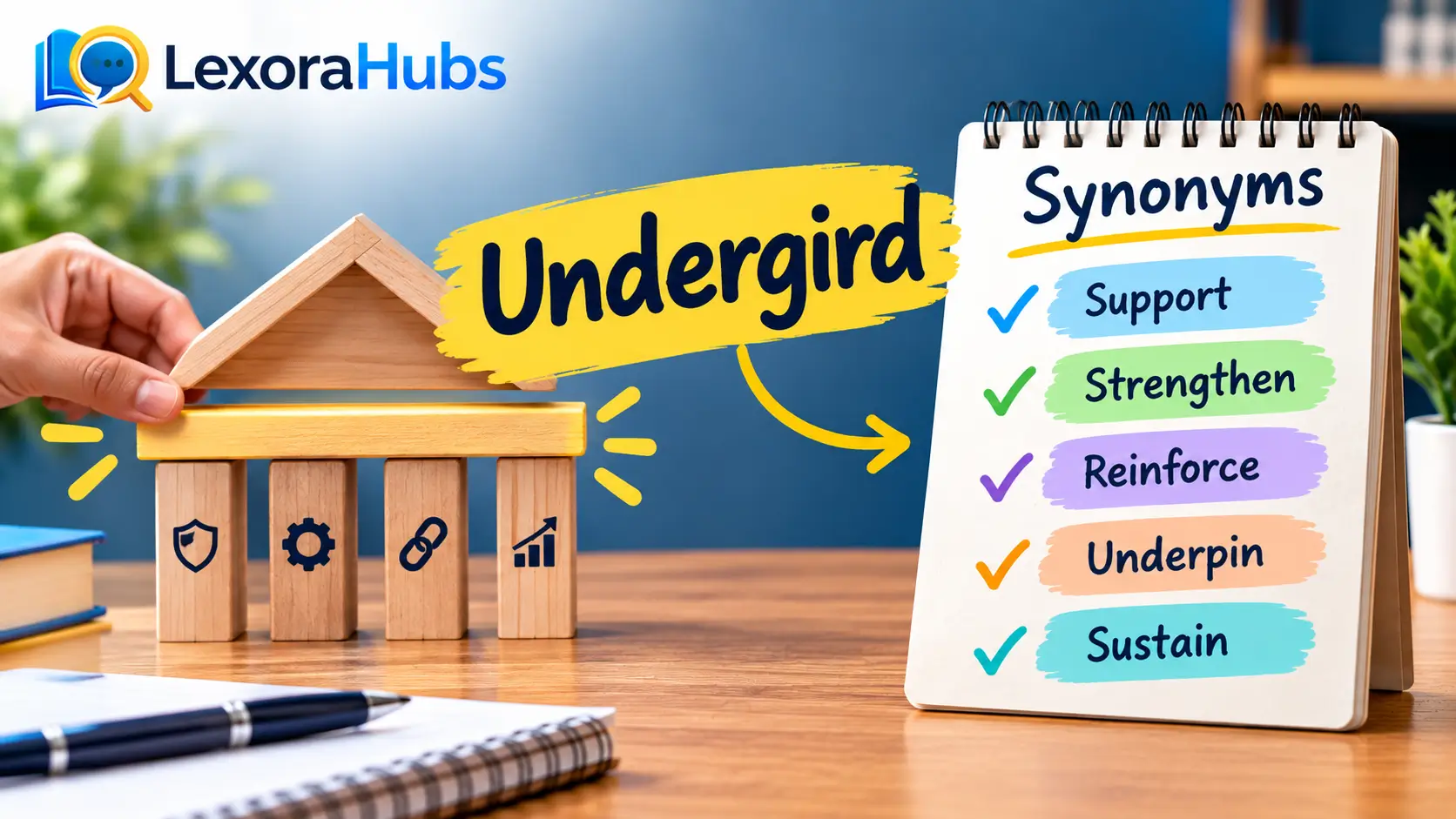
An undergird synonym is a word that means to support, strengthen, or form the foundation of something. Words like “buttress,” “support,” “underpin,” and “reinforce” all serve as strong undergird synonyms that help you express the idea of providing essential support or foundation in your writing.
Introduction
Imagine a bridge engineer explaining how steel cables hold up a massive suspension bridge. She doesn’t just say they “help”—she says they undergird the entire structure. That single word captures the sense of deep, essential support that ordinary words miss.
Most writers reach for basic words like “support” or “hold up” when they want to describe something fundamental. But undergird has a different weight to it. It’s the word for foundations, not surfaces. It’s for the kind of support that keeps everything else standing.
Here’s why this matters: Students need stronger vocabulary to stand out in essays. Bloggers want their writing to feel more authoritative. Content writers search for ways to avoid repetition and sound more professional. Daily English users simply want to express themselves more precisely.
Learning undergird synonyms gives you access to a whole toolbox of foundation-words. “The secret of effective writing is not in what you say, but in the exact words you choose to say it.” These synonyms let you say more with style.
Whether you’re crafting a business email, writing a research paper, or building your everyday vocabulary, knowing multiple synonyms for undergird helps you find the exact word that fits your meaning. “Vocabulary is a ladder that climbs toward eloquence.” The climb is worth it.
50 Essential Synonyms for Undergird
1. Support
- Meaning: To hold up or keep something from falling down or breaking.
- Examples: The team’s confidence helped support their successful project. Strong friendships support us through difficult times.
2. Buttress
- Meaning: To strengthen or reinforce something with solid backing or evidence.
- Examples: Scientific research buttresses the claim that exercise improves health. Good planning buttresses any business strategy.
3. Underpin
- Meaning: To form the base or foundation that something depends on.
- Examples: Trust underpins every healthy relationship. Strong reading skills underpin academic success.
4. Reinforce
- Meaning: To make something stronger by adding more support or material.
- Examples: Daily practice reinforces what you learn in class. Teamwork reinforces individual strengths.
5. Brace
- Meaning: To prepare yourself firmly or to provide support against pressure.
- Examples: Athletes brace their muscles before competition. Families brace for storms by securing their homes.
6. Prop
- Meaning: To hold something up using an object or person as support.
- Examples: He propped the door open with a book. Strong values prop up a meaningful life.
7. Sustain
- Meaning: To keep something going or support it over time.
- Examples: Good nutrition sustains your energy levels. Hope sustains people through hardship.
8. Bolster
- Meaning: To strengthen or improve confidence, support, or morale.
- Examples: A good night’s sleep bolsters your ability to focus. Encouragement bolsters a student’s confidence.
9. Anchor
- Meaning: To provide a firm base or fixed point that holds something steady.
- Examples: Family traditions anchor our sense of belonging. Logic anchors scientific arguments.
10. Foundation
- Meaning: The solid base on which something rests or is built.
- Examples: A good education forms the foundation for success. Trust is the foundation of friendship.
11. Pillar
- Meaning: A tall, strong support structure or something essential to stability.
- Examples: Education is a pillar of a strong society. Honesty is a pillar of good character.
12. Mainstay
- Meaning: The chief support or most important part of something.
- Examples: Family is the mainstay of most people’s lives. Rice is the mainstay crop in Asia.
13. Backbone
- Meaning: The main support structure; inner strength or courage.
- Examples: Courage is the backbone of heroic action. Infrastructure is the backbone of modern cities.
14. Base
- Meaning: The bottom part that something stands on or starts from.
- Examples: A solid knowledge base helps students succeed. The base of the mountain is wide and stable.
15. Uphold
- Meaning: To support or maintain something in strength and value.
- Examples: Leaders uphold laws to protect citizens. Teachers uphold standards to maintain quality.
16. Shore
- Meaning: To support something to keep it from falling; to strengthen.
- Examples: Parents shore up children’s confidence through praise. Governments shore up weak economies with investment.
17. Brace Up
- Meaning: To make stronger or more firm with added support.
- Examples: Extra staff brace up the team during busy seasons. Steel rods brace up tall buildings.
18. Steady
- Meaning: To make something stable and firm, not moving or changing.
- Examples: A wise leader steadies the company during change. Practice steadies your hands when playing sports.
19. Hold Up
- Meaning: To support the weight of something; to remain strong and stable.
- Examples: The old bridge still holds up under traffic. Strong principles hold up under pressure.
20. Strengthen
- Meaning: To make something more strong, powerful, or able to endure.
- Examples: Exercise strengthens your muscles and heart. Success strengthens a person’s confidence.
21. Stabilize
- Meaning: To make something steady and less likely to change or fall.
- Examples: Good policies stabilize the economy. Exercise stabilizes your mood and energy.
22. Maintain
- Meaning: To keep something in good condition or at a certain level.
- Examples: Regular cleaning maintains a healthy home. Honesty maintains strong relationships.
23. Preserve
- Meaning: To keep something safe and unchanged over time.
- Examples: Refrigeration preserves food freshness. Laws preserve natural forests for future generations.
24. Foster
- Meaning: To help something grow or develop by providing support.
- Examples: Teachers foster curiosity in young students. Community groups foster neighborhood connections.
25. Nourish
- Meaning: To provide what is needed for growth and strength.
- Examples: Good soil nourishes plant roots and leaves. Kindness nourishes the human spirit.
26. Fortify
- Meaning: To make something stronger and more able to resist damage.
- Examples: Calcium fortifies bones and teeth. Education fortifies your mind against ignorance.
27. Sustain
- Meaning: To give strength or energy to keep going.
- Examples: Water sustains all living things. Hope sustains people through crisis.
28. Prop Up
- Meaning: To keep something from falling by adding external support.
- Examples: Government loans prop up struggling businesses. Statistics prop up the research findings.
29. Backup
- Meaning: To provide additional support or a secondary plan if needed.
- Examples: A backup plan backs up your main strategy. Friends provide backup when you need help.
30. Scaffold
- Meaning: To provide temporary support while something is being built or developed.
- Examples: Teachers scaffold learning by breaking lessons into steps. Training scaffolds new employee development.
31. Reinvigorate
- Meaning: To give new strength and energy to something weakening.
- Examples: A vacation reinvigorates tired workers. New leadership reinvigorates struggling organizations.
32. Corroborate
- Meaning: To support a claim or statement with evidence or other proof.
- Examples: Witnesses corroborate the victim’s account of the accident. Research corroborates the study’s main findings.
33. Endorse
- Meaning: To publicly support or approve of something or someone.
- Examples: Experts endorse this new safety method. The president endorses the new policy.
34. Back
- Meaning: To support with help, resources, or a public statement.
- Examples: Investors back promising startup companies. Friends back you when you pursue your dreams.
35. Stand Behind
- Meaning: To fully support and be willing to defend someone or something.
- Examples: Teachers stand behind their students’ progress. Companies stand behind the quality of their products.
36. Champion
- Meaning: To actively support and fight for a cause or person.
- Examples: Activists champion environmental protection causes. Leaders champion education reform initiatives.
37. Rally
- Meaning: To gather support or bring people together for a cause.
- Examples: Communities rally around families in need. Nations rally their resources during crisis.
38. Sustenance
- Meaning: Food, energy, or support needed to keep something alive or going.
- Examples: Regular meals provide sustenance for children. Friendship provides emotional sustenance for the heart.
39. Ballast
- Meaning: Something that provides weight and stability to keep things balanced.
- Examples: Ships use ballast to stay stable in waves. Responsibility serves as ballast in chaotic life.
40. Fulcrum
- Meaning: The central support point on which something pivots or depends.
- Examples: The fulcrum makes a lever work effectively. Education is the fulcrum of social progress.
41. Thrust
- Meaning: The main driving force or purpose that pushes something forward.
- Examples: Innovation is the thrust of technology companies. Curiosity is the thrust behind scientific discovery.
42. Sinew
- Meaning: The tough, strong part that connects and supports body parts.
- Examples: Sinew and muscle give bodies strength and flexibility. Commitment is the sinew of lasting relationships.
43. Strut
- Meaning: A structural bar that provides support against pressure or weight.
- Examples: Metal struts support the bridge’s deck. Determination acts as an inner strut for success.
44. Truss
- Meaning: A framework of beams that works together to provide strength.
- Examples: Roof trusses distribute the weight evenly. Family values form a moral truss for life.
45. Joist
- Meaning: A beam that provides primary support in a structure.
- Examples: Wooden joists support the floor above. Integrity serves as a joist in character.
46. Bracing
- Meaning: Serving as support or reinforcement to prevent collapse or failure.
- Examples: Bracing walls prevent the building from swaying dangerously. Moral bracing keeps people firm in crisis.
47. Underpinning
- Meaning: The hidden foundation or basic support system for something.
- Examples: Science is the underpinning of medical treatment. Values are the underpinning of society.
48. Linchpin
- Meaning: The essential element that holds a system or plan together.
- Examples: Communication is the linchpin of teamwork. Trust is the linchpin of relationships.
49. Rib
- Meaning: A supporting structure that gives shape and strength to something.
- Examples: Ribs protect the heart and lungs in your body. Wooden ribs support a ship’s hull.
50. Stay
- Meaning: A rope, rod, or wire that braces and steadies something.
- Examples: Metal stays hold the antenna firmly in place. Faithful friends are the stays of our lives.
“Every word you learn is a new tool in your writing toolkit.” The more synonyms you know, the more precisely you can express your thoughts.
Undergird Meaning
The word “undergird” comes from combining “under” and “gird,” where “gird” means to encircle or bind tightly. When something undergirds another thing, it wraps around it with support, holding it together from beneath. This isn’t casual support—it’s the foundational kind that prevents collapse. Think of how steel cables undergird a suspension bridge, or how strong values undergird a person’s character. The word conveys both the strength of the support and its essential nature. Understanding undergird helps you communicate when something is more than just helpful—when it’s absolutely necessary for stability.
Undergird in a Sentence
Using undergird in a sentence sounds formal but powerful, and it works best when you’re describing something fundamental. For example: “Trust undergirds every successful business partnership” sounds more authoritative than “Trust helps every business partnership.” Or: “Education undergirds a person’s future opportunities” carries more weight than “Education helps people’s futures.” The key is using undergird when the support is essential, not optional. It’s the perfect word for academic writing, professional emails, and serious discussions where you want readers to understand that something is absolutely foundational, not just helpful or convenient. “The right word makes all the difference between good writing and great writing.”
Undergird vs. Underpin
Many writers use “undergird” and “underpin” interchangeably, but they have subtle differences. Undergird emphasizes the wrapping and binding quality of support, suggesting that something holds together a complete structure. Underpin, on the other hand, emphasizes the base or foundation—it’s the ground level support beneath something. Both words work in formal and academic writing. If you’re describing the essential framework that holds something together as a system, use undergird. If you’re describing the basic foundation or lowest level of support, use underpin. In practice, both communicate strength and fundamentality. Understanding the difference helps you pick the exact word that matches your meaning perfectly.
Undergird Etymology
The word “undergird” has Old English roots, combining “under” (meaning beneath) and “gird” (meaning to encircle, bind, or secure with a belt). Historically, a girdle was a belt used to hold clothing in place and bind things together. The prefix “under” added the sense of support from beneath. This etymological foundation makes undergird unique among synonyms—it literally means to bind support around something from below. Understanding the etymology enriches your appreciation for how the word communicates not just support, but a comprehensive, binding support that holds things together structurally. This historical understanding deepens your ability to use the word with confidence and precision in modern writing.
Buttress Synonym
A buttress is a architectural structure built to reinforce and support a wall. As a synonym for undergird, “buttress” works beautifully in contexts where you’re describing added strength or reinforcement. You might say, “Research buttresses the validity of the theory,” or “Strong friendships buttress us against loneliness.” Unlike undergird, which emphasizes foundational binding, buttress emphasizes added reinforcement—something built onto an existing structure to make it stronger. This makes buttress perfect when you’re describing how extra support or evidence makes something more stable. The architectural origin of buttress makes it especially powerful in formal and academic writing. Use buttress when you’re talking about reinforcing something that already exists with additional proof or support.
Underlie Synonym
The verb “underlie” means to form the base or foundation for something. Underlie synonyms include “undergird,” “underpin,” “base,” and “found.” When one thing underlies another, it forms the essential foundation or groundwork. For example: “Philosophy underlies all serious thought,” or “Fear often underlies aggressive behavior.” The key difference between underlie and undergird is that underlie emphasizes the base or reason something exists, while undergird emphasizes the support structure that holds it together. Both are powerful words for academic and professional writing. Understanding underlie and its synonyms helps you express the relationship between foundational elements and the structures they support, making your writing more precise and sophisticated.
FAQ: Real People Also Ask
What does the word “undergird” mean?
“Undergird” means to provide essential support or to form the foundation that something depends on. It combines the sense of support from beneath with the idea of binding things together. When you say something undergirds another thing, you’re saying it holds it up and keeps it whole—like how foundation beams undergird a house or how values undergird a person’s choices. The word carries a sense of necessity—undergirded support isn’t optional, it’s essential. This is why undergird appears so often in serious writing about relationships, values, systems, and structures that need foundational strength. It’s more powerful than casual words like “help” or “support.”
What is the synonym of gird?
The word “gird” means to encircle or bind something tightly, often with a belt or band. Synonyms for gird include “belt,” “bind,” “encircle,” “secure,” and “fasten.” When you gird something, you wrap it tightly for strength or preparation. The phrase “gird yourself” means to prepare for difficulty by pulling together your strength. “Gird up your loins” is a historic phrase meaning to prepare yourself for action. Understanding gird helps you appreciate why “undergird” is so powerful—it combines the binding, tightening action of gird with the foundational support of being under something. Gird’s synonyms all emphasize the wrapping and securing aspect of support.
What is the synonym of undergrowth?
“Undergrowth” refers to vegetation that grows beneath taller trees in a forest—the bushes, shrubs, and small plants at ground level. Synonyms include “underbrush,” “brush,” “shrubby vegetation,” and “ground cover.” These words describe the lower layer of plant life in forests and wild areas. Note that “undergrowth” is different from “undergird”—they share the prefix “under” but mean completely different things. Undergrowth is about plant layers, while undergird is about support and foundation. Both words use “under” to indicate something positioned beneath something else, but their meanings are distinct. Understanding this difference helps you avoid confusing these two words when writing about nature or when using undergird in your work.
Why is “undergird” a powerful word?
“Undergird” is powerful because it communicates essential support with both precision and formality. Unlike casual words such as “help” or “assist,” undergird conveys that something is absolutely foundational—not optional, but necessary for something to exist or function. The word carries architectural weight, suggesting structures and frameworks rather than simple assistance. In writing, using undergird elevates your tone and communicates authority and seriousness. It works especially well in academic, professional, and literary contexts. Readers recognize undergird as a sophisticated word, which adds weight to your argument. When you say values undergird a decision or evidence undergirds a theory, you’re communicating that these foundations are structural, not surface-level. This is why undergird is so valuable for writers who want their words to carry impact.
Conclusion
Learning synonyms for undergird transforms your writing from surface-level to foundation-focused. Strong synonyms make you sound more authoritative and help you express complex ideas with precision. When you move beyond basic words like “support,” you gain access to an entire vocabulary of foundation-words that capture layers of meaning.
Writing improves fastest when you actively use new words. “The most effective learning happens when you put new vocabulary to work immediately.” Try using one undergird synonym in an email today, another in a text tomorrow. Use them in essays, blog posts, and everyday conversations. Notice how they change the feel and impact of your sentences.
Your vocabulary is like a toolbox—the more tools you have, the better you can build your ideas. These 50 synonyms give you choices for every situation, whether you’re writing formally or casually, academically or creatively. “Mastery comes from practice, and practice with words is the path to eloquent communication.” Start now. Pick one synonym. Use it this week. Then pick another. Gradually, these words will become natural to you, and your writing will reflect that growth.

Emily writes simple, useful, and reader-friendly content, helping LexoraHubs provide valuable information to its audience.