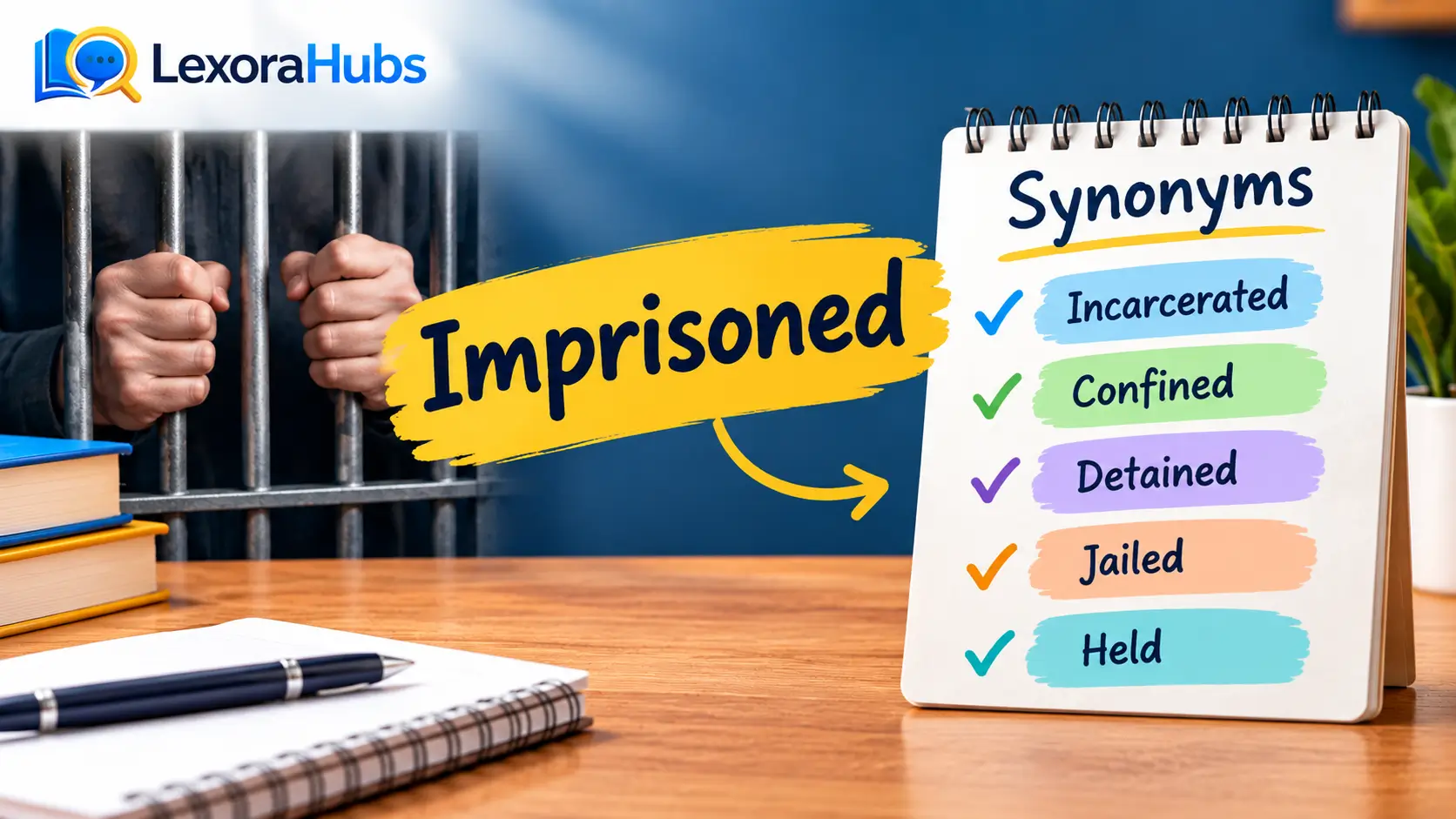
A synonym for imprisoned is confined, which means being locked up or restricted in a place. Other synonyms include incarcerated, detained, held captive, and restrained. These words all describe someone who is not free to leave or move about freely.
INTRODUCTION
Sarah was writing a crime novel when she realized she’d used the word “imprisoned” five times in just two pages. She needed better vocabulary. Her character wasn’t just imprisoned in a cell—he felt confined by guilt, trapped by circumstances, and held captive by his own fear. The same story often needs multiple words to show different shades of meaning.
Learning synonyms for imprisoned isn’t just for novelists. “Words are the tools of thought,” as Calvin Coolidge once said, and having the right tool makes all the difference.
Why does this matter for you?
- Students can write essays that sound more sophisticated and avoid repetition.
- Bloggers can create content that’s engaging and varied, keeping readers interested.
- Content writers need strong vocabulary to stand out and rank better in search engines.
- Daily English users communicate more clearly and precisely in emails, conversations, and presentations.
“The difference between the right word and the almost-right word is like the difference between a lightning bug and lightning,” Mark Twain famously wrote. That’s what this guide is about—finding the perfect word every time.
50 SYNONYMS FOR IMPRISONED
1. Confined
- Meaning: Kept inside a limited space; not allowed to leave or move freely.
- Examples: The dog was confined to the backyard after escaping twice. She felt mentally confined by outdated rules at her workplace.
2. Incarcerated
- Meaning: Locked up in prison as official punishment for a crime.
- Examples: He was incarcerated for three years for robbery. The documentary follows formerly incarcerated individuals rebuilding their lives.
3. Detained
- Meaning: Held back or stopped from leaving by police or authorities.
- Examples: Police detained the suspect for questioning all night. Customs detained the package at the border for inspection.
4. Captive
- Meaning: Taken as a prisoner; forced to stay in one place.
- Examples: The captive was finally released after the ransom was paid. She felt like a captive in her own home during lockdown.
5. Held Captive
- Meaning: Forcibly kept prisoner; unable to escape or be free.
- Examples: The hostages were held captive for five days. His fear held him captive and stopped him from trying new things.
6. Jailed
- Meaning: Locked up in jail as punishment or while awaiting trial.
- Examples: He was jailed overnight for public intoxication. She jailed her feelings for years before finally speaking up.
7. Caged
- Meaning: Enclosed in a cage or confined space like an animal.
- Examples: The lion paced back and forth in its caged area. He felt caged by his job, trapped doing the same thing daily.
8. Locked Up
- Meaning: Secured behind locked doors; prevented from leaving or escaping.
- Examples: The valuables are locked up in the vault. She’s been locked up in meetings all week with no breaks.
9. Shackled
- Meaning: Bound with chains or cuffs; held down by physical restraints.
- Examples: The prisoner was shackled during the court appearance. She felt shackled by debt and unable to move forward.
10. Restrained
- Meaning: Kept from moving freely; held back or restricted.
- Examples: The aggressive dog was restrained with a leash. He restrained his anger during the difficult conversation.
11. Bound
- Meaning: Tied up or held firmly in place by something.
- Examples: The captive’s hands were bound with rope. She felt bound by family expectations and traditions.
12. Ensnared
- Meaning: Caught in a trap or confined by something deceptive.
- Examples: The rabbit was ensnared in the hunter’s trap. He became ensnared in a scheme to defraud investors.
13. Sequestered
- Meaning: Isolated or separated; kept apart from others or from freedom.
- Examples: Jury members were sequestered during the high-profile trial. She sequestered herself in her room to focus on studying.
14. Interned
- Meaning: Confined or held during wartime or as punishment by authorities.
- Examples: Japanese Americans were interned during World War Two. Political prisoners were interned without trial during the conflict.
15. Cooped Up
- Meaning: Shut up in a small, confined space; feeling trapped and restless.
- Examples: Kids get cooped up when bad weather keeps them indoors. She felt cooped up in the tiny apartment with three roommates.
16. Clutched
- Meaning: Gripped tightly and held firmly; unable to escape grip.
- Examples: The eagle clutched the fish in its sharp talons. Anxiety clutched her heart whenever he was late coming home.
17. Fettered
- Meaning: Shackled with chains; held back by heavy restrictions.
- Examples: The slave was fettered to prevent escape attempts. She felt fettered by the controlling rules of her strict family.
18. Manacled
- Meaning: Handcuffed or chained at the wrists; restrained with metal cuffs.
- Examples: Prisoners were manacled before transport to the courthouse. He felt manacled by responsibility and couldn’t pursue his dreams.
19. Restricted
- Meaning: Limited in movement or freedom; kept within certain boundaries.
- Examples: Access to the classified section is restricted to security personnel. His movement was restricted after knee surgery.
20. Trapped
- Meaning: Unable to escape a place, situation, or circumstance.
- Examples: The hiker was trapped in the cave during the storm. She felt trapped in a dead-end job with no opportunities.
21. Holed Up
- Meaning: Confined in a small space, hiding or sheltering inside.
- Examples: The fugitive was holed up in an abandoned warehouse. Writers hole up in cabins to focus on their manuscripts.
22. Penned In
- Meaning: Enclosed in a pen or fenced area; prevented from roaming freely.
- Examples: Cattle were penned in for the night by the ranch hands. During winter, she felt penned in by snowstorms outside.
23. Held In
- Meaning: Kept inside; restrained from leaving or expressing freely.
- Examples: Emotions can’t be held in forever without causing stress. The animal was held in the sanctuary for its own safety.
24. Bottled Up
- Meaning: Kept inside without release; suppressed and contained tightly.
- Examples: He had bottled up his feelings for years before counseling. Energy bottled up in children needs outlets like sports or play.
25. Locked Down
- Meaning: Secured completely; confined strictly with no freedom of movement.
- Examples: The facility was locked down after the security breach. The city locked down during the emergency health crisis.
26. Cornered
- Meaning: Trapped in a position with no way out; surrounded and helpless.
- Examples: The animal was cornered and had nowhere to run. She felt cornered when confronted about her mistake.
27. Hemmed In
- Meaning: Surrounded closely so escape is impossible or very difficult.
- Examples: The car was hemmed in by traffic on all sides. Rural communities felt hemmed in by strict zoning laws.
28. Immobilized
- Meaning: Unable to move; kept stationary and unable to change position.
- Examples: The patient was immobilized in a full body cast. Fear immobilized him when presenting to large audiences.
29. Pinned Down
- Meaning: Held in one spot; unable to move because of pressure or force.
- Examples: The wrestler was pinned down on the mat. She felt pinned down by expectations that left no room for mistakes.
30. Barricaded
- Meaning: Blocked in by barriers; enclosed with structures preventing escape.
- Examples: Protesters barricaded themselves inside the building. He barricaded his emotions behind a wall of humor.
31. Blockaded
- Meaning: Surrounded by forces preventing entry or exit; completely blocked off.
- Examples: The port was blockaded during the naval conflict. Her mind felt blockaded by self-doubt and criticism.
32. Sealed In
- Meaning: Enclosed completely; shut inside with no opening to escape.
- Examples: The tomb was sealed in ancient times with treasures inside. She felt sealed in by circumstances beyond her control.
33. Walled In
- Meaning: Surrounded by walls; enclosed on all sides unable to leave freely.
- Examples: Medieval towns were walled in for protection from invaders. He felt walled in by his own insecurities and fears.
34. Enclosed
- Meaning: Surrounded completely on all sides; shut in without escape route.
- Examples: The porch was enclosed with glass to make a sunroom. She felt enclosed by the forest during her solo backpacking trip.
35. Coerced
- Meaning: Forced to do something against one’s will through pressure or threats.
- Examples: He was coerced into signing the contract through intimidation. She coerced her way into the exclusive club using family connections.
36. Held
- Meaning: Kept in custody or confined; not released or let go freely.
- Examples: The suspect was held without bail until trial. She held onto hope even when circumstances seemed impossible.
37. Gripped
- Meaning: Held tightly with strong force; unable to break free from grasp.
- Examples: Fear gripped the audience during the horror film. He was gripped by determination to succeed despite obstacles.
38. Captured
- Meaning: Taken prisoner or taken into custody by force or cunning.
- Examples: The escaped convict was finally captured after weeks on the run. Her smile captured the hearts of everyone in the room.
39. Seized
- Meaning: Suddenly grabbed or taken by force; held without permission.
- Examples: Police seized the stolen paintings during the raid. Opportunity seized him when the job offer came unexpectedly.
40. Apprehended
- Meaning: Arrested and taken into custody by law enforcement officers.
- Examples: The fugitive was apprehended at the airport trying to flee. She apprehended the danger and warned everyone immediately.
41. Arrested
- Meaning: Stopped and held by police; taken into custody for alleged crimes.
- Examples: He was arrested on suspicion of theft yesterday morning. Her progress was arrested by lack of funding and support.
42. Taken Into Custody
- Meaning: Officially held by authorities; placed under legal control by police.
- Examples: The suspect was taken into custody for further investigation. He was taken into custody of social services as a child.
43. Under Lock and Key
- Meaning: Securely locked away; confined behind locked doors and barriers.
- Examples: The diamonds are kept under lock and key in the vault. Her secrets remained under lock and key throughout her life.
44. Put Away
- Meaning: Sent to prison or confined; locked up for a long period.
- Examples: The criminal was put away for twenty years for his crimes. She put away her childhood toys when she grew into adulthood.
45. Inclosed
- Meaning: Old-fashioned spelling; means enclosed or confined within boundaries.
- Examples: The garden was inclosed by a stone wall in medieval times. His heart was inclosed by thick walls of protection.
46. Constrained
- Meaning: Kept within limits; forced to follow rules that restrict freedom.
- Examples: She felt constrained by the rigid schedule of her job. His movement was constrained by the injury to his ankle.
47. Pent Up
- Meaning: Shut up inside; confined and unable to be released freely.
- Examples: Pent up energy exploded when the child finally went outside. His pent up frustration came out in angry outbursts.
48. Stymied
- Meaning: Blocked or thwarted; prevented from moving forward or progressing.
- Examples: The project was stymied by budget cuts and delays. Her career was stymied by discrimination and unfair treatment.
49. Hindered
- Meaning: Slowed down or obstructed; prevented from moving freely forward.
- Examples: Heavy snow hindered travel throughout the entire state. She felt hindered by self-doubt in pursuing her dreams.
50. Retrained
- Meaning: Held back by restraint or restriction; forced to stay within limits.
- Examples: The horse was retrained with new techniques by the trainer. His natural impulses were retrained by years of discipline.
LONG-TAIL KEYWORD SECTIONS
Imprisoned Synonym and Antonym
An imprisoned synonym is a word with similar meaning, like confined, incarcerated, or captive. An antonym is the opposite—freedom, liberation, or released. Learning both helps your writing shine. Antonyms for imprisoned include free, liberated, released, unfettered, and unrestricted. Understanding opposite words deepens comprehension. When writing about contrast or freedom after captivity, antonyms become powerful tools. Students especially benefit from studying word pairs. This approach builds stronger vocabulary and richer writing skills faster.
Imprisoned Synonym Slang
Slang versions of imprisoned include locked up, caged, or busted. Casual speech uses simpler words than formal writing. Popular slang includes doing time, behind bars, or in the pen. These informal phrases appear in movies, music, and everyday conversation. Writers capturing realistic dialogue use slang naturally. However, formal essays and professional documents require standard English. Knowing both versions helps you match your vocabulary to your audience. Blogs targeting younger readers benefit from some casual language mixed with standard terms.
Imprisoned Synonym Crossword
Crossword puzzles challenge vocabulary with clues like “confined” or “locked up.” Common crossword answers include incarcerated, detained, captive, and confined. Short answers work best: jailed (6 letters), caged (5 letters), or bound (5 letters). Puzzle creators enjoy synonyms because they’re challenging yet fair. Solving puzzles builds vocabulary without feeling like studying. Many people discover new word meanings through crosswords. Regular puzzle players naturally improve their language skills over time.
Imprisoned Definition
Imprisoned means being locked up or confined against your will, usually as legal punishment. The word comes from the prefix “im-” (into) and “prison” (a place of confinement). A prisoner is someone imprisoned; imprisonment is the state or act. The definition extends beyond physical confinement—you can feel imprisoned by circumstances, emotions, or relationships. Legal imprisonment is an official punishment for crimes. Emotional imprisonment describes feeling trapped without literal walls. Understanding both meanings enriches your writing significantly.
Imprison Antonyms
Antonyms of imprison are actions that create freedom: release, free, liberate, and set loose. These words represent the opposite action. Discharge means releasing someone officially from custody or duty. Emancipate emphasizes freedom from oppression or legal control. Unshackle and unfetter suggest removing physical or emotional chains. Writers contrast imprisonment and freedom to show transformation stories. Recovery narratives often use antonyms to show progress. Learning opposite words deepens your ability to express complete ideas clearly.
FAQ SECTION — REAL PEOPLE ALSO ASK
What is the synonym of imprisonment?
A synonym of imprisonment is confinement, which means being restricted or held in a limited space. Other synonyms include incarceration, detention, captivity, and custody. Confinement is the most direct synonym, referring specifically to the state of being confined. Incarceration emphasizes legal punishment in a prison. Detention refers to being held temporarily by authorities. Captivity suggests being held against your will, often used for animals or hostages. Different synonyms fit different contexts. Choosing the right one strengthens your writing and communication.
What is the synonym of jailed?
Imprisoned, confined, incarcerated, and detained are all synonyms of jailed. The word jailed emphasizes being locked in a jail specifically. Imprisoned is more formal and suggests serving a sentence. Confined is broader and includes any restriction of movement. Locked up is informal but widely understood. Behind bars emphasizes the physical barriers of jail. Each synonym carries slightly different emotional weight. A skilled writer chooses based on the tone and context needed. Understanding nuance improves overall writing quality significantly.
What is the synonym of prisoner?
Captive, detainee, and inmate are strong synonyms for prisoner. A captive is someone held against their will by any captor. A detainee is someone held officially by authorities, often temporarily. An inmate specifically refers to someone confined in an institution like prison or hospital. Convict emphasizes someone found guilty of crime. Hostage describes someone held for ransom or leverage. Each term has specific legal or contextual meaning. Professional and academic writing benefits from using precise terms. Journalism uses suspect for someone not yet proven guilty.
What are synonyms for “imprison”?
Confine, incarcerate, detain, cage, and hold captive are synonyms for the verb imprison. Confine means to restrict within boundaries. Incarcerate specifically means locking up officially as punishment. Detain means holding someone, often temporarily. Cage emphasizes enclosure like an animal pen. Hold captive emphasizes force and against-will confinement. Ensnare means catching in a trap or scheme. Shackle means binding with chains. The right verb choice affects how readers perceive the action. Formal writing uses different verbs than creative fiction or casual blogs.
CONCLUSION
Learning synonyms for imprisoned expands your communication toolkit significantly. Whether you’re writing essays, emails, social media posts, or creative stories, strong vocabulary makes your message clearer and more compelling. These fifty synonyms give you choices that fit every tone, audience, and context you encounter.
“Vocabulary is a fundamental tool that allows us to express ideas with clarity and precision,” according to language education experts. The more synonyms you know, the more control you have over your writing. You can shift from formal to casual, from harsh to gentle, from obvious to subtle.
Start practicing these words today. Use them in emails to colleagues, incorporate them into your next essay, or drop them naturally into daily conversations with friends. Notice which synonyms feel most comfortable for your voice and style. Keep a list of your favorites. Read widely to see how successful writers use these words in context. Over time, they’ll become automatic, and your writing will shine with sophistication and precision.
“The difference between writing that works and writing that doesn’t is often just the right word in the right place,” as legendary writing teacher Roy Peter Clark reminds us. Now you have fifty different words to choose from. Your vocabulary—and your writing—will never feel limited again.

Emily writes simple, useful, and reader-friendly content, helping LexoraHubs provide valuable information to its audience.