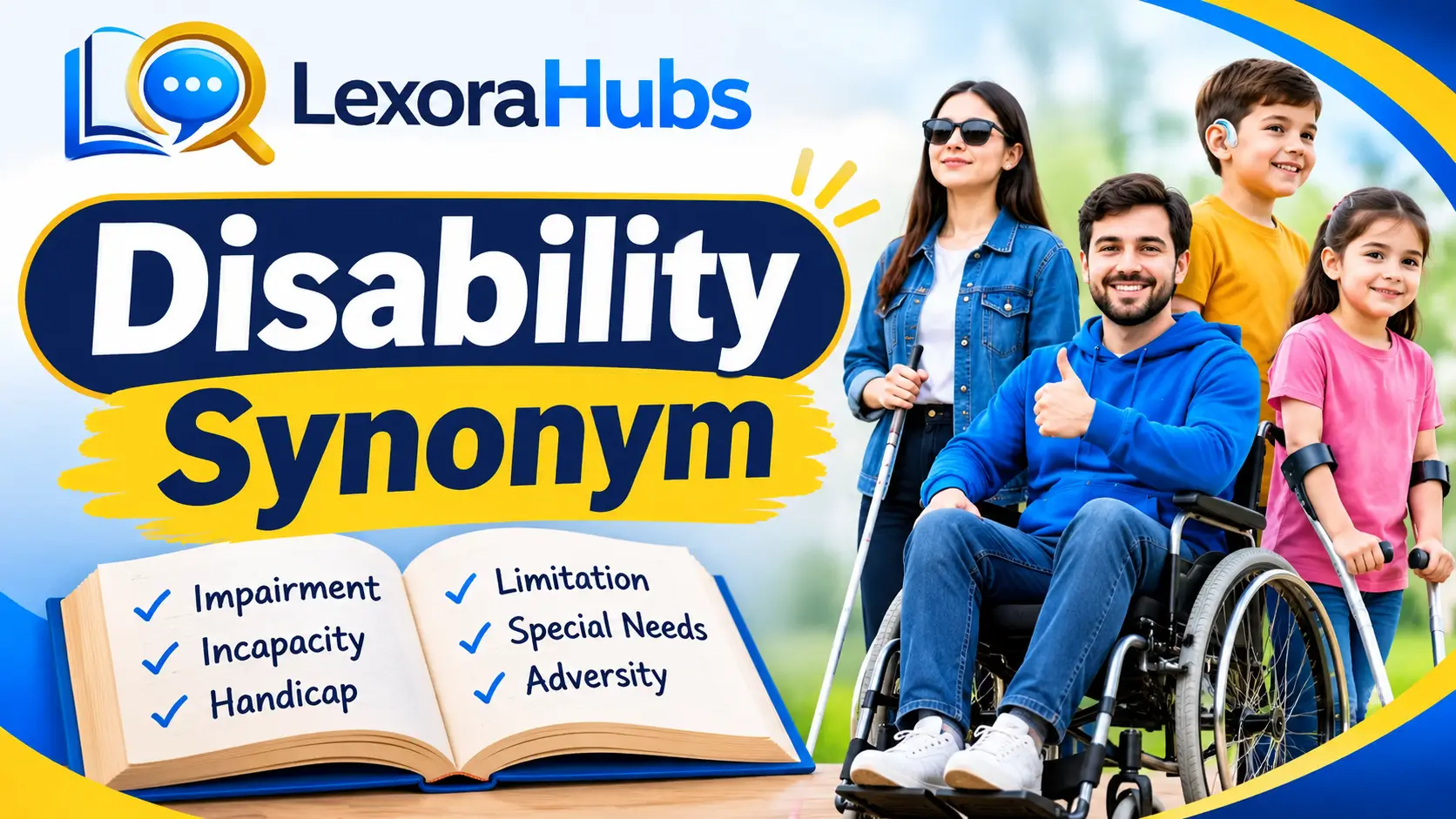
A synonym for disability is impairment, physical limitation, functional limitation, or accessibility need. Other related terms include health condition, mobility impairment, and developmental disability. However, the best word depends on the situation, the type of disability, and the meaning you want to express.
Key Takeaways
- Impairment describes a change or difference in a person’s physical, mental, or sensory function.
- Physical limitation refers to difficulty performing certain physical activities.
- Functional limitation describes challenges with everyday tasks or activities.
- Accessibility need refers to an adjustment that helps someone use a service, space, or facility.
- Health condition is a broader term that may describe a condition related to disability.
- The right word depends on context, accuracy, and respectful language.
What Is Another Word for Disability?
Another word for disability is impairment, although these terms do not always have the same meaning. Impairment usually describes a difference in body function or structure, while disability can also involve barriers that affect everyday activities.
Other alternatives include physical limitation, functional limitation, mobility impairment, and accessibility need. For example, a person who cannot walk may have a mobility impairment and may need wheelchair access.
However, not every disability involves physical movement. Some disabilities affect hearing, vision, learning, communication, or mental functions. Therefore, choosing a suitable alternative requires understanding the person’s situation rather than simply replacing one word with another.
Best Synonyms for Disability and Their Meanings
Several words and expressions can describe different aspects of disability. However, some are more accurate in medical, educational, or everyday conversations.
| Synonym | Meaning | Example |
| Impairment | A difference or loss in physical, mental, or sensory function. | Hearing impairment can affect communication. |
| Physical limitation | Difficulty performing certain physical activities. | His physical limitation makes climbing stairs difficult. |
| Functional limitation | Difficulty completing everyday activities. | Her functional limitation affects her ability to lift heavy objects. |
| Mobility impairment | A condition affecting movement or walking. | The building provides access for visitors with mobility impairments. |
| Sensory impairment | A difference affecting sight, hearing, or other senses. | Sensory impairment can influence how someone experiences their surroundings. |
| Developmental disability | A disability that begins during the developmental period and affects everyday functioning. | The program supports children with developmental disabilities. |
| Intellectual disability | A disability involving limitations in intellectual functioning and adaptive behavior. | The school provides learning support for students with intellectual disabilities. |
| Accessibility need | A requirement for an adjustment that improves access. | The venue provides wheelchair access to meet different accessibility needs. |
| Health condition | A physical or mental health issue that may affect daily life. | Her health condition sometimes limits her activities. |
| Activity limitation | Difficulty performing a particular activity. | An activity limitation may make certain household tasks challenging. |
| Support need | Assistance required to complete certain activities. | His support needs vary depending on the situation. |
| Communication impairment | A difficulty affecting speech, language, or communication. | Communication impairment may require additional classroom support. |
These alternatives are not interchangeable in every situation. For example, impairment describes a particular functional difference, while accessibility need focuses on the support or changes that improve access.
Formal and Professional Words for Disability
In professional, educational, and medical writing, precise language helps readers understand the situation. Instead of using a broad term repeatedly, choose an expression that describes the specific disability or support requirement.
Here are useful formal alternatives:
- Impairment: A difference in physical, mental, or sensory function. Example: The assessment identified a hearing impairment.
- Functional limitation: A restriction affecting everyday activities. Example: The report describes functional limitations affecting daily tasks.
- Mobility impairment: A condition affecting movement. Example: The facility offers services for people with mobility impairments.
- Sensory disability: A disability affecting one or more senses. Example: The school provides resources for students with sensory disabilities.
- Developmental disability: A disability beginning during childhood or the developmental period. Example: The organization supports people with developmental disabilities.
- Intellectual disability: A disability affecting intellectual functioning and adaptive behavior. Example: The program offers educational support for people with intellectual disabilities.
- Accessibility requirement: A change or feature needed to make something accessible. Example: Wheelchair access is an essential accessibility requirement.
- Activity restriction: A limitation affecting participation in an activity. Example: The injury caused temporary activity restrictions.
For professional documents, use the most specific term supported by the available information. In addition, avoid using medical labels when a simple description of the required support is enough.
Types of Disability and Related Terms
Disability covers many different experiences. Therefore, understanding the main categories can help you choose more accurate words.
Physical Disability Synonyms
Physical disability relates to conditions that affect movement, physical activities, or body functions.
Common related terms include:
- Mobility impairment
- Physical impairment
- Movement limitation
- Physical limitation
- Motor disability
- Mobility restriction
- Physical functional limitation
- Movement difficulty
For example, someone with a mobility impairment may use a wheelchair, walking aid, or other support. However, not everyone with a physical disability needs the same assistance.
Mental, Intellectual, and Developmental Disability Terms
These terms describe different types of disabilities and should not be treated as identical.
Related expressions include:
- Intellectual disability
- Developmental disability
- Cognitive impairment
- Learning disability
- Neurodevelopmental disability
- Psychosocial disability
- Cognitive limitation
- Developmental condition
For instance, intellectual disability involves limitations in intellectual functioning and adaptive behavior. Meanwhile, a learning disability affects particular learning skills, such as reading or writing.
Psychosocial disability describes disability associated with mental health conditions and the barriers they may create. Therefore, the specific term should match the situation.
Sensory Disability Synonyms
Sensory disabilities affect how a person receives or processes sensory information.
Common related expressions include:
- Visual impairment
- Hearing impairment
- Sensory impairment
- Vision loss
- Hearing loss
- Deafness
- Blindness
- Sensory disability
For example, visual impairment describes a difference in vision that may affect daily activities. Similarly, hearing impairment relates to reduced hearing ability.
These words have specific meanings, so choose the term that accurately describes the person’s experience.
Disability Synonyms in Sentences
Examples make it easier to understand how related words work in everyday writing.
- Impairment: The student has a hearing impairment and uses assistive technology in class.
- Physical limitation: His physical limitation makes long walks difficult.
- Functional limitation: The condition creates a functional limitation during everyday activities.
- Mobility impairment: The hospital provides special parking for visitors with mobility impairments.
- Sensory impairment: People with sensory impairments may benefit from accessible communication services.
- Developmental disability: The center offers educational programs for children with developmental disabilities.
- Intellectual disability: Every student with an intellectual disability deserves suitable learning opportunities.
- Accessibility need: The event organizers considered different accessibility needs before selecting the venue.
- Activity limitation: Her temporary activity limitation prevents her from playing sports.
- Support need: The organization provides services based on each person’s support needs.
Disability vs. Its Closest Synonyms
Although several words relate to disability, each one describes a slightly different idea.
| Word | Main Meaning | Best Used For | Tone |
| Disability | A condition or experience involving functional differences and barriers to participation | General discussions | Neutral |
| Impairment | A difference in body function or structure | Medical and functional descriptions | Formal |
| Physical limitation | Difficulty with physical activities | Everyday movement | Neutral |
| Functional limitation | Difficulty performing certain activities | Reports and assessments | Professional |
| Mobility impairment | A difference affecting movement | Physical accessibility | Formal |
| Health condition | A physical or mental health issue | General health discussions | Neutral |
| Accessibility need | An adjustment required for equal access | Services and facilities | Professional |
| Activity limitation | Difficulty completing an activity | Functional assessments | Formal |
Disability vs. Impairment: Disability is a broader term that can include the effects of social and environmental barriers. In contrast, impairment usually describes a difference in body function or structure.
Disability vs. Physical Limitation: A physical limitation refers specifically to difficulty with physical activities. However, disability can also involve sensory, intellectual, developmental, and other experiences.
Disability vs. Accessibility Need: Disability describes a broader experience, while an accessibility need identifies an adjustment that can improve participation. For example, a wheelchair ramp addresses an accessibility need.
Different Ways to Say “Disability”
The best alternative depends on whether you are speaking casually, writing professionally, or describing a particular support requirement.
Everyday Expressions
These expressions can help explain a specific difficulty in simple language:
- Physical limitation
- Difficulty with movement
- Hearing difficulty
- Vision difficulty
- Learning difficulty
- Communication difficulty
- Need for additional support
Formal Expressions
For professional documents and reports, consider these terms:
- Functional limitation
- Physical impairment
- Sensory impairment
- Developmental disability
- Intellectual disability
- Mobility impairment
- Activity limitation
Accessibility and Support Expressions
When discussing services, facilities, or inclusion, these expressions may be more useful:
- Accessibility needs
- Access requirements
- Reasonable adjustments
- Support requirements
- Assistive support
- Inclusive access
- Accessibility accommodations
In particular, accessibility-related expressions are useful when the focus is on removing barriers rather than describing a person’s condition.
Related Words for Disability
Related words can improve vocabulary and help create more accurate sentences. However, these terms have different grammatical roles and meanings.
| Word | Type | Meaning |
| Disabled | Adjective | Describes a person who has a disability. |
| Disability | Noun | A physical, mental, intellectual, or sensory experience involving functional differences and barriers. |
| Impaired | Adjective | Describes a function that is reduced or affected. |
| Impairment | Noun | A difference or loss in body function or structure. |
| Accessibility | Noun | The ability to use or reach something. |
| Accessible | Adjective | Designed or adjusted so people can use it. |
| Inclusion | Noun | Making sure people can participate equally. |
| Accommodation | Noun | An adjustment that helps someone access an activity or service. |
| Assistance | Noun | Help provided to someone who needs support. |
| Adaptation | Noun | A change made to improve access or function. |
| Assistive | Adjective | Providing help through tools, equipment, or technology. |
| Rehabilitation | Noun | Support that helps someone improve or maintain abilities. |
These words are useful in education, healthcare, employment, and accessibility discussions. For example, assistive technology can help people communicate, move, learn, or complete everyday tasks.
Antonyms of Disability
Disability does not have one exact opposite because it covers many different experiences. However, some words express contrasting ideas in specific contexts.
- Ability: The power or skill to perform an activity.
- Independence: The ability to manage activities without relying on others.
- Mobility: The ability to move freely.
- Accessibility: The availability of access to places, services, and information.
- Functionality: The ability of something to perform its intended function.
- Capability: The ability or capacity to do something.
- Participation: Taking part in an activity or event.
- Autonomy: The ability to make personal decisions independently.
These words are contextual opposites rather than direct antonyms. For example, disability and independence are not opposites because people with disabilities can live independently.
Frequently Asked Questions
1. What is the strongest synonym for disability?
Impairment is one of the closest formal alternatives to disability. However, it does not have exactly the same meaning. Disability describes a broader experience, while impairment refers to a difference in body function or structure. For professional writing, choose the term that accurately describes the situation.
2. What is a better word for disability?
There is no single word that is always better. For example, impairment may suit a medical description, while accessibility need works better when discussing adjustments. In general writing, disability is already a respectful and widely accepted term when used appropriately.
3. What is a formal synonym for disability?
Functional limitation, impairment, mobility impairment, and developmental disability are useful formal expressions. However, each describes a different aspect of disability. Therefore, choose the most accurate term for the subject rather than using a more complicated word unnecessarily.
4. What is another word for physical disability?
Physical impairment and mobility impairment are common alternatives. Physical limitation is another useful expression when describing difficulty with movement or physical activities. However, the best choice depends on the person’s specific condition and the context of the sentence.
5. What is the opposite of disability?
There is no exact opposite of disability. Words such as ability, capability, and independence can express contrasting ideas in certain situations. Nevertheless, disability does not mean someone lacks independence, skills, or the ability to participate in society.
6. Is impairment the same as disability?
No, impairment and disability are related but different terms. Impairment describes a difference in body function or structure. Disability can also involve difficulties with activities and participation because of barriers in the surrounding environment.
7. What is a respectful way to describe a person with a disability?
Person-first language, such as “person with a disability,” is widely used and respectful. However, some people prefer identity-first language, such as “disabled person.” The best approach is to respect the language and preferences of the individual.
Final Thoughts
Choosing the right disability synonym depends on what you want to describe. Words such as impairment, physical limitation, and functional limitation explain particular difficulties, while accessibility need focuses on the support required to improve access.
Moreover, disability includes many different experiences, so one alternative cannot describe everyone accurately. Use clear, respectful language and consider the context before selecting a replacement. Most importantly, remember that a person’s disability does not define their abilities, independence, or value.

Ryan is a content writer focused on creating informative and well-structured articles for LexoraHubs readers.