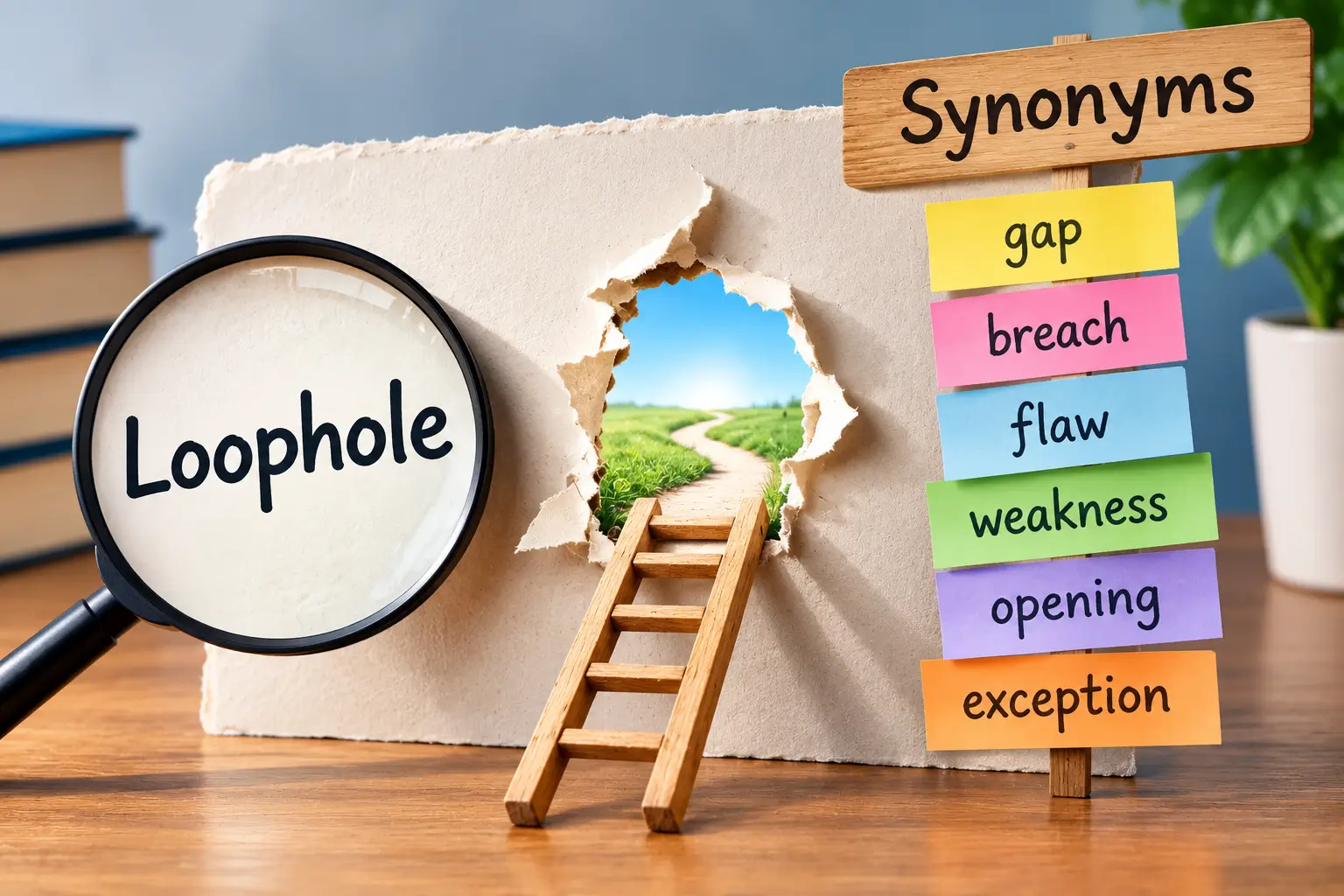
A loophole synonym is a word that means a small gap, flaw, or exception in a rule, law, or system. It lets someone avoid a strict rule without technically breaking it. Common examples are gap, technicality, exception, and workaround — clever ways to slip past rigid rules.
Introduction
Last year, a friend of mine found a strange gap in his gym contract. He could freeze his membership for free, unlimited times, as long as he did it before the 1st of each month. He used this loophole synonym trick to save nearly $200 a year, and he never technically broke a single rule.
Words like this show up everywhere. A tax form. A sports rulebook. A school policy. Somebody always finds the small crack that lets them slip through the system.
“Every rule has an exception, and every exception has a name.”
For students, these words sharpen essays and debates. For bloggers, they keep writing fresh instead of repetitive. For content writers, synonyms boost SEO and readability. For daily English speakers, they simply make conversation richer and more precise.
“Language rewards those who know more than one way to say the same thing.”
Main Content — 50 Synonyms for Loophole
1. Gap
Meaning: A gap is a small opening that lets something slip through unnoticed. Examples: She found a gap in the schedule. The gap let him skip the meeting.
2. Flaw
Meaning: A flaw is a small mistake or weak point in a plan. Examples: The flaw let them avoid taxes. He spotted a flaw in the deal.
3. Exception
Meaning: An exception is a special case that does not follow the normal rule. Examples: Students found an exception for late work. The exception saved her from a fine.
4. Loop
Meaning: A loop is a repeated pattern with a hidden way out. Examples: He found a loop in the code. The loop let data escape checks.
5. Escape Route
Meaning: An escape route is a clear path used to avoid trouble. Examples: The lawyer built an escape route. They used the escape route legally.
6. Technicality
Meaning: A technicality is a small legal detail that changes an outcome. Examples: He won the case on a technicality. The technicality freed the driver.
7. Opening
Meaning: An opening is a chance to act before the rules close it. Examples: She used the opening quickly. The opening helped him skip fees.
8. Crack
Meaning: A crack is a small break where problems or people slip through. Examples: The plan had a hidden crack. He slipped through the crack easily.
9. Hole
Meaning: A hole is a missing part that lets someone avoid rules. Examples: The contract had a big hole. She found the hole fast.
10. Weakness
Meaning: A weakness is a soft spot that someone can use wisely. Examples: He exploited the policy’s weakness. The weakness let him win easily.
11. Defect
Meaning: A defect is a fault that changes how a rule works. Examples: The form had a small defect. The defect helped them appeal.
12. Blind Spot
Meaning: A blind spot is something rule-makers forget to check closely. Examples: Lawyers found a blind spot fast. The blind spot saved his money.
13. Backdoor
Meaning: A backdoor is a hidden way to enter or avoid something. Examples: The company used a tax backdoor. He found a backdoor online.
14. Exit
Meaning: An exit is a way to leave a deal without penalty. Examples: The clause gave them an exit. She used the exit wisely.
15. Dodge
Meaning: A dodge is a clever move that avoids a strict rule. Examples: He used a smart dodge. The dodge kept him safe.
16. Shortcut
Meaning: A shortcut is a faster path that skips normal steps. Examples: They found a shortcut legally. The shortcut saved lots of time.
17. Evasion
Meaning: Evasion means avoiding something without directly breaking any rule. Examples: His evasion was completely legal. The evasion confused the officials.
18. Slip
Meaning: A slip is a small error that opens a chance for others. Examples: The form had a tiny slip. She used that slip wisely.
19. Workaround
Meaning: A workaround is a smart method to solve a tricky problem. Examples: He built a clever workaround. The workaround fixed the issue fast.
20. Glitch
Meaning: A glitch is a small system error that people can use. Examples: The app had a strange glitch. Users exploited the glitch quickly.
21. Ambiguity
Meaning: Ambiguity means unclear wording that leaves room for different meanings. Examples: The contract had confusing ambiguity. Lawyers used that ambiguity smartly.
22. Oversight
Meaning: An oversight is something missed by the people who made rules. Examples: The oversight helped many students. He noticed the oversight instantly.
23. Exemption
Meaning: An exemption frees someone from a rule under special conditions. Examples: She got a tax exemption. The exemption saved him money.
24. Exclusion
Meaning: An exclusion removes certain cases from a general rule or law. Examples: The policy had one exclusion. He used the exclusion wisely.
25. Discrepancy
Meaning: A discrepancy is a difference between two parts of a rule. Examples: The report had a discrepancy. The discrepancy changed the outcome.
“In every system, someone will always find the space between the lines.”
26. Inconsistency
Meaning: An inconsistency is a mismatch that weakens how strict a rule is. Examples: The law had an inconsistency. He pointed out the inconsistency.
27. Vulnerability
Meaning: A vulnerability is a weak point that someone can take advantage of. Examples: The system had a vulnerability. Hackers found that vulnerability fast.
28. Breach
Meaning: A breach is a break in security, trust, or an agreement. Examples: The breach exposed hidden data. They fixed the breach quickly.
29. Gray Area
Meaning: A gray area is a case where rules are not fully clear. Examples: The rule created a gray area. He stayed inside that gray area.
30. Catch
Meaning: A catch is a hidden condition that changes an offer’s meaning. Examples: The deal had a small catch. She spotted the catch instantly.
31. Snag
Meaning: A snag is a small problem that slows down a plan. Examples: The plan hit an odd snag. He solved the snag fast.
32. Kink
Meaning: A kink is a small flaw that needs fixing in a system. Examples: They found a kink early. The kink caused minor delays.
33. Wrinkle
Meaning: A wrinkle is an unexpected problem that appears in a plan. Examples: A new wrinkle appeared suddenly. The wrinkle changed their strategy.
34. Clause
Meaning: A clause is a specific part of a contract with a condition. Examples: The clause allowed an exit. He used the clause smartly.
35. Escape Clause
Meaning: An escape clause lets someone leave an agreement under set conditions. Examples: The escape clause saved money. She used the escape clause.
36. Way Out
Meaning: A way out is any method used to avoid a problem. Examples: He found a quiet way out. The way out was simple.
37. Get-out
Meaning: A get-out is an informal term for an easy way to avoid something. Examples: That’s a clever get-out. He used the get-out fast.
38. Chink
Meaning: A chink is a narrow gap in someone’s armor or defense. Examples: They found a chink quickly. The chink weakened their case.
39. Weak Spot
Meaning: A weak spot is a point where a system can fail. Examples: He targeted the weak spot. The weak spot cost them money.
40. Fault Line
Meaning: A fault line is a hidden crack where problems often begin. Examples: The deal had a fault line. She found the fault line early.
41. Slip-up
Meaning: A slip-up is a small mistake that creates an unplanned chance. Examples: The slip-up helped the team. He caused a small slip-up.
42. Legal Gap
Meaning: A legal gap is a missing rule inside the law itself. Examples: Lawyers used the legal gap. The legal gap surprised everyone.
43. Technical Flaw
Meaning: A technical flaw is a small error inside a formal system. Examples: The site had a technical flaw. They fixed the technical flaw fast.
44. Opening Clause
Meaning: An opening clause creates a special condition at a contract’s start. Examples: The opening clause allowed changes. She read the opening clause.
45. Safety Valve
Meaning: A safety valve is an option that releases pressure from strict rules. Examples: The policy had a safety valve. He used the safety valve wisely.
46. Provision
Meaning: A provision is a rule added to handle special situations. Examples: The law added a new provision. She used that provision smartly.
47. Condition
Meaning: A condition is a requirement that changes how a rule applies. Examples: The condition allowed an exception. He met the hidden condition.
48. Loose End
Meaning: A loose end is an unfinished detail left open in a plan. Examples: The contract had a loose end. They tied up the loose end.
49. Wiggle Room
Meaning: Wiggle room means extra freedom allowed inside a strict rule. Examples: The policy gave some wiggle room. He used the wiggle room wisely.
50. Cop-out
Meaning: A cop-out is an easy excuse used to avoid a duty. Examples: That excuse sounded like a cop-out. He used a lazy cop-out.
Loophole Synonym Slang
In casual talk, people rarely say “loophole” the formal way. They say things like “the cheat code,” “the out,” or “the back way.” Slang words feel playful and quick, and they fit texting or everyday chats. Younger speakers especially love slang because it sounds sharp, witty, and less stiff than formal legal terms like “exemption” or “provision.”
Loophole Synonym Crossword Clue
Crossword puzzles love short synonym words like “gap,” “out,” or “catch” as clues for loophole. These tight, three-to-five-letter words fit neat little boxes perfectly. If you ever get stuck on a puzzle, think simple: short nouns describing a flaw, gap, or clever exit usually solve the clue fast and correctly.
Another Word for Legal Loophole
In legal writing, people often say “technicality,” “legal gap,” or “exemption” instead of loophole. These words sound more formal and fit contracts, court documents, and tax forms. Lawyers use them daily because they describe the exact same idea — a small legal opening — without sounding too casual or slangy for professional settings.
Loopholes Antonyms
If a loophole is a gap, its opposite is something airtight. Words like “restriction,” “requirement,” “obligation,” or “strict rule” work as antonyms. These terms describe rules with no wiggle room at all. Knowing antonyms helps writers contrast ideas clearly, showing readers exactly when a rule is flexible versus completely locked down.
Loophole in a Sentence
Seeing a word used correctly helps it stick in memory. For example: “The company found a loophole in the tax code.” Or: “She closed the loophole before anyone noticed.” Practicing full sentences like these builds real confidence, helping students and writers use the word naturally in essays, emails, and daily conversation.
Frequently Asked Questions
What is a loophole in simple terms? A loophole is a small gap or mistake in a rule, law, or agreement. It lets someone do something the rule was meant to stop, without actually breaking that rule. Think of it like a tiny door left open in a fence. Most loopholes are legal, but they often feel unfair since they go against the spirit, not the letter, of the rule.
What is another word for “loophole”? Common alternatives include gap, technicality, exception, and workaround. Each word describes a small opening in a system, contract, or law that someone can use to avoid a rule. “Technicality” fits legal settings best, while “gap” and “workaround” feel more casual and work well in everyday writing, blogs, or simple conversation.
What are 5 good synonyms? Five strong choices are gap, technicality, exception, workaround, and gray area. Each carries a slightly different shade of meaning. “Gap” suits general writing, “technicality” suits legal contexts, “exception” suits rules and policies, “workaround” suits tech problems, and “gray area” suits situations where right and wrong feel unclear or debatable.
What’s a synonym for loop? Depending on context, good options include cycle, circuit, ring, or bend. In tech writing, “cycle” or “iteration” fits repeated code patterns best. In everyday speech, “circuit” or “ring” describes something that goes around and returns to its start, matching how a physical or digital loop actually behaves.
Conclusion
Learning synonyms like these does more than fill your vocabulary — it sharpens how you think and communicate. Strong word choices make your writing clearer, your blog posts more engaging, and your everyday speech more confident. Instead of repeating the same tired word again and again, you can pick the exact shade of meaning that fits your sentence, whether that’s a playful “get-out” or a formal “technicality.”
Try using a few of these words this week. Drop “workaround” into a work email. Use “gray area” in a debate with friends. Slip “loose end” into your next essay. Small changes like these build big habits over time, and soon these words will feel like natural parts of your everyday vocabulary.
“The right word is not a luxury — it is a tool that makes thought precise.”
Writing well is really about choosing well. The more synonyms you master, the more control you have over tone, clarity, and impact. Keep practicing, keep reading, and keep swapping tired words for sharper ones.
“Every strong writer started with one simple habit: learning one new word at a time.”

Ryan is a content writer focused on creating informative and well-structured articles for LexoraHubs readers.